
YTT stands for Yoga Teacher Training, the certification process that qualifies someone to teach yoga professionally. If you have been scrolling studio websites and retreat listings and keep hitting acronyms like RYT, E-RYT, and RYS without a plain explanation attached, you are not missing something obvious.

Yoga certification language was built by an accrediting body for insiders, and almost nobody translates it for someone just starting to look. This guide defines every term you will actually run into while researching a program, explains how they connect to each other, and clears up the single most common confusion: the difference between YTT and RYT.
What Does YTT Mean?
YTT is short for Yoga Teacher Training. It refers to the structured course itself, not a credential. When someone says they are "doing their YTT" or "enrolled in a 200-hour YTT," they mean the training program, whether that is an intensive in Bali, a weekend-format course spread over months, or a fully online curriculum.
The term describes the process of becoming certified, and it exists as a category label because yoga certification is not government-regulated anywhere in the world. Any studio or individual can technically call a course a YTT, which is exactly why the surrounding terminology, hour counts, and accrediting relationships matter so much when comparing programs.
YTT programs are most commonly described by their hour count: 200-hour, 300-hour, and 500-hour. These numbers refer to the minimum contact hours the curriculum covers, not the number of days you spend in a room.
A 200-hour YTT delivered as a 6-day intensive compresses those hours into long daily sessions plus pre-course study, while the same 200 hours delivered as a weekend format might stretch across four to six months. Neither delivery method changes what YTT means; it only changes the calendar shape of the same underlying requirement.
It helps to think of YTT as the umbrella term for the entire category, the way "college degree" describes a process rather than a single fixed thing. A YTT can be general Hatha or Vinyasa focused, or method-specific like a Bikram or Ashtanga training. What stays constant across all of them is the underlying curriculum structure Yoga Alliance requires for a training to count toward RYT registration, covered in the glossary section below.
Understanding that YTT names the process rather than a fixed product is the single most useful reframe for a first-time candidate, because it means two programs both labeled "200-hour YTT" can still differ enormously in quality, structure, and outcome, even though the acronym on both websites is identical.
What Does RYT Mean, and How Is It Different From YTT?
RYT stands for Registered Yoga Teacher. This is the credential you earn after completing a YTT that was delivered through a Yoga Alliance Registered Yoga School (RYS). YTT is the training. RYT is the certification you walk away with once that training is complete and you register your completion with Yoga Alliance, the primary global credentialing body for yoga teachers.
Put simply: you complete a YTT, and if that YTT was run through a Yoga Alliance Registered Yoga School, you become eligible to register as an RYT. The number after RYT indicates the hour tier of the training that qualified you, so RYT 200 means the credential came from a 200-hour training, and RYT 500 means the credential reflects a combined 500 hours of training, typically a 200-hour foundation plus an additional 300-hour advanced program, rather than a single 500-hour course.
This distinction trips people up constantly in online forums and studio conversations, because both terms get used loosely to mean "yoga teacher qualification" in casual speech. Knowing the difference matters once you start comparing programs, since a course claiming to produce "RYT graduates" should be able to show its Registered Yoga School status, not just the training itself.
Verifying that status directly with a program before enrolling is one of the more overlooked steps in choosing where to train, and it takes less time than most of the comparison research candidates already do on cost and location.
The Full Yoga Teacher Training Terminology Glossary
These are the terms that show up most often once you start researching programs seriously, listed in the order you are likely to encounter them.
| Term | Stands For | What It Actually Means |
|---|---|---|
| YTT | Yoga Teacher Training | The course or program itself, categorized by hour count (200, 300, 500) |
| RYT | Registered Yoga Teacher | The credential earned after completing a YTT through a Registered Yoga School and registering with Yoga Alliance |
| E-RYT | Experienced Registered Yoga Teacher | An RYT who has logged significant additional teaching hours and years since certifying (E-RYT 200 requires 1,000+ teaching hours over at least 2 years; E-RYT 500 requires 2,000+ hours) |
| RYS | Registered Yoga School | A training provider that Yoga Alliance has approved to deliver YTT curricula that qualify graduates for RYT registration |
| CEU / CE | Continuing Education (Units) | Additional training hours registered teachers log after certification to maintain active status and deepen specific skills |
| YACEP | Yoga Alliance Continuing Education Provider | A school or teacher approved to offer CEU-qualifying workshops and courses to already-certified teachers |
| 200hr / 300hr / 500hr | Training hour tiers | 200hr is the foundational teaching certification; 300hr is an advanced add-on; 500hr is the combined total, not a separate standalone tier |
One clarification worth making explicit: there is no such thing as a standalone "500-hour YTT" that skips the 200-hour foundation. Every legitimate path to RYT 500 runs through RYT 200 first, then a 300-hour advanced program layered on top. Any program marketing a direct 500-hour entry point without a 200-hour prerequisite is not following the standard Yoga Alliance pathway, and that is worth verifying directly with the school before enrolling.
The same verification logic applies to method-specific claims: a program advertising Bikram or Hot 26&2 certification should be able to confirm both its Yoga Alliance registration and the specific method lineage its founder trained under, the same way you would confirm an authentic Bikram studio before signing up for classes.
How Format and Terminology Interact
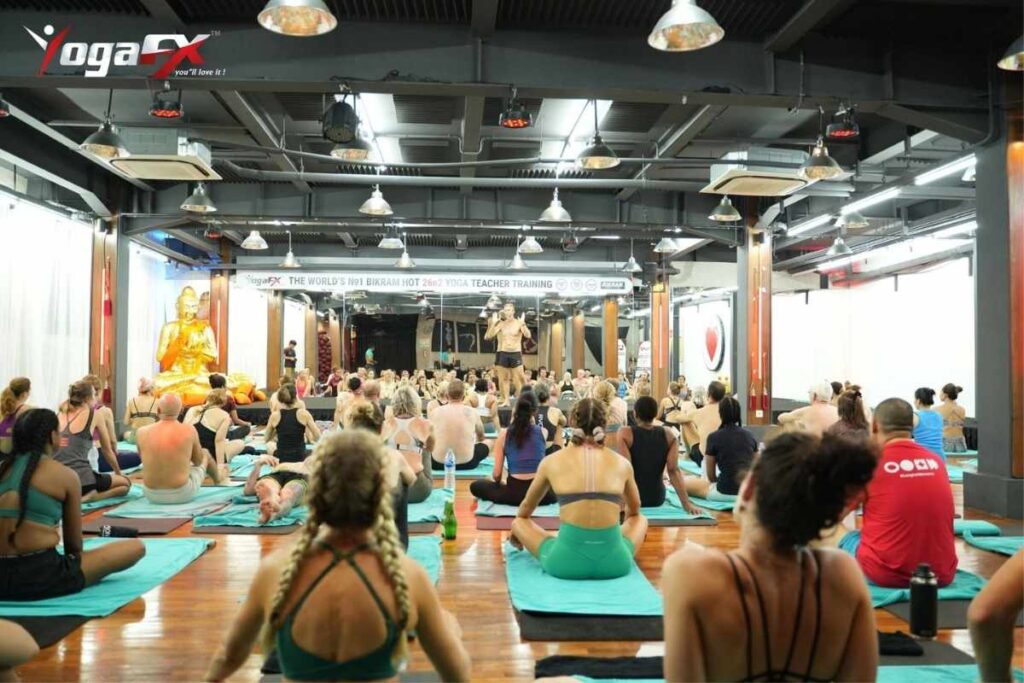
The terminology stays the same regardless of format, which is where a lot of confusion creeps in. A 200-hour YTT delivered as an intensive and a 200-hour YTT delivered as a weekend course over five months both produce the exact same RYT 200 credential, assuming both are run through a Registered Yoga School and cover the required curriculum categories: techniques and practice, teaching methodology, anatomy and physiology, yoga philosophy and ethics, and practicum.
What differs is not the credential but the experience of earning it. An intensive format compresses the same content into a shorter, more immersive window, often in a destination setting, while a long-format course spreads the same hours across a longer calendar with more time to integrate material between other commitments.
Neither format produces a "better" RYT 200 on paper. What varies in practice is retention, depth of correction time per student, and how much of the material actually sticks once the certificate is issued, which is a curriculum and instructor quality question rather than a terminology one.
There is also a growing category of online-only YTT, and the terminology question comes up there too. A course can be a legitimate Yoga Alliance-registered 200-hour YTT delivered entirely through online instruction, provided the school holds RYS status for that delivery format. The credential earned is still RYT 200.
What online formats typically cannot replicate is the live, in-room correction that shapes how a teacher actually cues a room once they are certified, which is a practical consideration separate from whether the terminology on the certificate is accurate.
A related format question candidates run into is hybrid delivery, where the theoretical portions of the curriculum, anatomy, philosophy, and teaching methodology, are completed online before arrival, and the practical, hands-on teaching hours are completed in person.
This structure has become common precisely because it solves a real tension in the terminology: it keeps the credential fully RYT-eligible while cutting down the number of days a candidate needs to take off work or travel for, without sacrificing the in-room correction time that pure online formats cannot offer. None of this changes what YTT or RYT mean on paper. It only changes how efficiently a candidate can fit the required hours into an already busy life.
Why the Terminology Matters When You Are Deciding
Understanding these terms is not just vocabulary homework. It directly affects how you evaluate whether a specific program is worth the investment for what you actually want out of it. A candidate who wants the broadest possible teaching eligibility should confirm RYS status and RYT 200 output before anything else.
A candidate drawn to a specific method, rather than general yoga instruction, needs to weigh the RYT credential against the method-specific certification separately, since the two answer different questions: RYT confirms you meet an industry-recognized minimum standard, while a method certification confirms you can actually deliver that specific style's technique and, where relevant, its scripted dialogue accurately.
Candidates comparing multiple programs side by side often find that once the terminology is sorted out, the real differentiators are things the acronyms do not capture at all: cohort size, instructor experience measured in actual teaching hours rather than years since certification, and whether the curriculum includes hands-on delivery practice or stays mostly theoretical until graduation.
YTT Terminology at YogaFX
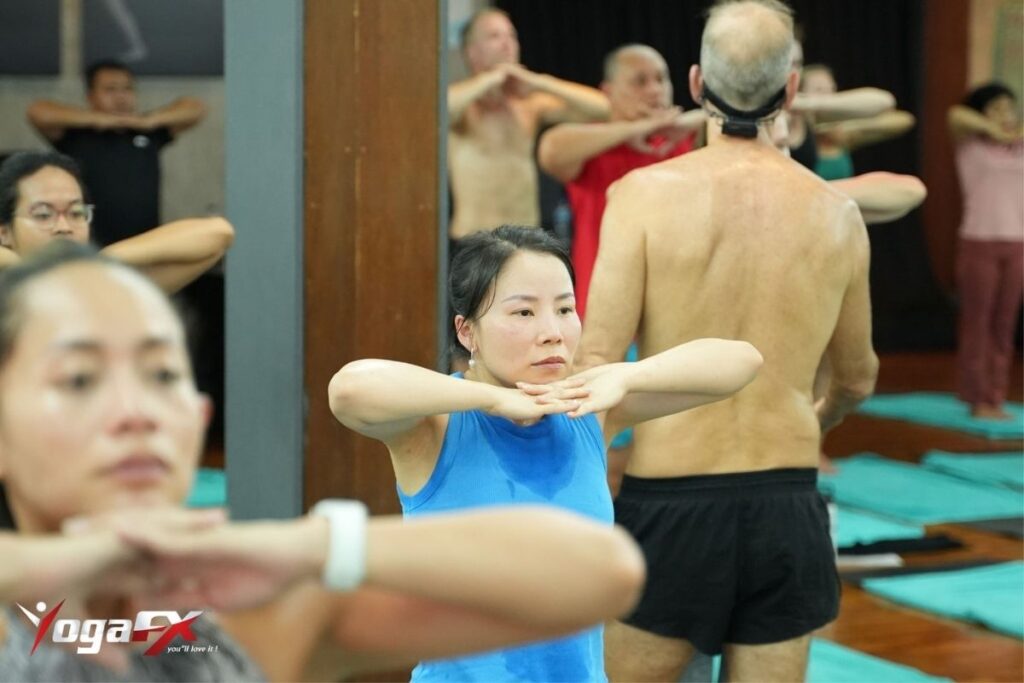
At YogaFX in Seminyak, Bali, graduates leave the 6-day intensive with a dual credential: Yoga Alliance RYT 200 plus a Bikram Hot 26&2 certification specific to the Original Hot 26&2 method, sometimes marketed elsewhere as Original Hot Yoga teacher training. This dual structure is worth explaining in plain terms, since it is a source of real confusion for candidates comparing programs. The RYT 200 is the Yoga Alliance-recognized credential that qualifies a graduate to register as a teacher and teach in any studio worldwide that requires that registration.
The Bikram Hot 26&2 certification is method-specific, confirming the graduate has been trained in the original scripted dialogue, the fixed 90-minute sequence, and the specific teaching approach the method requires, which general RYT training does not cover in depth.
Mr. Ian Terry, E-RYT 500, founded YogaFX in 2017 and has personally delivered this dual-certification curriculum to more than 1,500 graduates across 80 countries, drawing on over 12,000 teaching hours and 5 direct training events under Bikram Choudhury between 2012 and 2019. Every graduating cohort is capped at 19 students, a structural decision that keeps the terminology from staying abstract. Candidates do not just learn what E-RYT means; they train under one, and get the individualized correction time a 19-student cap makes possible.
A 2025 systematic review of 43 studies and 942 participants found consistent well-being and flexibility benefits associated with Bikram-style practice (Willmott et al., 2025), which is part of why candidates pursuing the Bikram Hot 26&2 credential specifically, rather than a generic RYT 200, often cite wanting to teach a method they have personally experienced results from, not just a certification with broad recognition.
FAQ
What does YTT stand for in yoga?
YTT stands for Yoga Teacher Training. It refers to the certification course itself, categorized by hour count such as 200-hour, 300-hour, or 500-hour, rather than to a credential you hold after completing it.
What is the difference between YTT and RYT?
YTT is the training program you complete. RYT, Registered Yoga Teacher, is the credential you earn afterward if that training was delivered through a Yoga Alliance Registered Yoga School and you register your completion with Yoga Alliance directly.
What does E-RYT mean?
E-RYT stands for Experienced Registered Yoga Teacher. It is awarded to RYTs who have logged significant additional teaching hours and years beyond initial certification: 1,000+ hours over 2+ years for E-RYT 200, and 2,000+ hours for E-RYT 500.
Is a 500-hour YTT a separate course from a 200-hour YTT?
No. RYT 500 is a combined total, typically built from completing a 200-hour foundation training first, then an additional 300-hour advanced program afterward. There is no standard standalone 500-hour entry point that skips the 200-hour prerequisite.
Do I need an RYT to teach yoga?
Yoga teaching itself is not government-licensed, so technically no law requires an RYT. In practice, most studios, gyms, and insurance providers require or strongly prefer RYT certification, which is why nearly every serious YTT candidate pursues it rather than an uncertified training.