


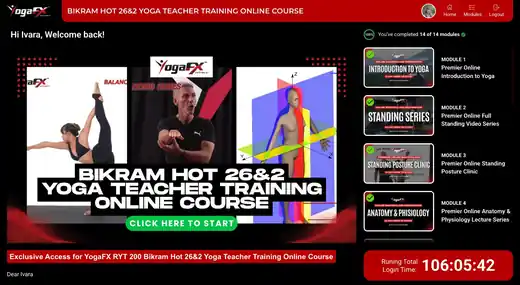



Accredited yoga teacher training is a loose label. In practice it points to a school on the Yoga Alliance register, a private body that records schools and teachers instead of licensing anyone. For a Bikram Hot 26&2 trainee, a fair question follows: where does a lineage certificate sit beside a registry credential?

Mr. Ian Terry, E-RYT 500, leads the YogaFX teacher training, so we wrote this guide from a 26&2 teacher's standpoint. It gives you checks for accredited yoga teacher training that you can run before you pay a deposit. It also shows where the lineage and the registry meet, and where they do not.
What Accredited Yoga Teacher Training Means for a 26&2 Trainee
No authority licenses yoga teachers the way a medical board licenses doctors, and that's the first thing to understand. Our research report R1a (October 2026) notes that the United States does not license the profession, and that Yoga Alliance, the best-known registry, is a private association. Accredited is therefore a word schools borrow, with a different meaning on every website.
The most common standard is the Yoga Alliance register. Yoga Alliance describes its own path in two steps. First you enrol in a Registered Yoga School (RYS) and finish the required hours. Then you apply for a credential with your training certificate. It calls the RYT 200 the foundational 200-hour training and says most new teachers begin there.
Money comes into it only after graduation, so plan for it early. Yoga Alliance lists a one-time application fee and an annual membership fee, and it says each school sets its own training price. Add both fees to any quote you compare.
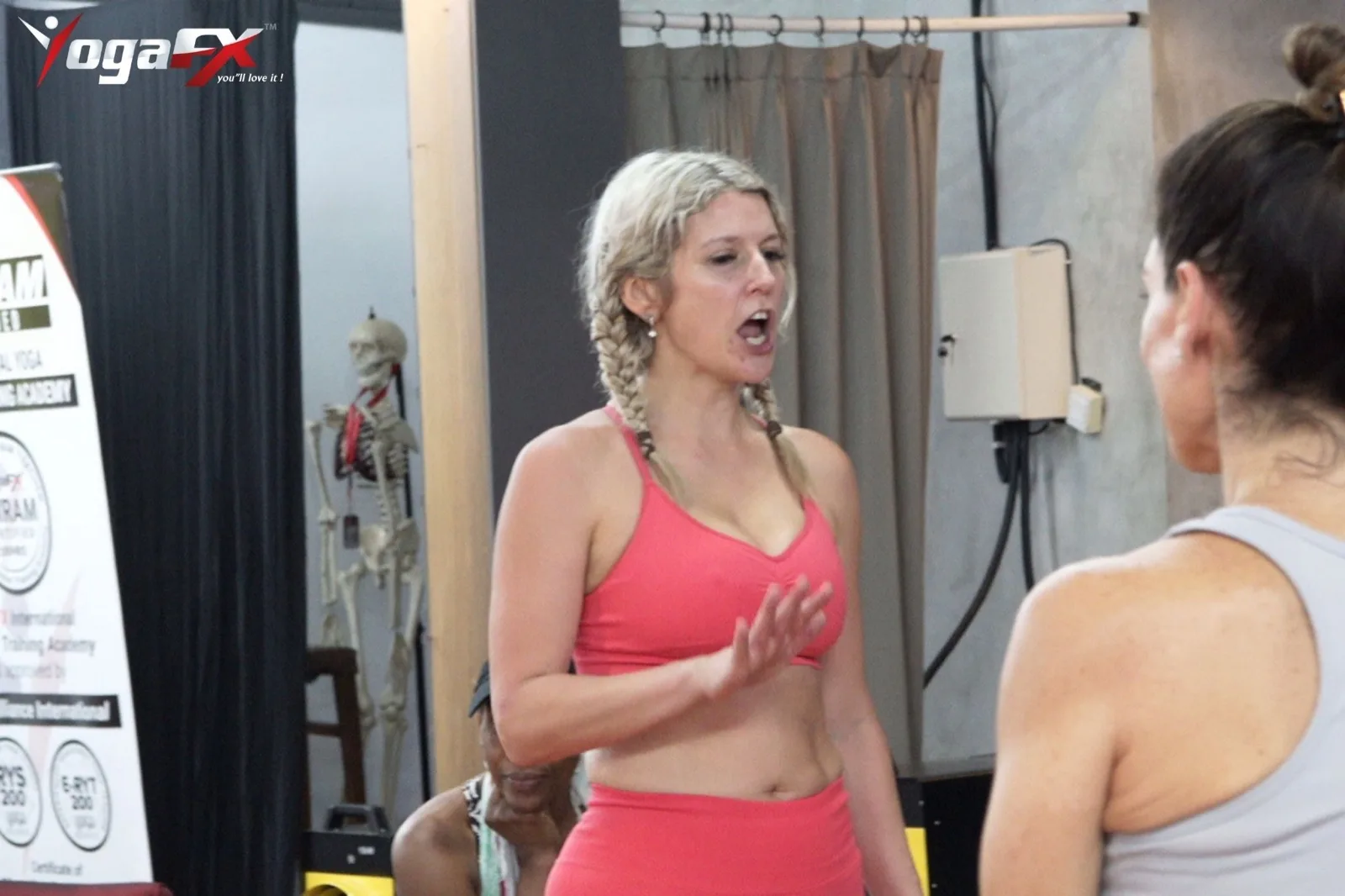
Three terms in accredited yoga teacher training, in plain English
- RYS 200. The school has put its 200-hour programme on the register.
- RYT 200. The graduate completed that programme and applied for a personal listing.
- E-RYT 500. The experienced level that a lead trainer typically holds. Our guide to what E-RYT 500 requires covers the detail.
The certificate itself comes from the school, while the registry only records it. So the school's own track record carries most of the weight when a studio reads your paperwork.
How the Bikram Lineage Fits Beside Today's Registries
Every dedicated 26&2 teacher training grows out of the Bikram lineage, because that is where the method comes from. In report R1a we looked at 19 Original Hot trainings that carry a private trade-association seal. Every leader had first qualified as a Bikram teacher. Yet only four of those 19 schools sat on the Yoga Alliance register.
That gap is the heart of the confusion, so when someone sells accredited yoga teacher training in the Bikram tradition, ask which kind of proof they mean. A lineage story and a registry listing answer two different questions. Lineage tells you who taught the teacher and which method you will learn. The registry tells you whether the school met a recognised baseline and whether the teacher is listed.
Mr. Ian Terry holds both kinds of proof. He spent five years, from 2014 to 2019, on the staff of the founder of the Bikram Hot 26&2 method. YogaFX itself has been a Yoga Alliance RYS 200 school since February 2018, as report R1a records. Mr. Ian is E-RYT 500, with 12,000+ teaching hours, and he serves as a Master Trainer for the Republic of Indonesia Yogasana Sports Federation. The numbers below come straight from his records.
Graduates therefore leave with two credentials, and the table below shows how they differ. Treat it as a checklist for any school, because the right question is never which one is better. It is what does each one prove, and can I verify it?
| Question | Registry credential (RYT 200) | Method certificate (Bikram Hot 26&2 200-Hour) | How you check it |
|---|---|---|---|
| What it tells a studio owner | You trained at a registered school and joined the registry | You learned the fixed 26-posture sequence and its dialogue from the lineage | Ask for both documents before you pay |
| Who stands behind it | Yoga Alliance, a private registry | The school and its lead trainer, Mr. Ian Terry | Search the directory, then read the teacher page |
| What it costs after training | A one-time application fee, then annual membership (as published by Yoga Alliance) | Issued as part of the programme | Ask for a written quote that lists every fee |
| What it does not prove | Skill in one specific method | Recognition by any outside registry | Watch a class and read independent reviews |
| Where studios use it | Hiring forms that ask for an RYT listing | Studios that want the dialogue taught faithfully | Phone the studios where you hope to teach |
If you want the same comparison in more detail, read how RYT 200 differs from the Bikram certificate.
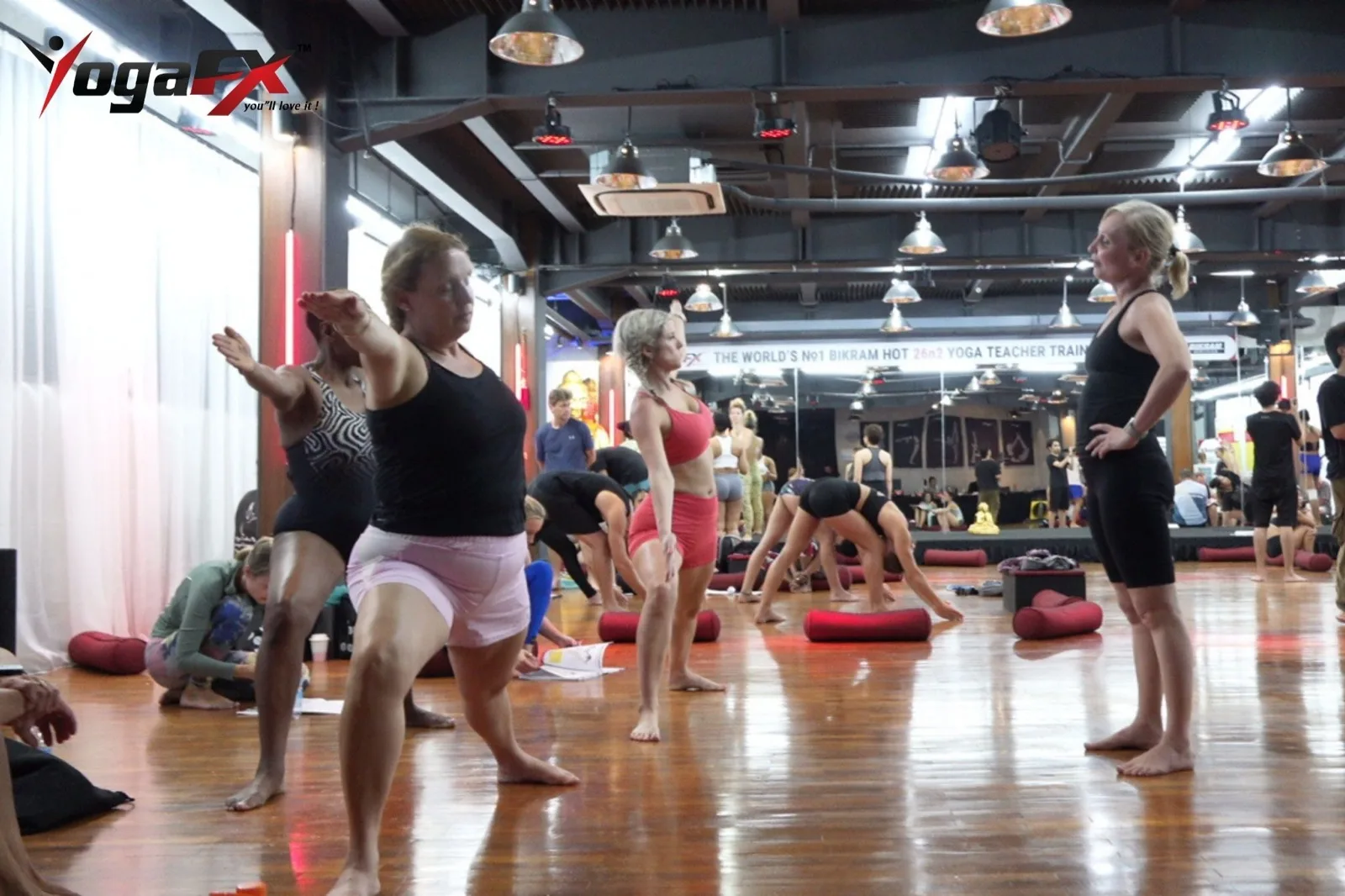
The credentials at a glance
5 Real Checks Before You Pay for Accredited Yoga Teacher Training
Run these in order whenever you compare accredited yoga teacher training options. Each takes a few minutes, and together they filter out most programmes that use the word loosely. Our longer guide on how to evaluate a Bikram teacher training goes deeper on the same ground.
1. Search the school by its exact name
Open the Yoga Alliance directory and type the name the school uses on its contract. Check that the credential level matches the course you are buying. Be wary of any school that dodges this question, because it takes one email to answer.
2. Search the lead trainer, too
A school listing is not a teacher listing. Look up the person who will actually stand in front of you, and read the level shown. Then ask how many hours that person has taught, because experience is what you're paying for.
3. Ask which documents you receive
- Do you receive a registry-eligible certificate, a method certificate, or both?
- Who signs each one?
- Can you see a sample before you pay?
A vague promise of a worldwide certificate is a red flag, so ask for specifics.
4. Ask who taught the trainer
Lineage is checkable. Ask for the years, the place and the role. Mr. Ian's answer is five years, 2014 to 2019, on the founder's staff. Anything vaguer than that deserves a follow-up question.
5. Read reviews outside the school's own site
YogaFX has 150 Google reviews, 50 Yoga Alliance reviews and 357 YouTube video testimonials. You don't have to trust us, though. Read them where we cannot edit them, and note which ones describe the teaching rather than the scenery. Our guide to reading training reviews critically explains how.
For example, some questions sit outside the five checks. Do you need a licence at all? Our answer is in do you need a license to teach yoga.
Three Myths About Accredited Yoga Teacher Training
Questions about accreditation tend to repeat. Three myths are worth clearing up, because each one can cost a trainee money or confidence.
Myth 1: accredited yoga teacher training means government approval
It doesn't. As the earlier section showed, no government licenses yoga teachers in the United States, and the registry is a private body. Accredited yoga teacher training from a registered school can still be mediocre, and a good school can be unregistered. The listing is one signal, not a verdict, so combine it with the other four checks.
Myth 2: a lineage certificate makes registration unnecessary
Some trainees hear the method comes from the original teachers, so nothing else matters. That skips a practical problem. Studios and insurers often ask for a registry listing on the hiring form, and a method certificate alone does not appear in that directory. If you plan to teach abroad, carry both.
Myth 3: a registry listing makes the lineage irrelevant
The opposite mistake is just as common. A registered school can teach any style, and the listing says little about the fixed 26-posture sequence or its dialogue. If you want to teach 26&2 faithfully, you need a trainer who learned it from people who taught it first-hand. That is a question of lineage, and only the trainer can answer it.
So the sensible plan is simple. Choose accredited yoga teacher training at a school that is on the register, led by a trainer who is on the register, and ask for the lineage story in writing. Then compare quotes. Cost matters, yet it should come last, because a cheap programme without the first three items rarely turns out cheap.
What the Research Does and Does Not Tell a New Teacher
A registry listing says nothing about whether a health claim is true, and accredited yoga teacher training does not change that. That matters, because new teachers are tempted to promise results. So it helps to know what the evidence supports before you stand in front of a class.
What the 2023 trial found
In 2023, Nyer and colleagues published A Randomized Controlled Trial of Community-Delivered Heated Hatha Yoga for Moderate-to-Severe Depression in the Journal of Clinical Psychiatry. Over 8 weeks, 59.3% of the yoga group had a symptom drop of 50% or more, against 6.3% of the waitlist group. The authors call the findings preliminary and ask for studies with active controls.
What the 2025 review found
A 2025 systematic review in Sports Medicine - Open (Willmott and colleagues), titled Hot Yoga: A Systematic Review of the Physiological, Functional and Psychological Responses and Adaptations, pooled 43 studies and 942 participants. It found interesting health and functional benefits, but it also found that claims of hot yoga beating other yoga or exercise are unsubstantiated. It called the psychological benefits promising yet inconclusive.
What that means for you as a teacher
That is the honest position, and it is the one we teach. Say what the studies measured, name the limits, and leave treatment to doctors. If you have a medical condition, consult a healthcare professional before you start any heated class.
What Graduates Say About Training at YogaFX
Credentials open the door, but teaching quality is what graduates remember about accredited yoga teacher training. Here is what three of them wrote or said, in their own words.
"What a gift I was given to have such a beautiful experience change how I see myself in so many profound ways!"
Arianti, Google review, 2018
"The training was clear, structured, synthesized. The information complemented the practice and provided alternatives of postures for people with certain injuries."
Cristina, Yoga Alliance review, 2024
Shiro recorded a short video review in 2025, thanking Mr. Ian and the team. You can watch it below (YouTube, 2025).
Where Accredited Yoga Teacher Training at YogaFX Fits Your Plan
The YogaFX Bikram Hot 26&2 Yoga Teacher Training MasterClass is a 6-day hybrid, and it works as accredited yoga teacher training in Bali that you start from home. You study online first, then join the intensive in Bali. Think of it as accredited yoga teacher training that respects your job: you do the theory at your own pace, then spend one focused week on the floor.
The next batch checks in on Sunday 24 January 2027 and checks out on Friday 29 January 2027 at Soham Wellness Center in Seminyak. Graduates leave with two credentials: Yoga Alliance RYT 200-Hour and the Bikram Hot 26&2 200-Hour International Yoga Certification. The price starts from US$1,899.
Want the registry checks in a longer, step-by-step form, with the same questions asked of any registered yoga school? The buyer's guide on our Bali teacher training hub walks through seven of them. For dates and formats, see the 2026-2027 dates, cost and formats.
What you leave with
- Two credentials: a registry-eligible RYT 200 certificate and the Bikram Hot 26&2 200-Hour International Yoga Certification.
- A lineage you can explain: the years, the place and the role of the person who trained your trainer.
- Proof you can show a studio: a school listing, a trainer listing and reviews on independent platforms.
In short, online accredited yoga teacher training can start your study, but the registered yoga school and the trainer decide what the certificate is worth. Check them first, and you'll know what you are buying.
FAQ
Is Yoga Alliance registration the same as a government licence?
No. Yoga Alliance is a private association, and no government licenses yoga teachers in the United States. Registration shows that a school and teacher joined a recognised register. Studios and insurers often ask for it, so it is practical proof for hiring, though it is not a legal requirement.
Who certifies yoga teachers?
The school that trains you issues your certificate. Yoga Alliance then lists graduates as Registered Yoga Teachers once they apply with that certificate. So the registry records your credential, but your school and its lead trainer stand behind what you actually learned, which is why you should check both.
Is online accredited yoga teacher training enough on its own?
Online study covers theory well, such as anatomy, ethics and the dialogue text. Teaching a live room is a skill you only build by doing it. That is why the YogaFX MasterClass is a hybrid: online pre-course first, then six days of live practice teaching in Bali with Mr. Ian.
How long does accredited yoga teacher training take?
It depends on the format. Part-time courses stretch over months, while intensives compress the contact time. The YogaFX MasterClass is a six-day hybrid: online pre-course study, then an intensive in Bali from Sunday check-in to Friday check-out, which means about five days off work.
Does a Bikram-era certificate still count today?
It counts as proof of the method you trained in and who taught you. A registry listing is a separate record with its own rules. Studios often want both, so ask any school which documents you receive at graduation, and whether the school and trainer appear in the Yoga Alliance directory.
Still have questions? Message Mr. Ian and the YogaFX team on WhatsApp and we will answer them personally.