

The question of Bikram yoga vs gym training has two genuinely contradictory studies sitting in the search results for this keyword. One from Houston Methodist says hot yoga does not significantly increase yoga's health benefits. One from Colorado State says Bikram yoga poses produces a 20 percent strength increase. Both are cited by credible sources. Neither is wrong. They asked different questions.
Bikram yoga and gym training are not direct alternatives they develop different physical capacities. Bikram produces documented posterior chain strength (20 percent deadlift increase at 8 weeks, Tracy and Hart 2013), heat-enhanced flexibility, cardiovascular conditioning at 80 percent of maximum heart rate, and joint health. Gym training produces superior upper body pushing and pulling strength (bench press, row, pull-up patterns), progressive overload capacity for muscle hypertrophy, and sport-specific strength. The optimal approach for most practitioners is combining both: Bikram for flexibility, posterior chain, cardiovascular conditioning, and joint health; gym for upper body strength and progressive overload.
The Two Contradictory Studies: What They Actually Said
Colorado State University, Tracy and Hart (2013)
Published in the Journal of Strength and Conditioning Research (PubMed: 23438366), the Tracy and Hart study measured outcomes of 8 weeks of Bikram yoga at 3 to 4 sessions per week in sedentary or lightly active adults. Results: 20 percent deadlift strength increase, 9 percent balance improvement, significant lower back and hamstring flexibility gains, and body fat reduction with lean muscle gain. What this study measured: whether Bikram yoga practiced consistently over 8 weeks produces fitness gains compared to baseline. Answer: yes, significant ones.
Houston Methodist, Heated vs Unheated Yoga Study
The Houston Methodist report summarises a study comparing the same yoga sequence performed in a heated room versus an unheated room. The finding: no statistically significant difference in calorie burn or VO2 between the heated and unheated conditions. What this study measured: whether the heat specifically adds fitness value over and above the same yoga practice at room temperature. Answer: for calorie burn and oxygen uptake specifically, heat does not create a statistically significant difference.
These are different questions. The Colorado State study asked: does Bikram yoga studio improve fitness? The Houston Methodist study asked: does the heat in Bikram yoga specifically drive those improvements? The answers can both be true simultaneously: Bikram yoga improves fitness (CSU) and the heat is not the primary driver of calorie burn and VO2 improvements (Houston Methodist). The heat's specific contribution is to connective tissue extensibility, joint lubrication, and thermoregulatory cardiovascular demand, not primarily to calorie burn per session.
Bikram Yoga vs Gym: The Honest Comparison
| Training Dimension | Bikram Yoga (26 and 2) | Gym Training |
|---|---|---|
| Upper body strength | Limited, no push or pull patterns | High, bench press, row, pull-up, overhead press patterns |
| Lower body strength | Significant, Awkward Pose 6 sets, single-leg series | High, but misses the specific ranges Bikram loads |
| Posterior chain | High, prone backbend series loads this specifically | Moderate to high, depends on deadlift/hip hinge inclusion |
| Progressive overload for hypertrophy | Not available, fixed bodyweight loads | Full, progressive loading is the mechanism of hypertrophy |
| Cardiovascular conditioning | 80 percent max HR sustained throughout (UW 2014) | Variable, depends entirely on training style chosen |
| Flexibility | Accelerated by heat, faster gains than room temp | Typically reduced, heavy training shortens muscles over time |
| Joint health | Eagle Pose lubricates 14 joints in heat-enhanced synovial state | Joint loading, beneficial with correct technique, harmful without |
| Spinal health | Systematic all-plane spinal mobility every session | Limited, few gym exercises address full spinal mobility |
| Calorie burn (90 min) | 333 to 460 kcal, directly measured (UW 2014) | Variable, strength training typically lower, HIIT higher |
| Mental health (documented) | Harvard 2023 RCT, 60% of participants reduced depression by 50%+ | General exercise benefits, no equivalent RCT |
| Cost | USD 20 to 40 per session typically | USD 30 to 150 per month membership typically |
Can You Build Muscle With Bikram Yoga?
The Tracy and Hart (2013) study documented a 20 percent deadlift strength increase after 8 weeks of Bikram practice at 3 to 4 sessions per week. Deadlift strength is a measure of posterior chain muscle capacity, glutes, hamstrings, and spinal erectors. A 20 percent increase represents genuine muscle development, not merely neural efficiency gains.
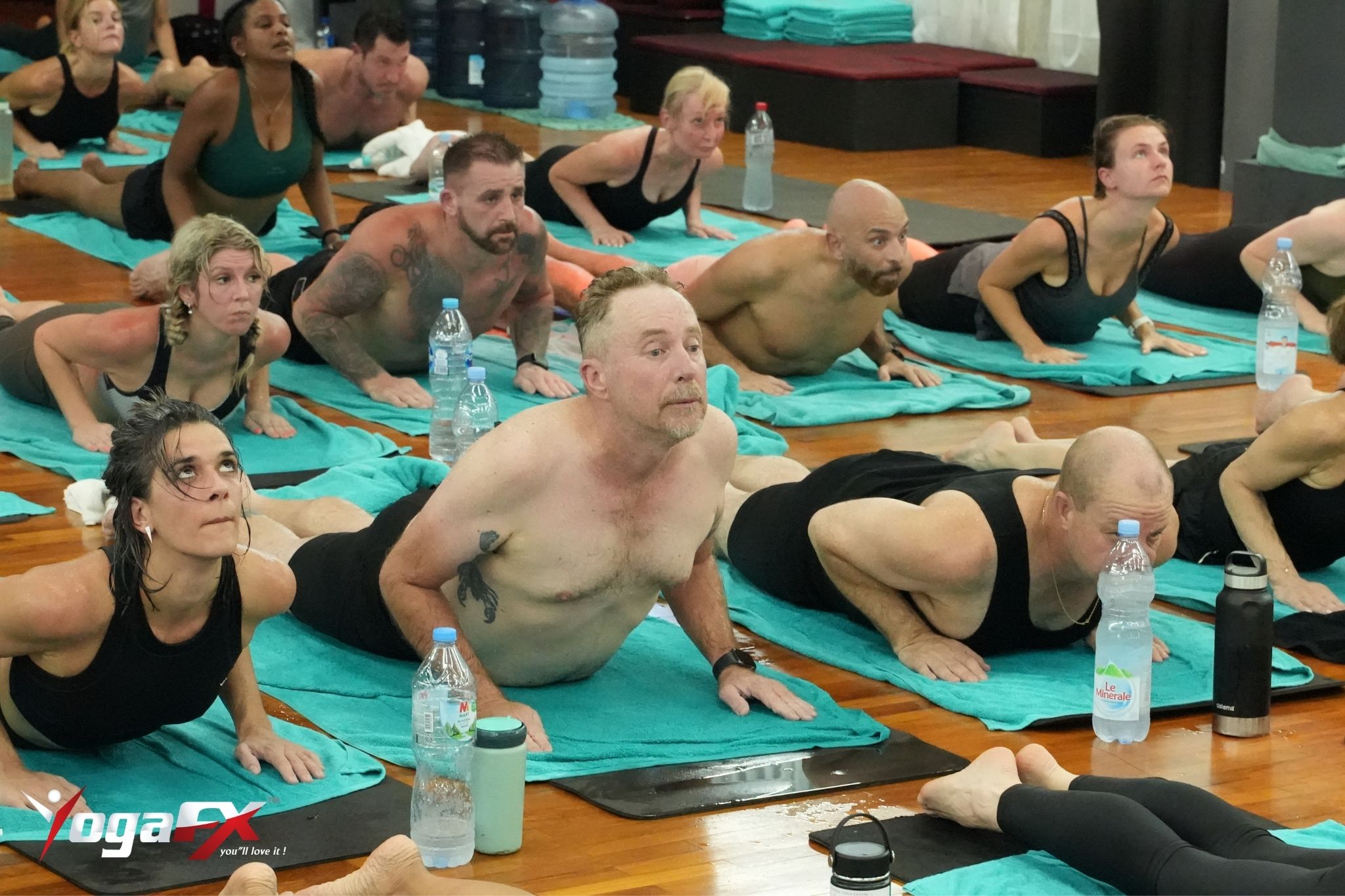
The mechanism: the prone backbend series, Cobra, single-leg Locust, Full Locust, and Bow Pose loads the posterior chain in positions where anterior chain compensation is eliminated. Full Locust specifically requires simultaneous maximal contraction of the spinal erectors, gluteus maximus, and posterior shoulder girdle in a movement pattern that conventional gym training rarely replicates.
The honest qualifier: the strength gains from Bikram yoga are concentrated in the posterior chain and lower body. Upper body hypertrophy, the chest, shoulder, and tricep development from pushing patterns is not developed by the Bikram sequence. The standing series develops isometric lower body strength and balance-related intrinsic musculature, but does not provide the progressive overload required for significant upper body muscle gain.
Does Bikram Yoga Count as Strength Training?
Partially. Bikram yoga qualifies as lower body and posterior chain strength training through: isometric lower body loading from Awkward Pose (6 sets of progressively challenging squat variations) and the standing balance series; eccentric and concentric posterior chain loading from the prone backbend series; and isometric core loading through sustained engagement of spinal stabilisers throughout the balance postures.
What Bikram yoga does not provide: progressive overload (the ability to add resistance incrementally), upper body pushing and pulling patterns, or the mechanical tension that specifically drives muscle hypertrophy in gym-based resistance training.
For a sedentary person starting from a low baseline (the population of the Tracy and Hart 2013 study): Bikram yoga produces strength gains because any resistance stimulus produces adaptation in untrained muscle. For an experienced gym trainer workout: Bikram adds posterior chain and balance strength in ranges that gym training does not specifically address, but does not replace progressive resistance training for continued hypertrophy.
The Reddit Problem: "Bikram Is Zapping My Lifting Strength"
A Reddit r/yoga thread from June 2025 (20 comments) titled "Speculation on why Bikram is zapping my lifting strength so much?" addresses a real phenomenon that experienced years workout. gym practitioners commonly report when they add Bikram yoga to their training schedule. Three causes:
1. Cumulative Fatigue From Training Volume
Adding 3 to 4 Bikram sessions per week (each 90 minutes at 80 percent of maximum heart rate) to an existing gym schedule increases total training volume significantly. The thermoregulatory demand of the heat adds physiological stress beyond the muscular loading. If total recovery capacity is already near its limit from gym training alone, adding Bikram without adjusting gym volume produces cumulative fatigue that presents as reduced lifting performance. The solution: when adding Bikram to an existing gym programme, initially reduce gym volume by 20 to 30 percent. After 4 to 6 weeks of adaptation, restored and often improved gym performance typically follows.
2. Heat-Induced Muscle Pliability Change
Sustained heat exposure changes the mechanical properties of muscle tissue. The sustained flexibility gains from consistent Bikram practice specifically reduced muscle stiffness can temporarily reduce the passive tension that muscles generate at the level beginning of a lifting session. This presents as reduced force output in the first 30 minutes of a post-Bikram gym session but is not a permanent strength reduction. The solution: schedule Bikram and gym sessions on separate days rather than back-to-back. If same-day practice is necessary, gym training first, Bikram second.
3. Electrolyte Depletion From Sweating
Consistent Bikram practice without adequate electrolyte replacement produces cumulative sodium and potassium depletion. These electrolytes are critical for muscular contraction. Reduced serum sodium from chronic sweat loss without replacement presents as reduced force output the feeling that lifting feels harder than it should. This is the most commonly overlooked cause of performance reduction in practitioners who add Bikram to a gym programme. The solution: electrolyte replacement after every Bikram session, sodium and potassium specifically, not just generic sports drinks with high sugar content.
Is Bikram Yoga More Effective Than the Gym?
| Goal | More Effective | Reason |
|---|---|---|
| Upper body muscle hypertrophy | Gym | Progressive overload in push/pull patterns, Bikram cannot replicate this |
| Posterior chain strength | Bikram yoga (slight edge) | Floor series loads posterior chain in patterns most gym programmes omit |
| Flexibility and range of motion | Bikram yoga | Heat-enhanced connective tissue extensibility at a rate room-temp training cannot match |
| Cardiovascular conditioning (documented) | Bikram yoga (slight edge) | 80% max HR sustained for 90 minutes, gym cardio comparable but typically shorter |
| Calorie burn per session | Comparable | 333 to 460 kcal Bikram (measured); gym varies 200 to 600 kcal depending on modality |
| Spinal health and mobility | Bikram yoga | All-plane spinal mobility every classes, no gym equivalent |
| Joint health and lubrication | Bikram yoga | Eagle Pose: 14 joints simultaneously in heat-enhanced synovial state |
| Mental health (documented RCT) | Bikram yoga | Harvard 2023 RCT, no equivalent strength training study |
| Body transformation (comprehensive) | Combine both | Bikram: posterior chain, mind, flexibility, CV, blood, mental health. Gym: upper body, hypertrophy. |
How to Combine Bikram Yoga and Gym Training
Schedule Structure
- Bikram yoga classes on Monday, Wednesday, Friday cardiovascular conditioning, posterior chain loading, flexibility maintenance
- Gym training on Tuesday and Thursday upper body push and pull movements, progressive resistance for hypertrophy
- Saturday: optional Bikram or gym depending on week's intensity
- Sunday: rest
The key scheduling rule: do not practice Bikram group and heavy lifting on the same day during the first 6 weeks of combining both. After adaptation is established (around weeks 6 to 8), most practitioners can tolerate same-day sessions with gym first, Bikram second.
What Each Practice Contributes to the Other
Bikram contributes to gym performance: posterior chain strength in functional ranges that improve deadlift mechanics and hip extension; hip flexor and thoracic flexibility that improves squat depth, overhead press range, and bench press extension; joint health from Eagle Pose that maintains shoulder, hip, and knee mobility under heavy training loads; and sleep and blood quality improvement that accelerates recovery between sessions.
Gym training contributes to Bikram performance: upper body stability from shoulder and rotator cuff training that improves Eagle Pose arm position and balance posture stability; general strength base that makes the isometric demands of the standing series less fatiguing; and core strength from compound lifts that supports the balance posture demands of the Bikram sequence.
The Electrolyte Rule for Combined Practice
Practitioners who do both Bikram yoga and gym training in the same week have higher electrolyte requirements than either practice alone. The cumulative sweat volume from 3 to 4 Bikram sessions plus 2 to 3 gym sessions requires systematic electrolyte replacement after every Bikram session. Failure to replace sodium and potassium consistently is the most common cause of the "Bikram is zapping my strength" phenomenon.
FAQ
Is Bikram yoga enough exercise without the gym?
For cardiovascular fitness, posterior chain strength, flexibility, joint health, and mental health: yes, Bikram yoga 3 to 4 times per week is sufficient and produces documented outcomes. For upper body muscle hypertrophy (chest, shoulder, tricep development) and comprehensive progressive strength training: no, the Bikram sequence type does not include pushing and pulling movements and cannot provide progressive overload. If upper body strength and size is a goal, gym training remains necessary alongside Bikram yoga classes.
Can you build muscle with Bikram yoga?
Yes, specifically in the posterior chain. The Tracy and Hart (2013) study documented a 20 percent deadlift strength increase after 8 weeks of Bikram practice measuring actual posterior chain muscle capacity improvement. The prone backbend series (Cobra, Locust, Full Locust, Bow) loads the glutes, hamstrings, and spinal erectors specifically. Upper body muscle mass cannot be built from Bikram yoga classes alone because the sequence contains no pushing or pulling patterns.
Does Bikram yoga count as strength training?
Partially. It qualifies as lower body and posterior chain strength training through the isometric loading of the standing series and the dynamic loading of the floor backbend series. It does not qualify as upper body strength training or as progressive resistance training for muscle hypertrophy. For sedentary practitioners starting from a low baseline, Bikram yoga produces strength gains because any resistance stimulus produces adaptation. For experienced gym practitioners, it adds functional strength in movement patterns gym training omits.
Why does Bikram yoga reduce my lifting strength?
Three causes: cumulative fatigue from adding Bikram's 80 percent max HR sessions to existing gym volume (reduce gym volume by 20 to 30 percent initially); heat-induced muscle pliability change that temporarily reduces passive tension in the first 30 minutes of post-Bikram lifting (schedule on separate days or gym first, Bikram second); and electrolyte depletion from cumulative sweating without sodium and potassium replacement. The performance reduction is temporary and resolves with schedule adjustment and electrolyte management.
What is better for weight loss, gym or Bikram yoga?
Both produce comparable calorie burn per session at equivalent effort levels. Bikram: 333 to 460 kcal per 90-minute session, directly measured (UW 2014). Gym: 200 to 500 kcal per session depending on modality. Bikram additionally produces lean muscle gain that increases resting metabolic rate. Gym training produces greater upper body muscle mass with a larger long-term metabolic rate effect. For body composition (fat reduction with muscle gain), combining both produces more comprehensive results than either alone.
Is yoga better for the body than the gym?
Better at different things. Bikram yoga is better for spinal health, joint health, feel flexibility, heat-enhanced connective tissue maintenance, posterior chain functional strength, and documented mental health outcomes. Gym training is better for upper body strength, progressive hypertrophy, and sport-specific strength development. Neither is universally superior, the right answer depends on which physical capacities you prioritise.