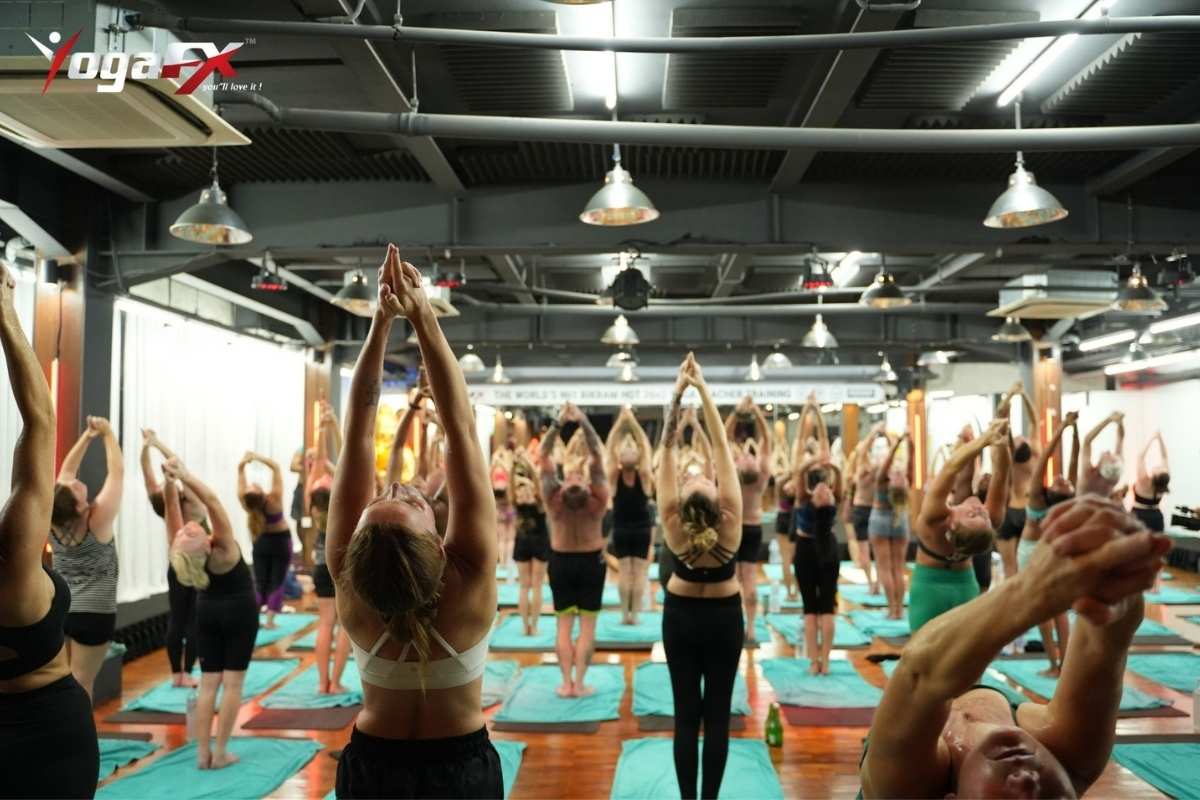

The answer to "can you do Bikram yoga without heat?" is yes. The more useful question is what you keep and what you lose when you practice the 26-posture sequence at room temperature because the difference between practicing with and without heat is not simply that it feels cooler.
Heat in Bikram yoga is not atmospheric preference. It is a functional component that changes specific physiological properties of the tissues being worked. Understanding precisely which properties change and which do not gives practitioners an accurate picture of what room-temperature 26-posture practice provides and where it falls short of the full specification.
Bikram yoga can be practiced without heat. Room-temperature practice retains: the sequence structure, posterior chain strengthening from the floor series, cardiovascular conditioning from the standing series, flexibility maintenance, and the mental focus demands of the balance postures. What is reduced without heat: the rate of flexibility gains (connective tissue is less extensible at room temperature), joint lubrication effectiveness (synovial fluid viscosity is temperature-dependent), and the documented thermoregulatory cardiovascular conditioning. The Houston Methodist study found heat does not significantly increase calorie burn or VO2 over the same yoga sequence unheated but heat does significantly affect connective tissue extensibility, which is why flexibility gains are faster in the heated format.
What Heat Actually Does in Bikram Yoga
Connective Tissue Extensibility
Connective tissue tendons, ligaments, and fascial tissue is viscoelastic. Its resistance to stretching decreases at higher temperatures. At 40 degrees Celsius, the passive stiffness of the hip flexors, hamstrings, thoracic capsule, and posterior shoulder capsule is measurably lower than at 22 degrees Celsius. This means the same effort produces greater range of motion in the heated environment.
This is the most significant contribution of heat to the flexibility outcomes documented in Bikram research. The Tracy and Hart 2013 study (PubMed: 23438366) measured significant lower back and hamstring flexibility gains after 8 weeks at 3 to 4 heated sessions per week. These gains depend partly on the connective tissue extensibility that heat provides. Room-temperature practice produces flexibility gains, but at a slower rate because the tissue's passive resistance is higher throughout each session.
Synovial Fluid Viscosity
Synovial fluid lubricates joint surfaces. Its viscosity decreases at higher temperatures, allowing freer distribution through the joint space with movement. Eagle Pose (posture 4) compresses and releases 14 major joints simultaneously shoulder, elbow, wrist, hip, knee, and ankle bilaterally. In the 40-degree heated environment, the synovial fluid in these joints is more fluid and distributes more completely with the compression-and-release mechanism than at room temperature.
The joint lubrication function of Eagle Pose is present at any temperature but is more complete in heat. For practitioners with joint stiffness, arthritis, or post-injury joint restriction, the heat advantage for joint lubrication is particularly significant. Room-temperature Eagle Pose still lubricates joints less completely.
Thermoregulatory Cardiovascular Demand
The body's response to sustained exercise in a 40-degree Celsius environment includes a specific thermoregulatory cardiovascular adaptation: increased blood flow to peripheral vasculature for cooling, on top of the blood flow demand from working muscles. The University of Wisconsin 2014 study (Porcari et al., PubMed: 24700459) measured average heart rate at 80 percent of maximum throughout 90-minute Bikram classes.
The Houston Methodist research compared heated and unheated practice of the same yoga sequence and found no statistically significant difference in calorie burn or oxygen uptake (VO2) between the conditions. This means the cardiovascular and metabolic demand of the yoga postures themselves is largely independent of heat. However, the heat creates a specific thermoregulatory cardiovascular adaptation that room-temperature practice does not the adaptation that makes practicing in heat progressively easier and that translates to heat tolerance in other contexts.
Muscle Pliability
At 40 degrees, muscle viscosity decreases muscles move through their range with less internal resistance. Postures feel more accessible in heat, particularly in the first 20 to 30 minutes. At room temperature, the warming phase takes longer and is less complete. Practitioners who practice without heat consistently report that postures feel harder, range is reduced, and the floor series in particular requires more active effort to achieve equivalent depth.
What Room-Temperature Practice Retains
| Element | With Heat (40°C) | Without Heat (room temp) |
|---|---|---|
| Sequence structure and logic | Full physiological sequence | Full physiological sequence, identical |
| Posterior chain strengthening | High, floor series in heat | High, floor series loading unchanged |
| Standing balance development | Full proprioceptive training | Full proprioceptive training, heat not required |
| Calorie burn | 333 to 460 kcal per 90 min (UW 2014) | Approximately similar, Houston Methodist found heat does not significantly increase calorie burn over same sequence unheated |
| Flexibility gains | Accelerated, heat reduces tissue resistance | Present but slower, room-temp tissue has higher passive resistance |
| Joint lubrication | High, synovial fluid more fluid in heat | Moderate, lubrication still occurs, less completely |
| Spinal mobility work | Full all-plane spinal conditioning | Full all-plane spinal conditioning, heat not required |
| Mental focus and concentration | Full demand, heat adds cognitive challenge | Full demand, balance postures require equivalent focus |
| Heat adaptation | Develops progressively with consistent sessions | Does not develop, heat adaptation requires heat exposure |
| Thermoregulatory conditioning | Present, specific adaptation to exercising in heat | Not present, no thermoregulatory stress |
| Mental health outcomes (documented) | Harvard 2023 RCT used heated sessions | Whole-body hyperthermia mechanism may be absent, insufficient research |
The Houston Methodist Finding: What It Actually Means
The Houston Methodist research comparing heated versus unheated yoga practice is important to understand correctly before drawing conclusions about practicing without heat.
What the study found: no statistically significant difference in calorie burn or VO2 between heated and unheated practice of the same yoga sequence. What this means: the metabolic demand of the yoga postures themselves is largely independent of room temperature. You burn approximately similar calories doing the 26-posture sequence at room temperature as in a 40-degree room.
What this does not mean: heat adds nothing to the practice. The study measured calorie burn and VO2, it did not measure connective tissue extensibility, synovial fluid distribution, or heat adaptation. Heat's primary contributions are to tissue mechanics (flexibility and joint health), thermoregulatory cardiovascular adaptation, and the whole-body hyperthermia that the Harvard 2023 depression research proposed as the mechanism for mental health benefits.
The practical implication: if your primary goal is calorie burn or general cardiovascular conditioning from the postures, room-temperature practice is roughly equivalent. If your primary goal is faster flexibility gains, maximum joint health, or the specific heat adaptation that improves performance in hot conditions, heat is necessary.
When Room-Temperature Practice Makes Sense
Sequence Maintenance During Travel
Practitioners who travel frequently and cannot access a heated studio can maintain sequence timing, posture familiarity, and structural flexibility through room-temperature practice. Flexibility gains achieved through consistent heated practice are not lost over 1 to 2 weeks of room-temperature maintenance practice.
Active Recovery Days
The 26-posture sequence practiced at room temperature is an effective active recovery session for practitioners whose primary training is heated Bikram yoga or high-intensity gym work. The posterior chain loading of the floor series, the spinal mobility work, and the balance posture demands all contribute to recovery without the thermoregulatory stress of the heated format.
Beginners Building Sequence Familiarity
Practitioners who want to learn the 26-posture sequence before starting studio practice can use room-temperature home practice to build posture familiarity and timing without the simultaneous challenge of heat adaptation. Arriving at a first studio class already familiar with the sequence allows attention to go toward heat management and posture refinement rather than basic sequence learning.
Medical or Heat Contraindications
Practitioners with conditions that contraindicate the full 40-degree heated environment, cardiovascular concerns requiring physician clearance, certain medications that impair thermoregulation, first-trimester pregnancy may practice the sequence at room temperature as an accessible alternative. The structural, strength, and flexibility benefits are available without the thermoregulatory demand.
High-Frequency Practice Weeks
Practitioners doing 5 to 6 sessions per week may find that substituting 1 to 2 room-temperature sessions reduces cumulative thermoregulatory stress while maintaining practice frequency. This is appropriate if the heated sessions are producing the core outcomes being targeted and the room-temperature sessions are serving as volume supplementation.
How to Practice Effectively Without Heat
Extend the Warm-Up Phase
Consider 5 to 10 minutes of gentle movement before beginning the Pranayama Series light walking, arm circles, gentle spinal rotations to begin the warm-up process that heat provides passively. Without heat, tissue warming that happens in the first 20 minutes of a hot room must be achieved through active movement.
Expect Reduced Range and Accept It
Every posture will feel harder at room temperature than in the heated studio. Range of motion will be 10 to 20 percent reduced across most postures. This is physiologically expected and is not a regression in your practice. Do not force range to match your heated studio depth room-temperature tissue resistance is higher and forcing past it increases injury risk without the protective benefit of heat-enhanced extensibility.
Spend More Time in Each Hold
In the heated studio, reduced tissue resistance allows postures to deepen during the hold as tissue warms through the stretch. At room temperature, this within-hold deepening is slower. Extending holds by 5 to 10 seconds beyond the standard dialogue timing compensates partially for the reduced extensibility.
Prioritise the Floor Series
The floor series postures particularly the prone backbends (Cobra, Locust, Full Locust, Bow) and the kneeling postures (Fixed Firm, Half Tortoise, Camel, Rabbit) are less dependent on heat than the standing series balance postures. The strength loading of the floor series is available at any temperature. If time is limited for a full 90-minute session, a focused floor series at room temperature is a high-value shorter practice option.
FAQ
Can you do Bikram yoga without heat?
Yes. The 26-posture sequence practiced at room temperature retains: sequence structure, posterior chain strengthening, balance posture development, spinal mobility work, and cardiovascular conditioning. The Houston Methodist research found no statistically significant difference in calorie burn or VO2 between heated and unheated versions of the same yoga sequence. What room-temperature practice does not provide: the accelerated flexibility gains from heat-enhanced connective tissue extensibility, the full joint lubrication of Eagle Pose in heat-enhanced synovial conditions, and the heat adaptation that develops only through consistent practice in heat.
Is Bikram yoga effective without heat?
Yes, for specific purposes. For calorie burn, strength development, sequence maintenance, and spinal mobility: room-temperature practice is largely equivalent. For flexibility gains and joint health: heat produces faster and more complete results. For the heat adaptation that makes subsequent heated practice more manageable: room-temperature practice provides no adaptation benefit. Room-temperature practice is most effective as maintenance and supplemental practice rather than as a permanent substitute for heated studio practice.
Is Bikram yoga harder without heat?
Yes, in terms of posture range and tissue resistance. Without heat, connective tissue resistance is higher and muscle pliability is lower every posture requires more active effort to achieve the same depth, and some depths accessible in heat are not available at room temperature. Most practitioners who have experienced both report that the postures feel significantly harder and ranges are noticeably reduced at room temperature. This is physiologically expected, not a sign of reduced fitness.
Can I learn Bikram yoga without heat?
Yes, for sequence learning. Room-temperature practice is an effective way to build posture familiarity, sequence timing, and basic alignment before beginning heated studio practice. Practitioners who arrive at their first heated studio class already familiar with the sequence from room-temperature home practice can direct attention to heat management and posture refinement rather than basic sequence learning.
Does heat matter for the mental health benefits of Bikram yoga?
Probably yes, at least partially. The Harvard Medical School MGH 2023 randomised controlled trial (Nyer et al., PubMed: 37883245) used heated Bikram yoga sessions and documented approximately 60 percent of participants reducing depression symptoms by 50 percent or more. The researchers proposed whole-body hyperthermia as a contributing mechanism a specific physiological response to sustained body temperature elevation that the heat environment produces. Room-temperature practice does not produce whole-body hyperthermia. Whether the mental health benefits are fully replicated without heat has not been specifically studied.
What should I do if I cannot access a heated studio?
Practice the 26-posture sequence at room temperature with extended warm-up, reduced range expectations, and extended holds. Use free YouTube resources (Heart Alchemy Yoga with Maggie Grove provides both heated and unheated format options) for verbal guidance. Consider setting up a home heated practice space as described in the Bikram yoga at home guide on this site. When heated studio access becomes available, return to it as the primary practice format for maximum outcomes from the sequence.