
Hot yoga men vs women: in the one study that measured both sexes in a real Bikram class, men ran hotter and harder. Men averaged 80% of predicted maximum heart rate and a peak core temperature of 103.2°F. Women averaged 72% and 102.0°F. So the class is the same, but the load it puts on each body is not.

That gap matters for anyone standing on a mat in a 40°C room, and it matters even more for anyone training to teach one. Below you'll find the full hot yoga men vs women numbers, why they differ, what the research can and can't tell you, and how a teacher uses this in a mixed room.
Hot Yoga Men vs Women: What the 2015 Bikram Study Found
The study most people quote on this question comes from the University of Wisconsin-La Crosse. Emily Quandt, John Porcari and colleagues published it in the Gundersen Medical Journal in 2015, and the American Council on Exercise sponsored the work. You can read the ACE summary of the Bikram core temperature study on its research pages.
The researchers tested 20 regular Bikram practitioners, 7 men and 13 women, aged 28 to 67. Each one swallowed a small sensor that tracked core temperature, so the team could follow heat build-up from the inside. Then they took a normal 90-minute class at 105°F and 40% humidity, with readings every 10 minutes.
The hot yoga men vs women numbers side by side
| Measure | Men (7) | Women (13) | What it tells you |
|---|---|---|---|
| Average heart rate, % of predicted max | About 80% | About 72% | Men worked closer to their ceiling for the whole class |
| Peak heart rate, % of predicted max | 92% | 85% | The hardest moments hit men harder |
| Average highest core temperature | 103.2°F (±0.78) | 102.0°F (±0.92) | Men stored more heat by the end |
| Highest single reading | 104.1°F (one man) | Not above the men's peak | The point where heat illness risk rises |
| Absolute heart rate, max heart rate, effort rating | Similar | Similar | Only the percentages differed |
What the averages hide
Read the last row carefully, because it changes how you see the rest. Men and women had similar absolute heart rates and rated the class as equally hard. The difference showed up as a percentage of each person's predicted maximum. In other words, the same beats per minute meant more for the men in this group.
Core temperature climbed steadily for both sexes across the 90 minutes. Sweating didn't cool anyone enough to stop that rise. Seven of the 20 people went above 103°F, and some started reaching worrying levels about 60 minutes in. Nobody showed signs of heat illness, but the authors noted that risk goes up around 104°F.
For context, Johns Hopkins Medicine lists a body temperature of about 101 to 104°F among the signs of exercise-related heat exhaustion, along with a rapid heartbeat, heavy sweating and cramps. So the men's average peak sat inside that range, even though nobody felt unwell. That's why the hot yoga men vs women gap is a safety question, not just a curiosity.

Average heart rate
80% vs 72%
Men vs women, share of predicted maximum across the class.
Peak heart rate
92% vs 85%
The hardest postures pushed men nearer their ceiling.
Peak core temperature
103.2°F vs 102.0°F
Average highest reading for men vs women.
Above 103°F
7 of 20
Practitioners who crossed 103°F during one class.
The 60-minute mark
~60 min
When some core temperatures began reaching risky levels.
Why Men Ran Hotter: Body Size, Not Just Sex
It's tempting to read the hot yoga men vs women table as "men can't handle heat". That isn't what the wider research suggests. Instead, most of the gap seems to come from body size and shape, which happen to differ on average between men and women.
Surface area versus mass
Your body sheds heat through its skin. A larger, heavier body makes more heat during effort, but it doesn't get a matching increase in skin to lose it. So the ratio of surface area to body mass drops as body size rises.
A 2017 study in Experimental Physiology tested this directly. Notley and colleagues put 36 men and 24 women through exercise in the heat. They found that body shape, not sex, explained most of the difference in sweating and skin blood flow. Their conclusion was blunt: the sex differences were "largely determined morphologically, rather than being sex dependent".
As a result, a small, light man may handle a hot room more like the average woman did in the Quandt study. Likewise, a tall, muscular woman may run closer to the men's numbers. The label on the enrolment form matters less than the body on the mat.
Why the heart rate percentages split
Here's the part that confuses people. Men and women in the study had similar absolute heart rates, yet different percentages. That happens because the percentage depends on each person's predicted maximum, which is usually estimated from age.
So the split partly reflects who was in the sample, and partly how hard each body worked to dump heat. In a hot room, blood moves toward the skin for cooling. As a result, the heart beats faster to keep blood flowing to working muscles too. Some of that heart rate is cooling, not effort.
Bigger bodies burn more energy
The same Wisconsin team measured energy use a year earlier. In that 2014 study (Porcari and colleagues, PubMed 24700459), men burned about 460 kcal per 90-minute class and women about 333 kcal. Heart rate averaged around 80% of maximum across the group.
More calories burned means more heat produced. For example, if your body turns more fuel into movement, it also turns more into warmth. That fits neatly with the men's higher core temperatures a year later.
How Men and Women Can Practise Safely in the Heat
The hot yoga men vs women research doesn't say men should avoid hot yoga, or that women are safe by default. What it does say is that the heat builds through class for everyone. So the practical rules are the same for both sexes, with a few points that matter more for larger bodies.
Rules for everyone
- Arrive hydrated. Drink steadily in the hours before class, not a litre in the last five minutes. Porcari put it simply: "Nothing is gained from withholding water in any setting."
- Give yourself 10 to 14 days. The study authors suggest that much time for your body to adapt to the heat. Your first two weeks are an adjustment, not a test.
- Use Savasana. The rest periods between floor postures let heart rate settle. Lie still instead of fixing your towel.
- Know the warning signs. Cramps, headache, dizziness and weakness come before heat illness. Lie down when you notice them. Johns Hopkins also lists dehydration, obesity and not being used to hot environments as risk factors.
- Watch the last 30 minutes. Core temperature keeps rising, so the floor series isn't the "easy half" for your body.
Extra points for men and larger bodies
- Don't chase the deepest posture in week one. Effort adds heat on top of the room, and you may already be storing more of it.
- Pick a spot near the door for your first few classes, so stepping out is easy.
- Don't trust your watch alone. A high reading may be cooling work rather than overexertion, and a calm face can hide rising heat.
Points women often ask about
Many women notice that their heat tolerance and energy shift across the month. That experience varies a lot from person to person, so most teachers suggest learning your own pattern rather than following a fixed rule. Pregnancy is different: heated practice during pregnancy is a conversation for your doctor, not a general guideline.
This article is general information, not medical advice. If you have a heart condition, take medication, are pregnant or have a history of heat illness, consult a healthcare professional before practising hot yoga.
What the Science Can and Cannot Tell You
The 2015 numbers are useful, but they come with real limits. A good teacher knows both the finding and its weak spots, because students ask about both.
- It was small. Twenty people, and only seven of them men. One unusual person can move an average that much.
- Everyone was experienced. All 20 already practised Bikram regularly and were used to the heat. Beginners may respond more strongly.
- It measured one class. Long-term adaptation across months wasn't part of the design.
- Body size wasn't separated from sex. Given the 2017 morphology research, some of the "male" effect is probably a "bigger body" effect.
The wider evidence base on Bikram practice is still growing. For instance, a 2025 systematic review by Willmott and colleagues (PMC12488547) pulled together 43 studies and 942 participants. It reported benefits for flexibility, bone density and well-being, while noting how small and varied many of the trials were.
Strength results don't split cleanly by sex either. Tracy and Hart (2013, PubMed 23438366) reported a roughly 20% gain in posterior chain strength after eight weeks of practice, with flexibility gains alongside it. So the benefits look broadly shared, even where the heat load differs.
Put plainly, the honest summary of the hot yoga men vs women evidence is this. Men in one careful study ran hotter and closer to their heart rate ceiling. Body size probably explains much of that. Neither finding means one sex should stay out of the room.
Hot Yoga Men vs Women Beyond the Heat
Heat is only one part of the hot yoga men vs women picture. In a real studio, you'll also see differences in flexibility, strength, starting points and even who walks through the door. Here's a quick comparison of what tends to differ, and what doesn't.
| Area | Typical pattern for men | Typical pattern for women | Teaching takeaway |
|---|---|---|---|
| Heat load | Higher core temperature and % heart rate in the 2015 study | Lower on average in the same study | Watch larger bodies closely after the first hour |
| Energy use per class | About 460 kcal (Porcari 2014) | About 333 kcal (Porcari 2014) | More fuel burned means more heat made |
| Starting flexibility | Often tighter hamstrings and hips | Often more range, less stability at end range | Cue men toward patience, women toward strength in range |
| Who attends | Usually the minority in a class | Usually the majority | Don't let a mixed room change the dialogue |
| The sequence itself | Same 26 postures and 2 breathing exercises | Same 26 postures and 2 breathing exercises | One method, delivered to every body |
For example, men often arrive tight and strong. Women, on the other hand, often arrive more open but need to build strength at the edge of their range. Still, those are averages, not rules, and every teacher meets plenty of exceptions in the first week.
Where to go next
If you're a man weighing up your first class, our guide to what hot yoga feels like for male beginners covers clothing, the first four weeks and how it fits with gym training. For a longer view, read what Bikram honestly changes in men's bodies. If you're a woman thinking about teaching, the article on female yoga teachers in the Bikram tradition looks at careers, pregnancy policies and teaching in the heat.
For the cardiovascular side in more depth, including the five heart rate zones of a class, see what Bikram studies measured about the heart.
How a 26&2 Teacher Reads a Mixed Room
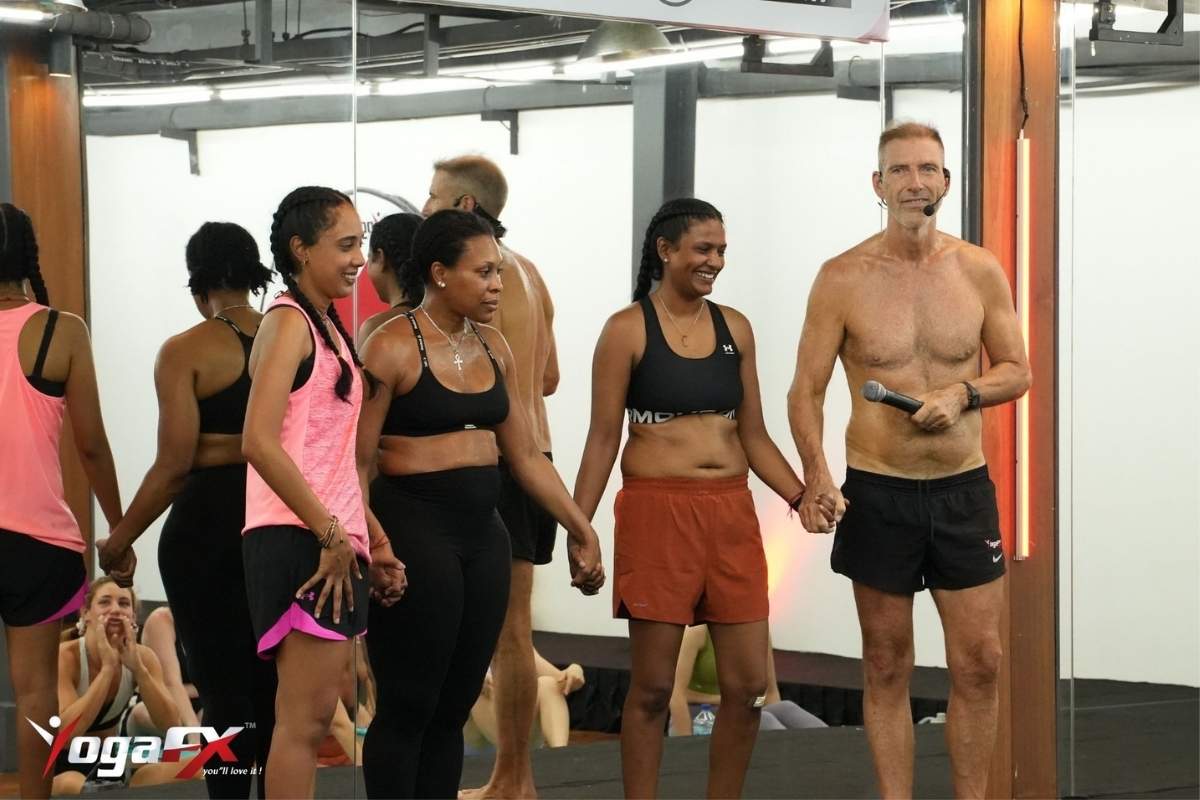
In the Original Hot 26&2 method, the teacher doesn't demonstrate and there's no music. That makes the teacher the only safety system in the room. So the hot yoga men vs women data isn't trivia for a trainee. Instead, it shapes where you look and when.
Mr. Ian Terry, E-RYT 500 and founder of YogaFX, has taught more than 12,000 hours and trained over 1,500 graduates from 80+ countries. He also spent five years, from 2014 to 2019, training with the founder of the Bikram Hot 26&2 method.
His view on heat is simple: a teacher who lets a student push through dizziness hasn't taught a hard class, they've failed to teach a safe one.
In practice, that turns into a few habits trainees learn early:
- Scan the room after the first hour. That's when the 2015 study saw core temperatures start to climb into risky territory.
- Look at bodies, not labels. A large student of either sex may be storing more heat than they show.
- Read the early signs. Mouth breathing in the standing series, a student who stops following the dialogue, or someone who sits down and doesn't get up again.
- Make lying down normal. When the teacher treats Savasana as smart rather than weak, students use it before they need it.
What students say about the heat and the training
Men in particular often arrive expecting a pure physical test. Thomas, from a Bali cohort, said it plainly: "I just thought it was going to be like a tough, tough physical class. That's what I prepared for." What he found instead was a group that shared far more than sweat. (Thomas, YouTube review, 2023)
Hermann, who trained in Bali and went home to Belgium, described a moment in Locust Pose. "He came to me to prepare me to raise my legs up to 90 degrees. I never thought I could do it." (Hermann, Google review, 2025)
Rachel's reason for coming was different again. "I came for healing. I found family, community, inspiration. I found new dreams for myself." (Rachel, YouTube review, 2024)
Learn to Teach Every Body at YogaFX Bali
Knowing the research is one thing. Using it while you deliver the dialogue to 20 sweating people is another, and that's what teacher training is for. At YogaFX, heat safety is a teaching skill, not a disclaimer at the bottom of a page. Because every cohort mixes men and women, the hot yoga men vs women question comes up in almost every training.
- Format: a 6-day hybrid MasterClass, with online pre-course study and an in-person intensive in Bali.
- Certification: Yoga Alliance RYT 200 plus the Bikram Hot 26&2 200-Hour International Yoga Certification.
- Next intake: check-in Sunday 24 January 2027, check-out Friday 29 January 2027, in Seminyak.
- Led by: Mr. Ian Terry, E-RYT 500 and Master Trainer of the Republic of Indonesia Yogasana Sports Federation.
You can compare formats, dates and costs in our guide to Bikram yoga teacher training in 2026 and 2027. Then, if the heat question is the thing holding you back, ask Mr. Ian about it directly before you book.
FAQ
Is hot yoga harder for men?
In terms of heat load, it can be. In a 2015 Bikram study, men averaged 80% of predicted maximum heart rate and a peak core temperature of 103.2°F, against 72% and 102.0°F for women. Body size explains much of that gap, so larger students of either sex should pace themselves carefully.
Do men burn more calories in hot yoga than women?
Yes, on average. A 2014 University of Wisconsin study measured about 460 kcal per 90-minute Bikram class for men and about 333 kcal for women. The difference mostly reflects body size and muscle mass. Burning more energy also produces more heat, which fits with men's higher core temperatures in class.
Can men do hot yoga?
Absolutely. Nothing in the research suggests men should avoid hot yoga. The same 26 postures and 2 breathing exercises suit both sexes. Men simply benefit from hydrating well, allowing 10 to 14 days to adapt to the heat, and using Savasana fully, especially during the last 30 minutes of class.
Who does more yoga, men or women?
Women make up the clear majority of yoga students and teachers in most Western markets, and hot yoga classes usually follow that pattern. Men are still a regular part of most Bikram rooms. For teachers, the mix shouldn't change the dialogue, only where they look for early signs of heat stress.
Who should not do hot yoga?
Anyone with a heart condition, uncontrolled blood pressure, a history of heat illness, or medication that affects heart rate or hydration should get medical clearance first. Pregnant women should speak to their doctor before any heated practice. Everyone else should still build up gradually and lie down when dizzy.
Still have questions? Whether it's about hot yoga men vs women differences, your own heat tolerance, or whether teacher training suits your body, ask us directly. Message Mr. Ian and the YogaFX team on WhatsApp and we'll answer them personally, so you can decide with real answers.