
Bikram Yoga vs Hatha Yoga. This is not a loose characterisation — it is the precise definition used in the peer-reviewed literature. The journal Evidence-Based Complementary and Alternative Medicine (Hewett et al., 2015, PMC4609431) opens its systematic review with: "Bikram yoga is a style of hatha yoga involving a standardised series of asanas performed to an instructional dialogue in a heated environment."
This relationship changes the nature of the comparison. Bikram and Hatha yoga are not competing alternatives in the way Bikram and Vinyasa are. Bikram is a specific, highly defined subset of the Hatha tradition. The differences are in application: heat, fixed sequence, scripted dialogue, and a documented research base that most Hatha discussions do not cite because they do not apply to Hatha yoga broadly.
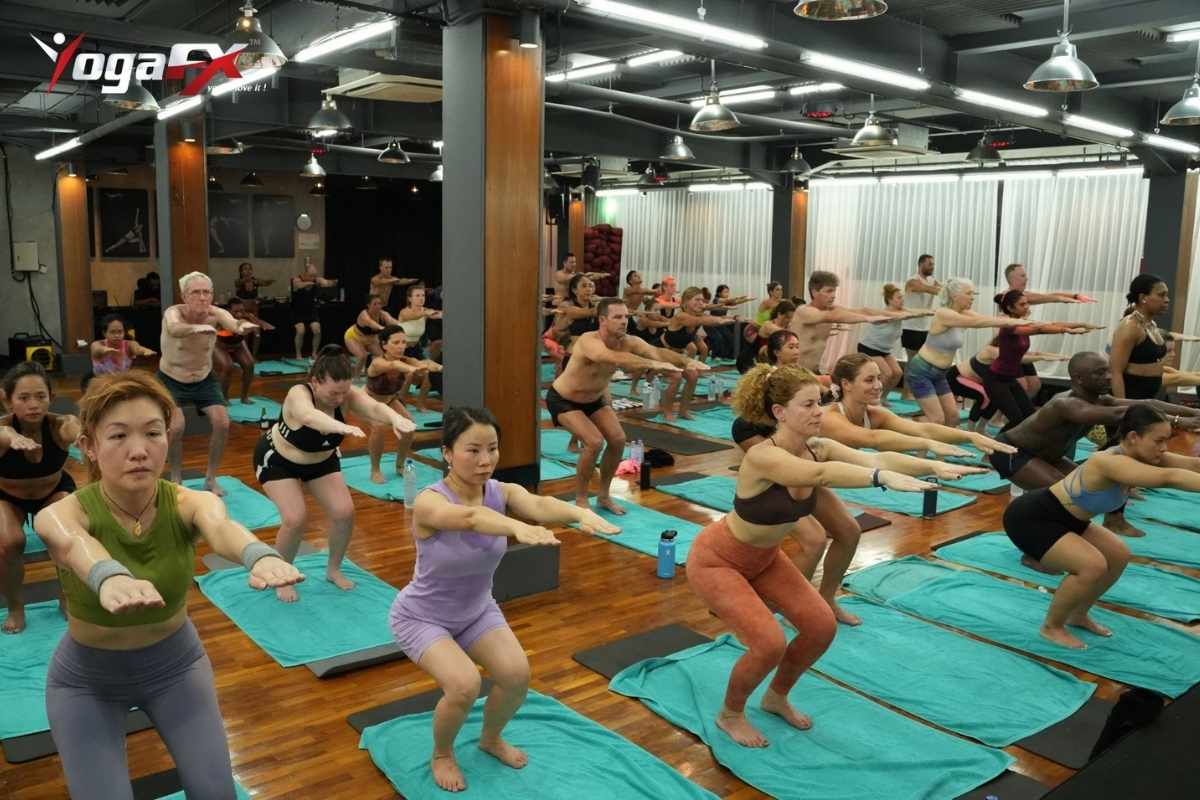
Bikram yoga is a form of Hatha yoga, not a competing alternative. Hatha is the broad foundational category of physical yoga posture practice from which Bikram draws all 26 of its postures. The differences are in application: Bikram adds a fixed 26-posture sequence, 40-degree Celsius heat with 40 percent humidity, 90-minute duration, and scripted verbal dialogue. Hatha yoga in a studio context is typically room temperature, instructor-designed, slower-paced, and shorter. Bikram produces more intense cardiovascular demand and faster flexibility gains from the heat. Hatha is more accessible, spiritually oriented, and less physically demanding.
The Correct Relationship: Bikram Is a Form of Hatha
Hatha yoga is not a single style — it is the foundational category of physical yoga practice from which Vinyasa, Iyengar, Ashtanga, and Bikram Yoga vs Hatha Yoga all descend. The word hatha combines ha (sun) and tha (moon), referring to the balance of opposing energies through physical posture practice.
Bishnu Charan Ghosh, who developed the therapeutic Bikram Yoga vs Hatha Yoga system in Calcutta that Bikram Choudhury later systematised into the 26-posture sequence, was a Hatha yoga practitioner. Every posture in the Bikram Yoga vs Hatha Yoga sequence exists in the broader Bikram Yoga vs Hatha Yoga yoga tradition: Bhujangasana (Cobra Pose) is Hatha. Ustrasana (Camel Pose) is Hatha. Ardha Matsyendrasana (Spine Twist) is Hatha.
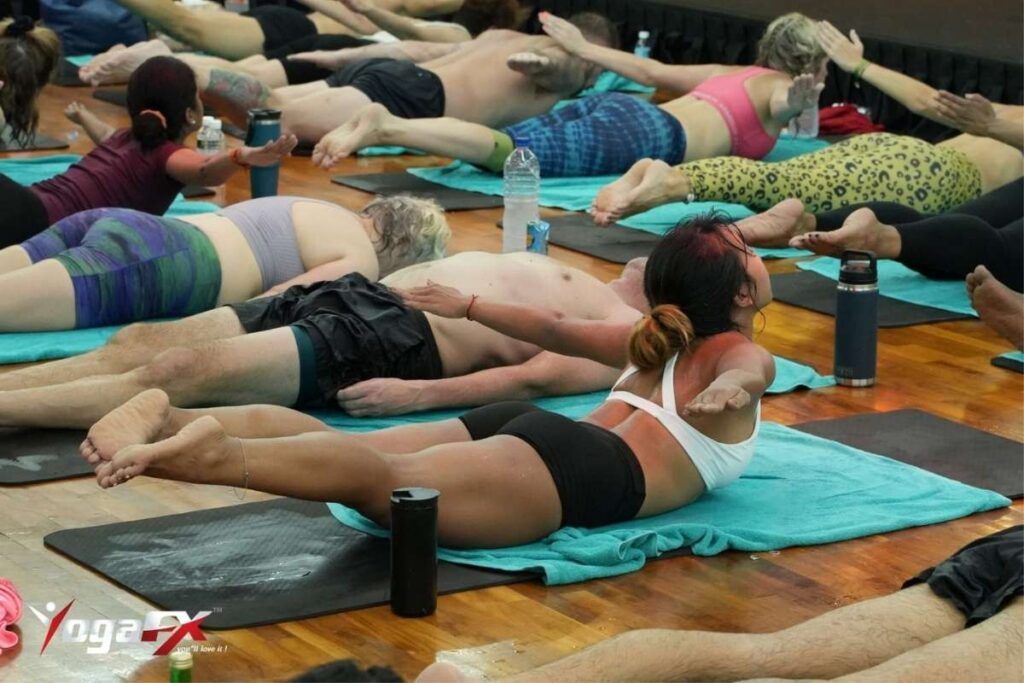
What Bikram yoga adds to the Hatha foundation: a fixed selection of 26 postures in a specific non-negotiable sequence order; a 40-degree Celsius, 40 percent humidity environment specification; a scripted verbal dialogue delivered identically by all certified instructors; a fixed 90-minute duration; and systematic double-set repetition of most postures.
Side-by-Side Bikram Yoga vs Hatha Yoga Comparison
| Feature | Bikram Yoga (26 and 2) | Hatha Yoga (studio class) |
|---|---|---|
| Relationship | Specific subset of the Hatha tradition | Broad foundational category of physical yoga |
| Temperature | 40°C, 40% humidity — specified | Room temperature: 18 to 25°C typically |
| Sequence | Fixed: 26 postures identical every class globally | Variable: instructor-designed, changes by class focus |
| Duration | 90 minutes fixed | 60 to 90 minutes typically |
| Pace | Active: 10 to 20-second holds with specific transitions | Slower: longer holds with breathing focus |
| Instruction | Scripted verbal dialogue — identical from all certified instructors | Variable by instructor; often includes demonstration |
| Cardiovascular demand | High: 80 percent max HR sustained (UW 2014) | Low to moderate: varies significantly by class |
| Calorie burn (60 min, 70kg) | Approximately 276 kcal | Approximately 175 to 240 kcal |
| Flexibility gains | Accelerated by heat — faster early gains | Gradual — room-temperature limits extensibility rate |
| Spiritual emphasis | Minimal in modern practice — primarily functional | Often includes philosophy, pranayama, meditation |
| Beginner accessibility | High — verbal dialogue, no prior knowledge needed | High — generally accessible, no heat challenge |
| Research base | 3 major peer-reviewed studies | General yoga research — less specific |
Correcting Two Common Errors
Error 1: Bikram's Goal Is "Detoxification Through Sweating"
This claim appears in an AI Overview comparison table for this keyword. It is a marketing claim, not a physiological fact.
The body's primary detoxification organs are the kidneys and liver. Sweat glands are not significant detoxification organs — sweat is primarily water, sodium, potassium, and small amounts of urea and ammonia. The sweating in a Bikram Yoga vs Hatha Yoga class is a thermoregulatory response to the heat environment, not a detoxification mechanism.
What sweating does do: clear sebum and debris from pore openings through sustained mechanical perspiration. This is Bikram Yoga vs Hatha Yoga genuine and beneficial for skin. It is not detoxification in the physiological sense.
The documented goals and outcomes of Bikram Yoga vs Hatha Yoga from peer-reviewed research are: cardiovascular conditioning at 80 percent of maximum heart rate (Porcari et al., PubMed: 24700459), strength development of 20 percent deadlift increase at 8 weeks (Tracy and Hart, PubMed: 23438366), flexibility gains, body composition improvement, and depression reduction (Harvard MGH 2023, PubMed: 37883245). These are the legitimate documented outcomes.
Error 2: Bikram Burns 630 Calories Per Hour
A widely shared figure for Bikram Yoga vs Hatha Yoga calorie burn is 630 calories per hour. This number appears on social media and in older blog posts. It is not supported by direct measurement.
The University of Wisconsin 2014 study directly measured metabolic output during actual 90-minute Bikram Yoga vs Hatha Yoga classes using indirect calorimetry: 333 kcal for women (average 68kg) and 460 kcal for men (average 82kg) per 90-minute session. This translates to approximately 220 kcal per hour for women and 307 kcal per hour for men — significantly lower than the 630 figure. Active participants reached higher totals (up to 600 or more kcal per 90-minute session), but this is the upper range, not the average.
Compared Bikram Yoga vs Hatha Yoga (approximately 175 to 240 kcal per 60-minute session), Bikram's calorie burn advantage is genuine and substantial — approximately 40 to 50 percent greater per equivalent session time. But it is not 630 per hour.
How the Heat Changes the Bikram Yoga vs Hatha Yoga Comparison
Flexibility Access
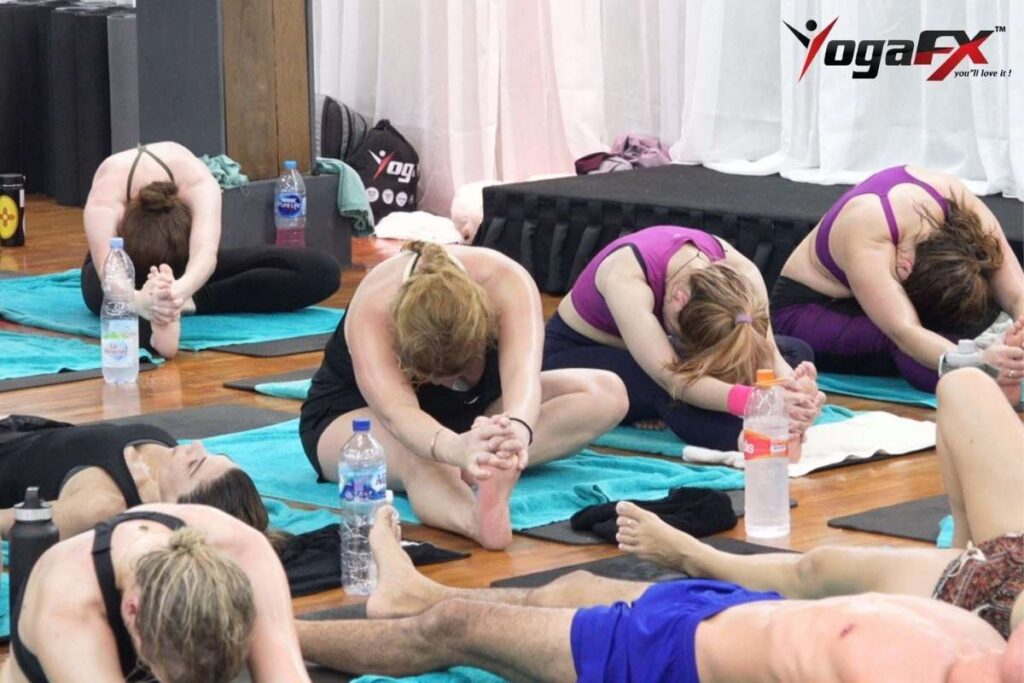
Connective tissue (tendons, ligaments, fascia) has viscoelastic properties that make it more extensible at elevated temperatures. At 40 degrees Celsius, the passive resistance of connective tissue to stretching decreases measurably. A practitioner attempting Padahastasana (Hands to Feet Pose) at 40 degrees accesses a deeper forward fold than the same practitioner at 22 degrees with equivalent effort. The Tracy and Hart (2013) study documented significant lower back and hamstring flexibility gains after 8 weeks — both areas where connective tissue properties directly affect range.
In a room-temperature Bikram Yoga vs Hatha Yoga class, the same postures produce flexibility gains over time through repeated mechanical loading. The rate is slower because the tissue's extensibility threshold is not altered by temperature. Both produce flexibility improvement; Bikram produces it faster for most practitioners.
Cardiovascular Demand
Hatha yoga at room temperature produces low to moderate cardiovascular demand. A Harvard Medical School assessment of yoga types characterised Hatha yoga as comparable to a gentle walk in cardiovascular output. Bikram yoga at 40 degrees sustained 80 percent of maximum heart rate throughout the session in the UW 2014 direct measurement. The heat creates additional cardiovascular demand independently of the postures through the thermoregulatory work of maintaining core temperature in a 40-degree room.
Joint Lubrication
Synovial fluid has lower viscosity at elevated temperatures. In the 40-degree Bikram environment, synovial fluid in every major joint becomes more fluid before the first posture begins. Eagle Pose (posture 4), which compresses and releases all shoulder girdle, hip, knee, and ankle joints simultaneously, performs its joint lubrication function more completely in heat than at room temperature. This joint lubrication effect is specific to the heat environment and absent in room-temperature Hatha practice of the same postures.
For Beginners: Which to Start With
Start With Hatha Yoga If:
- You want a gentle, accessible introduction to yoga postures without the additional challenge of heat
- You have cardiovascular concerns — Bikram's sustained high heart rate requires physician clearance for some conditions
- You want to explore yoga philosophy, pranayama, and meditation alongside physical practice — Hatha classes typically include these; Bikram does not
- You prefer a varied class format where the instructor adapts content to the group
Start With Bikram Yoga If:
- You want measurable fitness outcomes — the documented cardiovascular and strength outcomes of Bikram exceed those of Hatha yoga
- You want to track progress directly — the fixed sequence means your session 20 is directly comparable to your session 1
- You prefer clear, complete instruction — the scripted verbal dialogue tells you exactly what to do in every posture
- You want faster flexibility gains — heat-enhanced connective tissue extensibility accelerates early development
Combining Bikram Yoga vs Hatha Yoga Practices
Because Bikram yoga is a form of Hatha yoga, combining the two is not crossing between unrelated disciplines — it is exploring different applications of the same foundational tradition. Bikram 3 times per week for cardiovascular conditioning, heat-enhanced flexibility, and documented health outcomes; Hatha yoga once per week as a recovery session, a spiritual practice, or a more contemplative exploration of anatomy and posture.
Practitioners who do both consistently report that the strength and flexibility developed in Bikram makes Hatha postures more accessible, and the mindful attention cultivated in Hatha improves the quality of focus they bring to Bikram Yoga vs Hatha Yoga balance postures. The two practices are genuinely complementary because they draw from the same posture tradition at different intensities and intentions.
FAQ
Is Hatha yoga the same as Bikram yoga?
No, but Bikram yoga is a form of Hatha yoga. Hatha is the broad foundational category of physical yoga posture practice. Bikram is a specific, highly defined subset with a fixed 26-posture sequence, 40-degree Celsius heat with 40 percent humidity, 90-minute duration, and scripted verbal dialogue. The peer-reviewed literature (Hewett et al., PMC4609431) defines Bikram as "a style of hatha yoga involving a standardised series of asanas performed to an instructional dialogue in a heated environment."
Which is better for beginners, Bikram or Hatha?
Both are accessible for beginners. Hatha is easier initially — room temperature, instructor-adjustable in real time. Bikram Yoga vs Hatha Yoga is harder initially because of heat adaptation in sessions 1 to 10, but its scripted verbal dialogue provides complete instruction that makes postures clear without prior knowledge. For beginners interested in measurable fitness outcomes: Bikram. For a gentle, reflective, spiritually oriented introduction: Hatha.
Does Bikram yoga really detoxify the body?
No, not in the physiological sense. The kidneys and liver are the body's primary detoxification organs. Sweat is primarily water, sodium, and potassium — not a significant toxin elimination pathway. What sweating in Bikram does produce: pore clearing, cardiovascular conditioning from thermoregulatory demand, and the documented health outcomes from the research (strength, flexibility, body composition, depression reduction). These are the legitimate benefits — not detoxification.
How many calories does Bikram yoga burn compared to Hatha yoga?
Bikram yoga: 333 kcal (women) and 460 kcal (men) per 90-minute session, directly measured (UW 2014). This is approximately 220 to 307 kcal per hour — not the 630 per hour figure circulating online. Hatha yoga: approximately 175 to 240 kcal per 60-minute session. The Bikram calorie burn advantage is genuine and approximately 40 to 50 percent greater per equivalent session time.
Is Bikram yoga harder than Hatha yoga?
Yes, significantly harder thermally and cardiovascularly. Bikram Yoga vs Hatha Yoga sustains 80 percent of maximum heart rate throughout a 90-minute session in a 40-degree room. A typical Hatha class produces low to moderate cardiovascular demand at room temperature. The postures themselves — drawn from the same Hatha tradition — are comparable in complexity. The heat is the primary differentiator.
Can I practice Bikram yoga if I have only done Hatha yoga?
Yes. Because Bikram yoga is drawn from the Hatha tradition, practitioners with Hatha backgrounds find the postures familiar in their first Bikram class. The heat and scripted dialogue format will be new, but the physical vocabulary of the poses is shared. Hatha practitioners typically have good alignment awareness that transfers effectively to the Bikram sequence. The primary adjustment is heat adaptation, which develops over sessions 1 to 10 regardless of prior yoga experience.