
The Bikram Hot Yoga Room temperature is 40 degrees Celsius (105 degrees Fahrenheit) with 40 percent relative humidity. Both numbers are specifications, not approximations. The temperature determines how the musculoskeletal system responds. The humidity determines how the thermoregulatory system responds. Together they create the physiological environment that the 26-posture sequence was designed to operate in.
Most practitioners know the Bikram Hot Yoga Room is hot. Fewer understand why those precise numbers were chosen, what they do to the body that other temperatures do not, and why the source of the heat — natural or electric — produces meaningfully different physiological results. This guide covers all three.
The Bikram yoga room temperature is exactly 40 degrees Celsius (105 degrees Fahrenheit) with 40 percent relative humidity. At 40 degrees C, muscle viscosity decreases measurably, connective tissue extensibility increases, and the cardiovascular system sustains 80 percent of maximum heart rate throughout the session. At YogaFX Bali, this environment is produced by Bali's natural tropical climate without electric heaters at either the Seminyak or Canggu studios — the only hot yoga studios practicing in the original humid-heat conditions the Bikram sequence was designed for.
The Exact Specification: Temperature and Humidity
The Bikram yoga room specification has two parameters, not one. Both are required. Most discussions of Bikram yoga temperature focus only on the heat. The humidity specification is equally important and more frequently misunderstood.
| Parameter | Specification | Physiological Function |
|---|---|---|
| Temperature | 40°C / 105°F (40.6°C in original specification) | Reduces muscle viscosity, increases connective tissue extensibility, elevates cardiovascular demand through thermoregulation |
| Humidity | 40 percent relative humidity | Controls rate of sweat evaporation to maintain core temperature in therapeutic range throughout the 90-minute session |
| Air movement | Still — no fans during class | Prevents sweat evaporation acceleration that would drop core temperature below therapeutic threshold |
| Duration at specification | 90 minutes | The full physiological sequence requires sustained temperature exposure — the floor series specifically needs the deep pre-heating from the complete standing series |
The still air requirement is the specification detail most commonly absent from descriptions of Bikram Hot Yoga Rooms. Fans feel better. They cool the skin and reduce the perceived intensity of the heat. They also accelerate sweat evaporation, drop skin surface temperature, and reduce the deep tissue warming that the session requires. Bikram yoga rooms have no fans during class by design.
What 40 Degrees Celsius Does to the Body
Musculoskeletal System: Viscosity and Extensibility
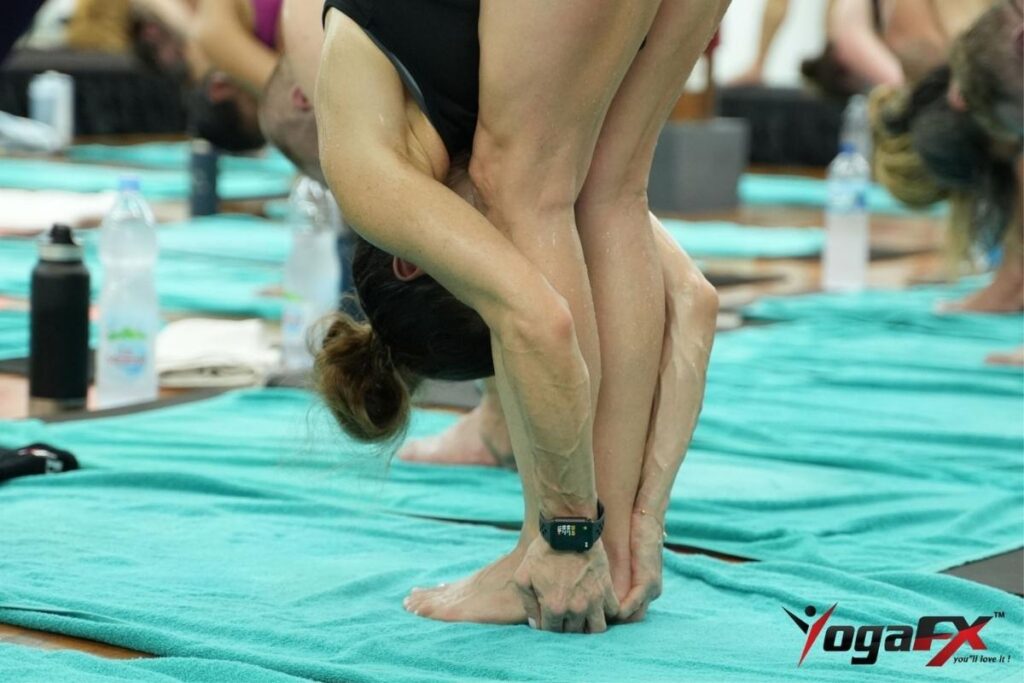
Muscle tissue has a property called viscosity — the internal resistance of muscle fibres sliding past each other during movement. At Bikram Hot Yoga Room temperature (20 to 22 degrees C), resting muscle viscosity is at its baseline level. At 40 degrees C, muscle viscosity decreases measurably, which means the same muscular effort produces greater range of motion. This is not a subjective feeling of being more flexible. It is a documented change in the mechanical properties of muscle tissue in response to thermal input.
Connective tissue, specifically the collagen and elastin fibres of tendons, ligaments, and fascia, shows the same temperature-dependent extensibility change. At 40 degrees C, connective tissue can stretch further before reaching its structural limit. This is why the hip flexor depth available in Fixed Firm Pose, the hamstring range in Standing Head to Knee, and the thoracic extension in Camel Pose all exceed what the same practitioner achieves in the same postures at Bikram Hot Yoga Room temperature.
The research documents this: the University of Wisconsin 2014 study (Porcari et al., Experimental Physiology, PubMed: 24700459) recorded heart rate averaging 80 percent of maximum throughout 90-minute Bikram sessions. The Tracy and Hart (2013) study (PubMed: 23438366) documented 20 percent strength increase and significant flexibility gains after 8 weeks at 3 to 4 sessions per week at Bikram temperature.
Cardiovascular System: Dual Demand
At 40 degrees C, the cardiovascular system is managing two simultaneous demands: the physical effort of performing 26 postures and the thermoregulatory demand of maintaining safe core temperature in a hot environment. Blood is redirected to the peripheral vasculature to allow heat dissipation through the skin while simultaneously being demanded by working muscles.
This dual cardiovascular demand is why heart rate in a Bikram class is significantly higher than heart rate in the same postures at room temperature. The body is doing more total work because it is managing both exercise and thermoregulation simultaneously. This is also why the calorie burn of a Bikram session (333 to 460 kcal per 90 minutes from direct measurement) exceeds what MET-based estimates for room-temperature yoga would predict.
Synovial Fluid and Joint Lubrication
Synovial fluid, which lubricates the major joints, has reduced viscosity at elevated temperatures. In a 40-degree room, synovial fluid moves more freely through the joint space in response to the compression-and-release mechanism of postures like Eagle Pose (which opens 14 major joints simultaneously). The joint lubrication benefit of the Bikram sequence is significantly enhanced at heat compared to the same postures at Bikram Hot Yoga Room temperature.
Nervous System: Thermal Regulation and Stress Adaptation
Sustained exposure to 40-degree heat activates heat shock proteins in response to cellular thermal stress. These proteins are involved in cellular repair and stress resilience. The activation of the sympathetic nervous system during the demanding standing postures, followed by the parasympathetic response of the floor series and Savasana periods, creates a structured alternation between activation and recovery that produces the nervous system regulation benefits documented in the Harvard MGH 2023 depression RCT (Nyer et al., PubMed: 37883245).
Why Humidity Matters as Much as Temperature
Sweat Evaporation Rate
Sweat evaporation is the body's primary mechanism for cooling core temperature. The rate of sweat evaporation is directly controlled by ambient humidity. At low humidity (15 to 25 percent, typical of electric-heated studios), sweat evaporates rapidly from the skin surface. Rapid evaporation cools the skin quickly, which creates a temperature gradient where the skin surface is significantly cooler than the body core. This gradient reduces the depth of thermal penetration to the muscles and connective tissue.
At 40 percent humidity, sweat evaporation is slower. Core temperature rises more consistently with ambient temperature. The muscles and connective tissue that need to warm for the postures to be therapeutically effective reach the target temperature more completely. The 40 percent specification is not coincidental — it is the humidity level at which sweat evaporation allows sustained core temperature elevation without creating either the cooling effect of low humidity or the dangerous overheating of high humidity.
Respiratory Comfort
Dry hot air (below 20 percent humidity) creates respiratory discomfort for many practitioners because the mucous membranes of the respiratory tract dry out rapidly under sustained inhalation demand. The 40 percent humidity maintains adequate respiratory moisture throughout the 90-minute session. This is why many practitioners who find electric-heated studios with low humidity uncomfortable report that 40 percent humidity environments feel significantly more breathable despite identical temperature.
Natural Bali Heat vs Electric Heating: A Fundamental Difference
Every Bikram and hot yoga studio outside of Bali (and most within Bali) uses electric heating systems to reach 40 degrees C. These systems produce forced-air heat with relative humidity typically ranging from 15 to 25 percent. The result is a technically hot room that does not replicate the original conditions the Bikram sequence was designed for.
YogaFX operates in Bali's natural tropical climate without electric heaters at either the Seminyak or Canggu studios. Bali's ambient temperature of 28 to 33 degrees C with humidity consistently above 70 percent provides the base conditions. The studios are ventilated to maintain the balance between ambient heat retention and air quality. Maintaining the delicate balance of 40°C and 40% humidity requires precision engineering. To build it right, you must understand the foundational Bikram hot yoga room requirements.
| Feature | Electric-Heated Studio (Global Standard) | YogaFX Bali (Natural Heat) |
|---|---|---|
| Heat source | Electric forced-air heaters | Bali's natural tropical climate |
| Temperature | 40°C (achieved artificially) | 40°C (ambient plus studio environment) |
| Humidity | 15 to 25 percent (dry electric heat) | Above 70 percent ambient, studio-moderated |
| Sweat evaporation | Rapid — skin surface cools quickly | Slow — consistent core temperature elevation |
| Deep tissue warming | Incomplete — surface-to-core gradient | More complete — consistent thermal penetration |
| Respiratory comfort | Often dry and uncomfortable for sensitive practitioners | More comfortable — humidity supports respiratory moisture |
| Posture depth accessible | Limited by incomplete deep tissue warming | Greater — hip flexors, connective tissue more extensible |
| Energy cost | Significant electricity consumption | Zero — no heaters required |
What Practitioners Report
Practitioners who have trained in both environments consistently report several specific differences in the Bali natural heat experience:
- The heat feels more enveloping and consistent rather than blasting from a single direction
- Respiratory comfort is significantly better — the humid air does not dry out the airways
- Posture depth, particularly in the floor backbend series (Camel, Fixed Firm, Rabbit) and deep standing postures (Standing Head to Knee), exceeds what they achieve in their home electric-heated studios at the same stated temperature
- Recovery between postures feels faster — the consistent thermal environment means the body does not have to readjust to alternating hot-air and skin-cooling cycles
- The first class feels more intense than electric-heated studios — the thermal penetration is deeper and more immediate than the surface heat of dry electric environments
Why Bali Is the Ideal Bikram Environment
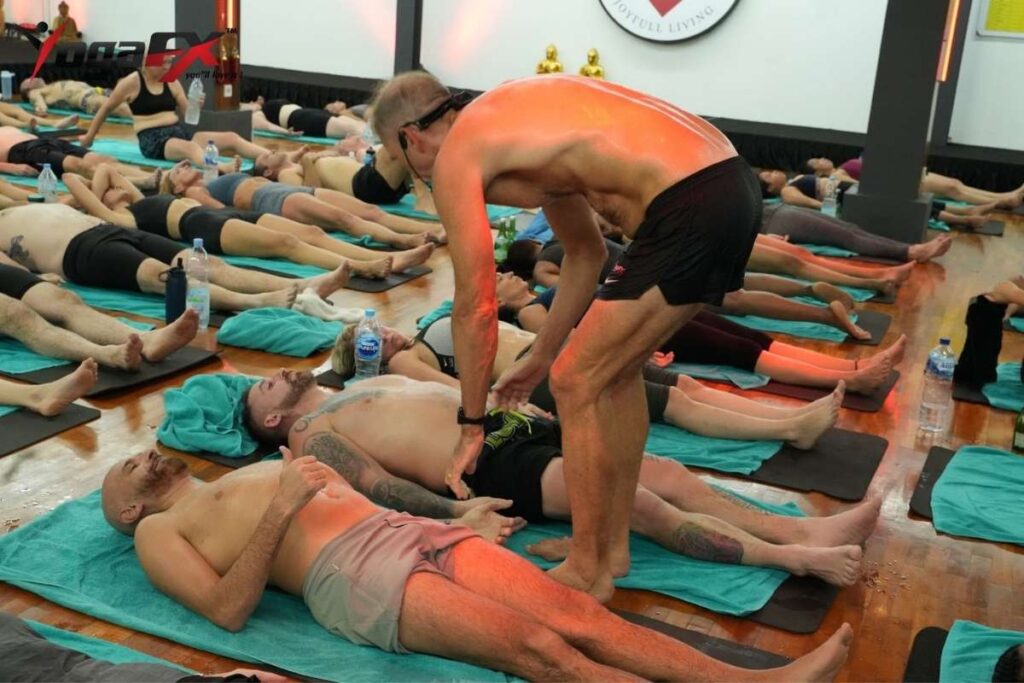
Bikram Choudhury developed the 26-posture sequence in Kolkata, India — a tropical city with ambient temperatures consistently above 35 degrees C and humidity above 70 percent. The sequence was designed in, and for, a naturally hot and humid tropical environment.
When the practice spread to the United States and Europe, electric heaters were introduced to approximate the tropical conditions in non-tropical climates. The approximation is functional but incomplete: electric heating can reach the target temperature but cannot replicate the ambient humidity of a tropical climate without additional humidification infrastructure, which most studios do not maintain.
Bali's climate is the closest naturally occurring equivalent to Kolkata's that is accessible for international yoga practitioners. The island sits near the equator with consistent tropical temperatures and high ambient humidity year-round. For the Bikram sequence specifically, practicing in Bali is practicing in the type of environment the sequence was built for — not an electric approximation of it.
Mr. Ian Terry's 12,000 or more teaching hours span studios in Beijing, Dubai, Moscow, London, Sydney, and Manila — all electric-heated environments. His assessment, based on direct comparison across all these contexts, is that the natural heat produces the most consistent, the most physiologically effective, and the most comfortable hot yoga practice he has experienced or delivered in any context.
Adjusting to the Bikram Room Temperature: What to Expect
Sessions 1 to 3: Thermal Overwhelm
The first 1 to 3 sessions in a 40-degree Bikram Hot Yoga Room feel disproportionately difficult relative to physical fitness level. Practitioners who are highly fit in other disciplines frequently find their first Bikram class harder than expected because cardiovascular fitness does not directly transfer to heat tolerance. The thermoregulatory system needs time to adapt independently. In the Bali natural heat context, this initial period can feel more intense than practitioners expect — the deep thermal penetration of natural humid heat reaches the body more completely than dry electric heat at the same stated temperature.
Sessions 4 to 10: Adaptation
Heat adaptation develops progressively across sessions 4 to 10. The cardiovascular system becomes more efficient at managing simultaneous exercise and thermoregulation. Sweat onset comes earlier in the session (an adaptation that improves cooling efficiency). Resting heart rate decreases. The standing series becomes more sustainable. Practitioners visiting YogaFX for a week or more typically report a noticeable transition in their experience between class 3 and class 5.
Session 10 and Beyond: Optimal Practice
By session 10, heat adaptation is sufficiently developed that the temperature becomes an asset rather than an obstacle. The physiological benefits of the heat — increased range of motion, enhanced cardiovascular conditioning, joint lubrication — are now fully accessible. The practice that beginners describe as surviving becomes what experienced practitioners describe as thriving.
FAQ
How hot is a Bikram yoga room?
Exactly 40 degrees Celsius, which is 105 degrees Fahrenheit (or more precisely 40.6 degrees C in the original Bikram Choudhury specification). The room also maintains 40 percent relative humidity. Both parameters are functional specifications, not approximations. The temperature decreases muscle viscosity and increases connective tissue extensibility. The humidity controls sweat evaporation rate to maintain core temperature in the therapeutic range throughout the 90-minute session.
Why does Bikram yoga need to be so hot?
The heat serves three specific physiological functions: it reduces muscle viscosity (allowing greater range of motion), increases connective tissue extensibility (allowing deeper and safer access to the postures), and creates a thermoregulatory cardiovascular demand that produces the documented calorie burn and cardiovascular conditioning effects. Without the heat, the sequence is a series of Hatha yoga postures. With the heat, it is a physiological system designed to work specifically in that thermal environment.
What is the difference between Bikram yoga heat and regular hot yoga heat?
Bikram yoga specifies both temperature (40 degrees C) and humidity (40 percent). Most hot yoga studios control temperature and not humidity. Electric-heated studios typically run at 15 to 25 percent humidity, which causes rapid sweat evaporation and incomplete deep tissue warming. The Bikram specification at 40 percent humidity maintains slower sweat evaporation and more consistent core temperature elevation. At YogaFX Bali, natural tropical heat with ambient humidity above 70 percent produces the most complete version of these conditions available anywhere.
Is the heat at YogaFX Bali different from other hot yoga studios?
Yes, fundamentally. Electric-heated studios globally produce dry heat at 15 to 25 percent humidity. YogaFX Bali uses Bali's natural tropical climate with no electric heaters and humidity consistently above 70 percent at the ambient level. The natural humid heat produces more consistent deep tissue thermal penetration, more comfortable respiratory conditions, and greater access to the connective tissue extensibility that the Bikram sequence requires. Practitioners from electric-heated studios consistently report that the Bali natural heat experience is more effective and more comfortable despite the identical stated temperature.
Is 40 degrees Celsius safe for yoga?
Safe for healthy adults without cardiovascular conditions when hydration is adequate and heat adaptation is allowed to develop progressively. The University of Wisconsin 2014 study found no significant core temperature concerns in healthy practitioners completing full 90-minute sessions. The key variables are pre-class hydration (arrive already hydrated, not planning to hydrate during class), willingness to rest in Savasana during the adaptation period, and absence of the contraindications: cardiovascular disease, first-trimester pregnancy, recent fever, and medications that impair thermoregulation.
How long does it take to adapt to the Bikram Hot Yoga Room temperature?
Heat adaptation develops across sessions 1 to 10 for most practitioners at 3 to 4 sessions per week. Sessions 1 to 3 feel thermally overwhelming regardless of general fitness level. Sessions 4 to 7 become progressively more manageable as the cardiovascular system adapts. By session 8 to 10, most practitioners report that the heat begins to feel supportive rather than threatening. In the Bali natural heat environment, the adaptation timeline is broadly similar but the quality of the adapted experience is typically reported as superior to electric-heated studios.