The yoga championship has a longer history than most people expect. Formal contests began in Calcutta in 1973. The Ghosh Cup brought them to Los Angeles in 2003. In June 2026, the first World Yogasana Championship in Ahmedabad drew 522 athletes from 79 countries.

This guide follows that story from the start. It explains who built the early contests, how the rules took shape, and where the sport stands today. It also shows what Mr. Ian Terry and the YogaFX team learned from sending graduates to a world yoga championship.
Yoga Championship History at a Glance
If you only have a minute, here's the short version of yoga championship history. The sport grew in five eras. Each one added something the next one needed: a lineage, a stage, a rulebook, government support, and finally a world championship.
Yoga championship timeline in one table
The table below puts the same timeline in order. It shows the place and the reason each step mattered. Dates come from the federations themselves and from news reports at the time.
| Year | Milestone | Where | Why it mattered |
|---|---|---|---|
| 1923 | Bishnu Charan Ghosh opens his College of Physical Education | Calcutta, India | Creates the teaching lineage that later feeds yoga sport |
| 1973 | First formal asana competitions | Calcutta, India | Turns posture practice into a judged event |
| 1989 | Annual championships begin under the International Federation of Sports Yoga | Montevideo and Pondicherry | First yearly international circuit |
| 2003 | Bishnu Charan Ghosh Cup begins its annual run | Los Angeles, USA | Brings competition to a Western audience |
| 2013-2014 | International Yoga Sports Federation founded, then registered | Lausanne, Switzerland | Creates a worldwide governing body |
| 2019 | International Yogasana Sports Federation established | India | Builds the structure for a state-backed sport |
| 2020 | Sports Ministry recognises yogasana | New Delhi, India | Opens government funding and school competitions |
| 2026 | First World Yogasana Championship | Ahmedabad, India | First global championship with 79 countries |
Where the Yoga Championship Began: Calcutta and the Ghosh Lineage
Every story about the yoga championship starts with one teacher. Bishnu Charan Ghosh was born in 1903. In 1923 he opened a College of Physical Education in Calcutta. He was the younger brother of Paramahansa Yogananda, and he taught postures as a physical discipline alongside strength and fitness. His biography records the college date and his family ties.
Ghosh died in 1970. Three years later, the first formal asana competitions took place in Calcutta, says the International Yoga Sports Federation history page. The West Bengal Yoga Federation ran them, and its founders were students of Ghosh. Another press account dates the first recorded contest to 1975, so the exact year depends on the source. Both agree on the place and the lineage.
That lineage matters for Hot 26&2 readers too, because the method Bikram Choudhury later taught is based on Ghosh's teaching. For the wider story of the heat, the dialogue and the legal rulings, read our guide to the history of hot yoga.
Early contests were simple by today's standards. For example, athletes showed postures in front of judges, and the judges scored form. There was no electronic scoring, no world ranking and no Olympic talk. Still, the core idea of the yoga championship was already in place: a posture can be done well or badly, so it can be judged.
The Ghosh Cup: Early Bikram Contests in Los Angeles
The next big step happened in the United States. Bikram Choudhury named the Bishnu Charan Ghosh Cup in honour of his teacher. Winners received it each year at the International Yoga Asana Championships in Los Angeles. The IYSF history says it ran annually from 2003.
Those Los Angeles events gave Western students their first look at a yoga championship. Hot 26&2 students were a natural fit because the sequence already trains the skills judges want to see: balance, flexibility and control under heat. As a result, the contests grew out of studio culture, not out of a university or a ministry.
Rajashree Choudhury, a student of the Ghosh lineage and a former all-India asana champion, then helped move the yoga championship into a formal organisation. She founded USA Yoga in 2009 as a nonprofit, and the national championship moved under it. A 2022 account still calls USA Yoga the leading competitive yoga body in the United States.
Not everyone welcomed the idea. Critics argued that calling yoga a sport clashes with its spiritual roots. USA Yoga answered with a letter from B.K.S. Iyengar. He supported competitions that focus on physical postures, as long as athletes perform them humbly. The argument hasn't fully ended, and you'll still hear both sides.
How Yoga Championship Rules Took Shape
A sport needs rules, and yoga sport built them slowly. The best-known Western yoga championship format is the USA Yoga routine. Each athlete performs six postures in three minutes. Four are compulsory: a forward compression, a backward bend, a traction and a spinal twist. The other two come from an approved list.
Judges look at alignment, precision and stability. Athletes must hold each posture for at least three seconds. Because the format is so tight, nobody can hide a weak area. That means every athlete needs balance, strength and flexibility together. A strong backbend doesn't cover a poor twist.
Meanwhile, the international side grew in parallel. Lausanne saw the founding of the IYSF in 2013, and it registered in 2014. Its yoga championship events then visited London (2014), Pordenone (2016), Beijing (2018), Bengaluru (2022) and Cyberjaya (2025), with an online edition in 2021. To see how these bodies differ, read our explainer on the International Yoga Sports Federation.
One note on the numbers. The IYSF page lists championships from 2003, even though the federation itself came later. So we treat 2003 as the start of the Ghosh Cup era and 2013 as the start of the federation.
Yogasana Becomes a Recognised Sport in India
India took the yoga championship in a different direction. Instead of a studio-led circuit, it built a government-backed system, so the state became a partner. The National Board for Promotion and Development of Yoga and Naturopathy recommended the sport in July 2019. Four months later, in November 2019, the International Yogasana Sports Federation was set up.
The big announcement came on 17 December 2020. Onmanorama reported that Sports Minister Kiren Rijiju and AYUSH Minister Shripad Yesso Naik formally recognised yogasana as a competitive sport. As a result, it became eligible for government funding, and school competitions followed. The ministry had recognised a national federation the month before.
A government presentation, Yogasana as a Competitive Sport, lists seven events for men and women:
- Traditional Yogasana using compulsory and optional postures from a technical committee list.
- Artistic Yogasana in single and pair formats.
- Rhythmic Yogasana for pairs, set to music.
- Free Flow and Group Yogasana, the team-based events.
- Individual All Round and Team Championships, which combine results.
The same paper describes an automated scoring system that aims to make judging more objective. That detail matters because scoring has always been the hardest problem in any yoga championship. Human judges can disagree, while a measured system can show its working.
The First World Yogasana Championship in 2026
Everything above led to Ahmedabad in June 2026. The five-day event ran from 4 to 8 June at the EKA Arena. Tribune India reports 522 athletes from 79 countries. They competed in six age groups, from Sub-Junior (10 to 14) to Senior C (45 to 55).
Events included artistic pair, rhythmic pair, leg balance, hand balance, back bend, twisting body and supine. India topped the table with 114 medals, 102 of them gold. For a full breakdown of the results, see our dedicated report on the World Yogasana Championship 2026.
Organisers also used an electronic scoring system for the first time in the sport. It judges posture, balance and flow. In other words, the idea that began with a few judges in Calcutta now has software behind it. That makes this world yoga championship a turning point.
Indonesia on the world stage
So how did Indonesia do? It sent a team, and two YogaFX graduates were part of it. Together they returned with 7 medals: 1 gold, 2 silver and 4 bronze.
- Ivara Candra Kartika (YogaFX graduate, 2023) won one gold and one bronze in Ahmedabad. She also took silver at the Asian Championships in the United Arab Emirates in August 2025 and gold at FORNAS VIII in July 2025.
- Arkan Fauzan Riyanto (YogaFX graduate, 2022) won two silver and three bronze medals in Ahmedabad. He is also a three-time FORNAS champion, in 2022, 2023 and 2025.
- Slamet Ariyanto (YogaFX graduate, 2024) is Chairman of the Yoga Practitioner Association of Indonesia (PPYNI) and Team Manager of the Indonesian Yogasana team.
Across national, Asian and world events, YogaFX graduates have now won 12 medals: 5 gold, 3 silver and 4 bronze. PPYNI, KORMI and KONI gave the athletes official send-offs before the trip.
What Research Says About Competition-Style Postures
Do the postures behind a yoga championship actually change the body? Research on hot yoga gives a partial answer. It doesn't study competitors directly, but it does measure the qualities judges reward.
A 2025 systematic review by Willmott and colleagues pooled 43 studies and 942 participants. It reported benefits from Bikram yoga for flexibility, bone density and well-being.
A 2013 study by Tracy and Hart looked at healthy young adults. After regular Bikram yoga, they showed more strength in the muscles of the back of the body. Their flexibility and body composition improved too.
For effort, a 2014 University of Wisconsin study, led by Porcari, measured a 90-minute class. It found about 333 calories for women and 460 for men, at roughly 80 percent of maximum heart rate. That's a real workload, so it explains why athletes use the sequence as conditioning.
Both papers are listed in PubMed, but the site blocked automated access when we checked, so we name them here instead of linking. Keep the limits in mind, too. These studies show benefits for regular practice, and they don't show that any class will make you a champion. Please consult a healthcare professional before starting a heated practice, especially with a heart condition, pregnancy or regular medication.
A Hot 26&2 Teacher's View of the Yoga Championship
Mr. Ian Terry has taught more than 12,000 hours and has been based in Bali for over a decade. He spent five years, from 2014 to 2019, as a senior teacher at the large teacher trainings run by the method's founder, Bikram Choudhury.
Since 2022 he has served as a Master Trainer for the Republic of Indonesia Yogasana Sports Federation. Because of that role, he sees both sides of the sport. Our guide to what a Master Trainer does explains it.
So how does a Hot 26&2 teacher see the sport? Three ideas run through both the class and the competition floor:
- Precision first. The scripted dialogue trains students to follow exact cues, and judges reward exactly that kind of control.
- Calm under stress. Heat, a full room and a clock all push attention away from the posture. Athletes learn to pull it back.
- Teacher and student together. Ivara and Arkan were students first, and both carry that training onto the competition floor.
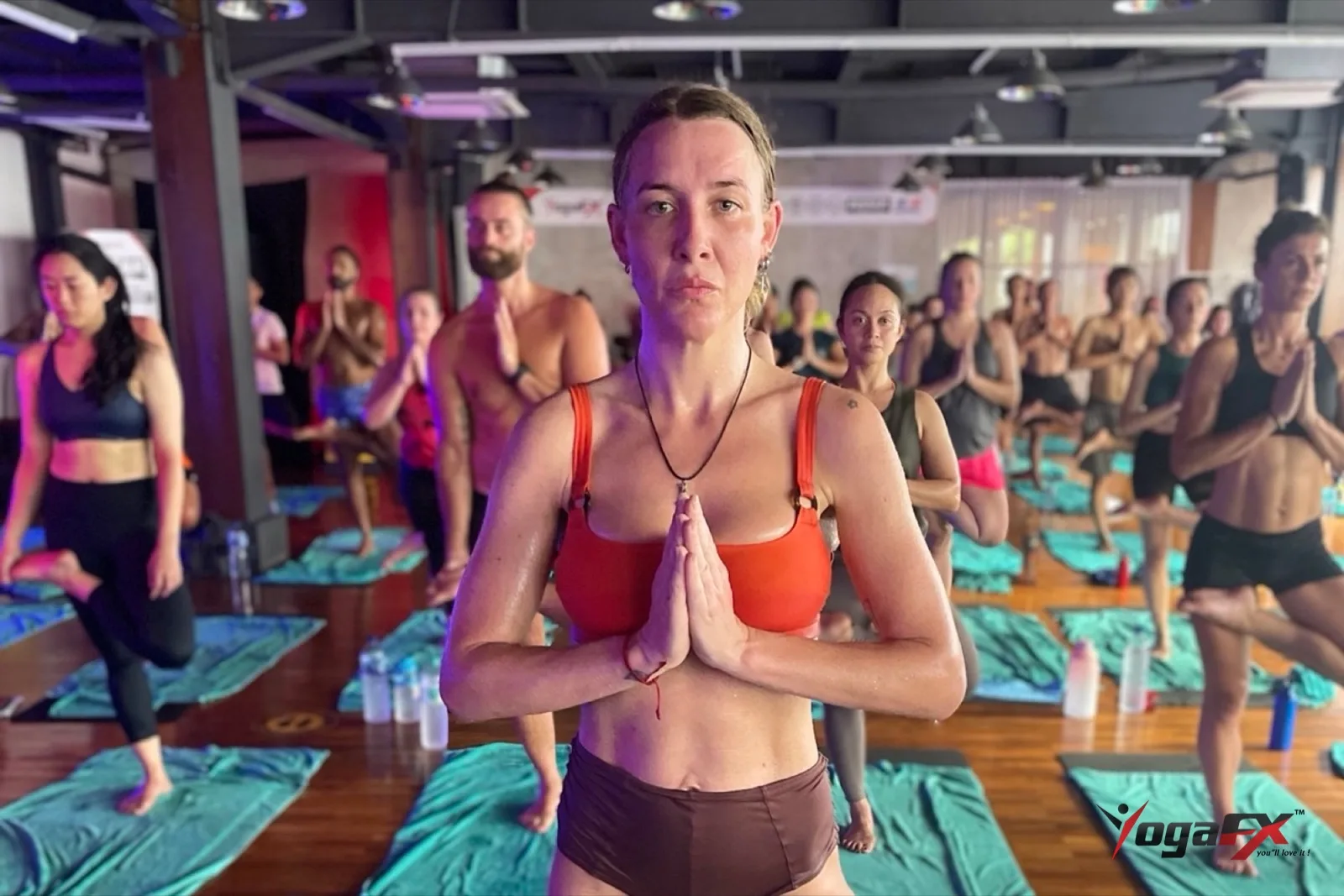
Students describe the same atmosphere in their own words. For example, here are three reviews from YogaFX students.
A room full of strangers quickly become your family of friends, & your biggest cheerleaders.
Lisa, Google review, 2026
My best yoga experience, n my biggest improvement in yoga.
Tridy, Google review, 2020
he is really patient and energetic love it
Udes, Google review, 2020
Not every student wants to compete, and that's fine. Many simply want a stronger practice or a teaching career. If that sounds like you, see how the six-day hybrid MasterClass works in our Bikram yoga teacher training dates, cost and formats guide.
What Comes Next for the Yoga Championship
The sport is still young, so the next chapter of the yoga championship is open. The federation behind the 2026 event hopes Yogasana will reach the Olympic stage. All India Radio described the event as aimed at the Olympic movement.
Mr. Ian is in dialogue with the chairman and board members of the World Yogasana Sports Federation. They share a vision of Yogasana as an Olympic Games test event in 2032 and a full event in 2036. That's a stated goal, not a decision. Olympic inclusion depends on many bodies, so nothing is confirmed.
The practical takeaway is simple. Yoga championship history shows that yoga sport moves in steps: a lineage, a contest, a federation, a recognition, a world stage. The next step will probably bring more countries, clearer scoring and more age groups. If you want to follow it, watch the national federation in your own country.
FAQ
Is yoga a competitive sport?
Yes, in many countries. India formally recognised yogasana as a competitive sport on 17 December 2020. USA Yoga has run national championships for years. Athletes perform set postures before judges. Some yogis still argue that competition clashes with the spiritual roots of yoga, so opinions remain divided.
Is yoga in the Olympics?
Not yet. Yoga is not an Olympic sport today. The World Yogasana Sports Federation hopes Yogasana will become an Olympic Games test event in 2032 and a full event in 2036. That is a stated ambition. Olympic authorities have confirmed nothing.
When was the first yoga championship held?
The IYSF history page dates the first formal asana competitions to Calcutta in 1973, run by students of Bishnu Charan Ghosh. Another press account says 1975. The Ghosh Cup began its annual run in Los Angeles in 2003. The first World Yogasana Championship followed in 2026.
How is a yoga championship judged?
Judges score alignment, precision and stability. In the USA Yoga format, athletes perform six postures in three minutes. Four are compulsory and two are chosen, each held for at least three seconds. The 2026 World Yogasana Championship used an electronic scoring system for the first time.
Who won the first World Yogasana Championship in 2026?
India topped the medal table with 114 medals, 102 of them gold, according to Tribune India. The event ran from 4 to 8 June 2026 in Ahmedabad with 522 athletes from 79 countries. Indonesia won 7 medals, including two YogaFX graduates: 1 gold, 2 silver and 4 bronze.
Still have questions? Message Mr. Ian and the YogaFX team on WhatsApp and we will answer them personally. We can explain how the training works, which dates are open, and whether the six-day MasterClass suits your goals, whether you want to compete or simply teach.