
Master Trainer of the Republic of Indonesia Yogasana Sports Federation is an official appointment confirmed in June 2026, and Mr. Ian Terry, E-RYT 500 and founder of YogaFX, holds it. As founder of YogaFX, he leads a prominent Hot 26&2 yoga teacher training academy headquartered in Bali, operating in Seminyak and Canggu.

Unlike a teaching certification a school issues to its own graduates, a Master Trainer role is granted by an external sporting federation and involves training and certifying instructors and competitors at a national level.
Here is what the title actually means, how the appointment came about, and why it is a different kind of credential from anything a training academy can award itself.
What "Master Trainer" Means in Yogasana Sport
Yogasana is the competitive sport built around judged execution of yoga postures, distinct from yoga as a wellness or fitness practice. It is contested on precision, alignment, and technical execution rather than personal experience, closer in structure to gymnastics or figure skating than to a studio yoga class. The World Yogasana Sports Federation, which organised the sport's first-ever global championship in Ahmedabad, India in June 2026, has stated its ambition to see Yogasana included as an Olympic test event by 2032 and a full Olympic discipline by 2036.
A Master Trainer within that structure is an individual authorised by a national federation to train and certify other instructors and competitors, effectively extending the federation's own standards down through a country's coaching pipeline. This is a fundamentally different function from a personal teaching credential like RYT 200 or E-RYT 500, which certifies an individual's own qualification to teach.
A Master Trainer certifies other trainers, which is why the role sits at a different level in the credentialing hierarchy entirely, closer to a national sport federation's certified coach educator than to a yoga studio instructor.
How the Appointment Came About
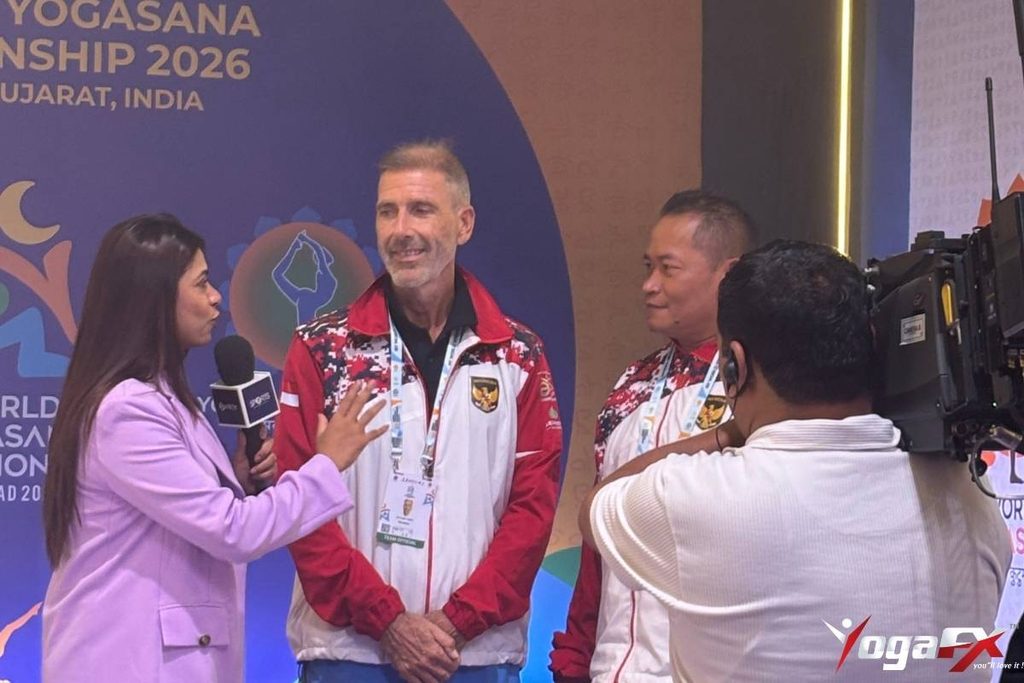
The Republic of Indonesia Yogasana Sports Federation confirmed Mr. Ian Terry's appointment as Master Trainer in June 2026, in recognition of his contribution to developing the sport in the country. The appointment did not happen in isolation. It followed years of building the coaching pipeline that produced Indonesia's Yogasana competitors, documented in full in Ian Terry's track record: 12,000+ teaching hours, 1,500+ graduates, 80 countries, and it coincided with Indonesia's strongest-ever result on the international stage.
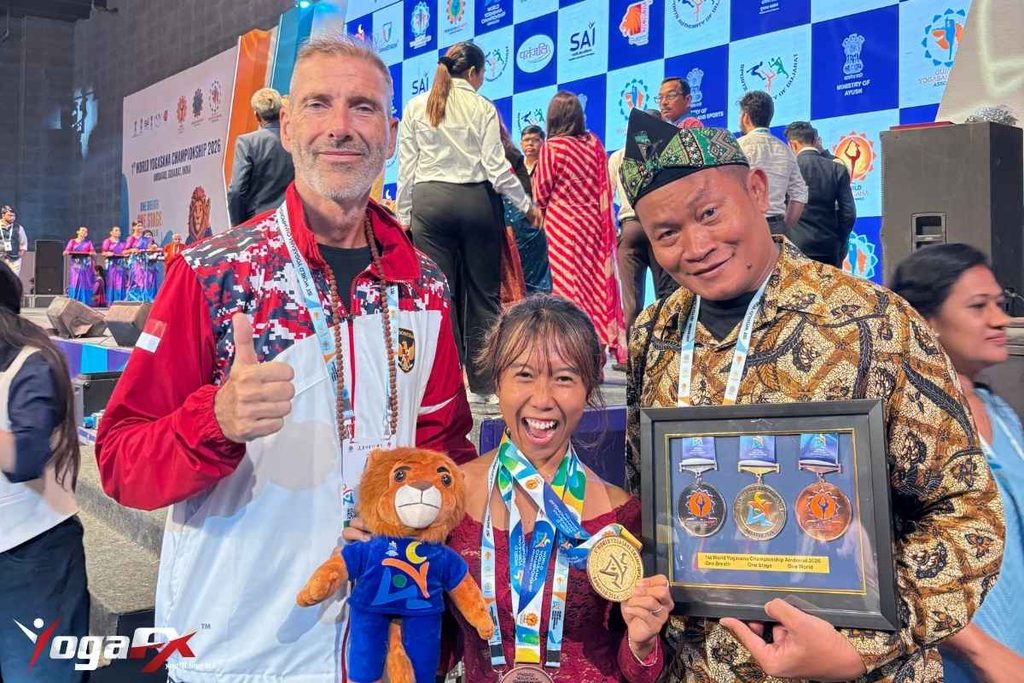
At the inaugural World Yogasana Sport Championship in Ahmedabad, Mr. Terry served as National Coach for the Indonesian team, guiding YogaFX graduates Ivara Candra Kartika and Arkan Fauzan Riyanto to a combined 7 medals, 1 gold, 2 silver, and 4 bronze for Indonesia, a result confirmed publicly by ICCR Jakarta and independently corroborated by the Tangerang City Government.
Alongside the competition itself, Mr. Terry engaged directly with the sport's international leadership, including a meeting with the UAE Minister of Sports during the Asian Yoga Federation Championship in Dubai and ongoing dialogue with the Chairman and board of the World Yogasana Sports Federation regarding the sport's Olympic ambitions. Those relationships, built through years of direct involvement rather than a single event, are the kind of standing a federation actually weighs before extending a national training appointment.
The sequencing here is worth noting because it runs opposite to how credentials often work in the wellness industry, where a title is claimed first and results are expected to follow. Here, the competitive results and the international relationship-building came first, over a period of years, and the federation appointment followed as formal recognition of work already demonstrated rather than a title granted on promise. That ordering is part of what makes the appointment meaningful rather than ceremonial.
What the Role Involves
A Master Trainer's responsibilities run in two directions: developing the next tier of instructors who will go on to coach competitors, and maintaining the technical standard the federation competes at internationally. In practice for Mr. Terry, this has meant continuing to lead YogaFX's own teacher training cohorts in Seminyak, where the dual RYT 200 and Bikram Hot 26&2 certification produces instructors, while separately guiding Indonesia's competitive Yogasana athletes at national and international events as coach.
The two tracks reinforce each other rather than running independently. A national federation does not appoint a Master Trainer based on credentials alone, it looks for someone whose training methodology has already produced measurable competitive results, which is precisely what the medal outcomes in Ahmedabad demonstrated before the appointment was confirmed. This is also why the role differs meaningfully from an honorary title: it comes with an ongoing expectation of developing talent, not a one-time recognition for past achievement.
Why This Matters for Indonesia's Yogasana Development
Indonesia's Yogasana infrastructure is being built by a small number of people occupying complementary roles rather than a large institutional bureaucracy, and understanding how those roles connect explains why the sport has moved quickly in the country.
Mr. Slamet Ariyanto, a 2024 YogaFX graduate, currently serves as Chairman of the Yoga Practitioner Association of Indonesia (PPYNI) and as the Indonesian Yogasana Team Manager, responsible for organising the national team's participation in events like Ahmedabad. Mr. Terry's Master Trainer appointment sits alongside that structure, focused on the coaching and technical development side rather than team administration.
Across National, Asian, and World Yogasana competition, YogaFX graduates representing Indonesia have accumulated a combined 12 medals, 5 gold, 3 silver, and 4 bronze, a track record that predates and directly informed the federation's decision to confirm the Master Trainer role. With the sport's organisers targeting Olympic test-event status by 2032, the coaching pipeline being built now in Indonesia is not incidental, it is the groundwork a national federation needs in place years before an Olympic bid is realistic.
For prospective YogaFX students who have no interest in competitive Yogasana themselves, the appointment is still relevant, though indirectly. A Master Trainer's day-to-day responsibility for maintaining a national technical standard tends to sharpen the same alignment and precision teaching that shows up in a standard teacher training cohort, since the same eye for correct posture execution applies whether the audience is a competitor preparing for a judged event or a beginner learning the sequence for the first time.
Several graduates now teaching internationally cite the same attention to alignment detail as one of the more demanding, and more valuable, parts of their own training.
Yogasana as a Judged Sport, Not a Wellness Practice
Confusion about the Master Trainer title often starts with confusion about what Yogasana actually is. It is not a marketing rebrand of yoga classes, it is a distinct competitive discipline with its own judging system, similar in structure to how rhythmic gymnastics or diving formalised movements that also exist outside competition.
Athletes are scored on precision, alignment, and technical execution of specific postures against a defined standard, not on flexibility alone or on subjective impression.
The World Yogasana Sports Federation, which ran the inaugural World Championship in Ahmedabad in June 2026, sits at the top of a structure that includes national federations, like the Republic of Indonesia Yogasana Sports Federation Mr. Terry serves, which in turn oversee regional associations and individual athlete development.
This structure matters for understanding the Master Trainer role specifically, because a judged sport with Olympic ambitions cannot rely on informal coaching relationships the way a wellness-oriented yoga community often does. Judges need a consistent technical standard to score against, which means someone has to be responsible for teaching that standard to coaches and competitors in a repeatable way across an entire country.
That is the specific gap a Master Trainer fills, and it is a different job from running a yoga teacher training programme even though the same person can hold both roles simultaneously, as Mr. Terry does.
Why the Appointment Is Verifiable, Not Self-Claimed
A recurring problem in the yoga teacher training industry is the difficulty of verifying claimed credentials, since many titles used in marketing copy have no issuing body a prospective student could actually check.
The Master Trainer appointment does not have that problem. It was confirmed by the Republic of Indonesia Yogasana Sports Federation as an external organisation, not announced unilaterally by YogaFX, and it sits alongside other independently confirmed facts: the 7-medal result at Ahmedabad reported by ICCR Jakarta and corroborated separately by the Tangerang City Government, and Mr. Terry's documented engagement with the World Yogasana Sports Federation's own leadership.
Anyone evaluating the claim can trace it through sources outside YogaFX's own website, which is precisely the kind of verification this credential invites and most marketing titles in the industry do not.
Master Trainer vs Other Yoga Credentials
The credentialing landscape around yoga has several distinct tiers that get conflated in casual conversation, so it's worth being precise about where each one sits.
| Credential | Issued By | What It Certifies |
|---|---|---|
| RYT 200 | Yoga Alliance | Individual completion of a 200-hour teacher training programme |
| E-RYT 500 | Yoga Alliance | 500-hour training tier plus a documented multi-year history of logged teaching hours |
| Bikram Hot 26&2 Certification | Style-specific (issued by the training school) | Method-specific qualification to teach the fixed 26-posture sequence |
| Master Trainer | National sport federation (Yogasana Sports Federation) | Authorisation to train and certify other instructors and competitors at a national level |
The first three credentials all certify an individual's own teaching qualification, each building on the last. Master Trainer is categorically different: it is a federation appointing someone to develop other trainers, which requires an existing personal credential as a prerequisite but is not itself a personal teaching certificate. For the fuller breakdown of the yoga teaching title hierarchy, see what do you call a yoga teacher: RYT, E-RYT, and other titles explained, and for the specific requirements behind the E-RYT 500 tier, see RYT 500 meaning: what the credential is and how it differs from RYT 200.
FAQ
What is a Master Trainer in Yogasana sport?
A Master Trainer is an individual authorised by a national sport federation to train and certify other instructors and competitors, extending the federation's technical standards through a country's coaching pipeline. It differs from a personal teaching credential because it certifies other trainers rather than the individual's own qualification alone.
When was Ian Terry appointed Master Trainer?
The Republic of Indonesia Yogasana Sports Federation confirmed the appointment in June 2026, in recognition of his contribution to developing Yogasana sport in Indonesia, coinciding with the country's 7-medal result at the inaugural World Yogasana Sport Championship in Ahmedabad, India.
Is Master Trainer the same as E-RYT 500?
No. E-RYT 500 is a Yoga Alliance credential certifying an individual's own advanced teaching qualification. Master Trainer is a separate appointment from a national sport federation, authorising someone to train and certify other instructors and competitors. An E-RYT 500 credential is typically a prerequisite, not a substitute, for a Master Trainer role.
Can a training academy award itself a Master Trainer title?
No. Unlike style-specific teaching certifications a school can issue to its own graduates, a Master Trainer appointment must come from the external sport federation itself, based on the federation's own evaluation of the individual's contribution and results.
Is Yogasana going to become an Olympic sport?
The World Yogasana Sports Federation has stated its ambition to see the sport included as an Olympic test event by 2032 and as a full Olympic discipline by 2036, though this depends on future IOC recognition and has not yet been confirmed.