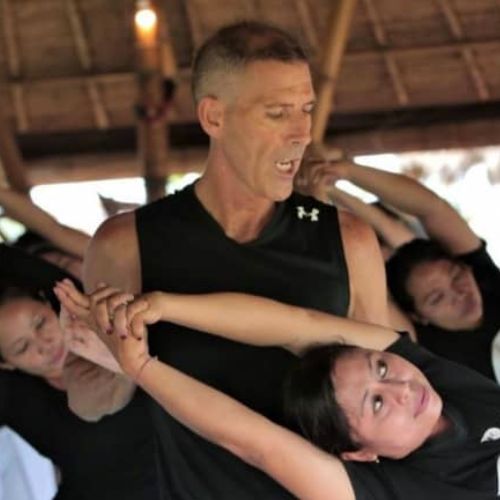
Golf demands rotational power through a limited hip and thoracic range that most golfers never train directly, which is exactly why so many players plateau on swing speed or develop recurring lower back pain around their mid-30s.

Yoga targets the rotational mobility, single-leg stability, and shoulder range a full swing actually requires, and a focused 15-20 minute routine two or three times a week produces a noticeably freer, more powerful turn within a few weeks for most players.
This is not a niche idea within golf fitness circles. Professional tours have had dedicated mobility and yoga coaches on staff for years, precisely because the modern power-focused swing places rotational demands on the body that traditional golf-specific gym work, mostly strength training, does not fully address. What has been slower to reach recreational golfers is the specificity: knowing which poses actually target the swing's demands rather than generic full-body stretching.
Why Golfers Need Yoga
A golf swing is one of the most rotationally demanding movements in any recreational sport, asking the thoracic spine, hips, and shoulders to generate and control force through an asymmetrical range most bodies never practice outside of golf itself. Combine that with the long periods of standing, carrying, and repetitive one-sided loading across a round, and a predictable pattern of restriction builds up over a golfing career.
- Restricted thoracic rotation. Most golfers rotate primarily through the lower back rather than the mid-back, because the thoracic spine has lost the rotational range it should be contributing, which both limits power and increases lumbar strain.
- Tight hips, especially the lead-side hip. The lead hip has to internally rotate through impact while the trail hip externally rotates, and asymmetrical golf-only movement rarely trains this range in both directions.
- Limited shoulder and lat mobility. A full backswing requires significant shoulder external rotation and lat length that sedentary desk-bound lifestyles actively work against.
- Weak single-leg stability. The swing loads one leg at a time through the downswing and follow-through, and poor single-leg balance shows up as inconsistent contact and lost power.
None of this requires becoming a dedicated yoga practitioner to see results. Golfers who add even a short, targeted routine before or after rounds consistently report a longer, freer-feeling turn within a few weeks, along with less of the lower back tightness that tends to show up on the back nine of a long round.
Age is a real factor here, but not in the way most golfers assume. It is not that older players inevitably lose swing speed; it is that rotational range of motion, unlike raw strength, tends to decline steadily without direct maintenance work starting in the late twenties, and most golfers never do anything specific to counteract it.
A 50-year-old who has maintained thoracic and hip rotation through consistent mobility work often out-rotates a 30-year-old who has never trained flexibility at all. This is genuinely good news: the limiting factor on swing speed for most amateur golfers past a certain age is training range of motion, not fighting an unavoidable physical decline.
What the Research Says
A 2013 study published in the International Journal of Yoga found that eight weeks of consistent yoga practice increased posterior chain strength by roughly 20% while also improving flexibility, both directly relevant to a golfer's ability to generate and control rotational force. A broader 2025 systematic review covering 43 studies and more than 900 participants confirmed consistent flexibility gains across regular practitioners, which lines up with what golf-specific trainers already emphasise: rotational range of motion, not raw strength, is usually the limiting factor on swing speed for amateur players.
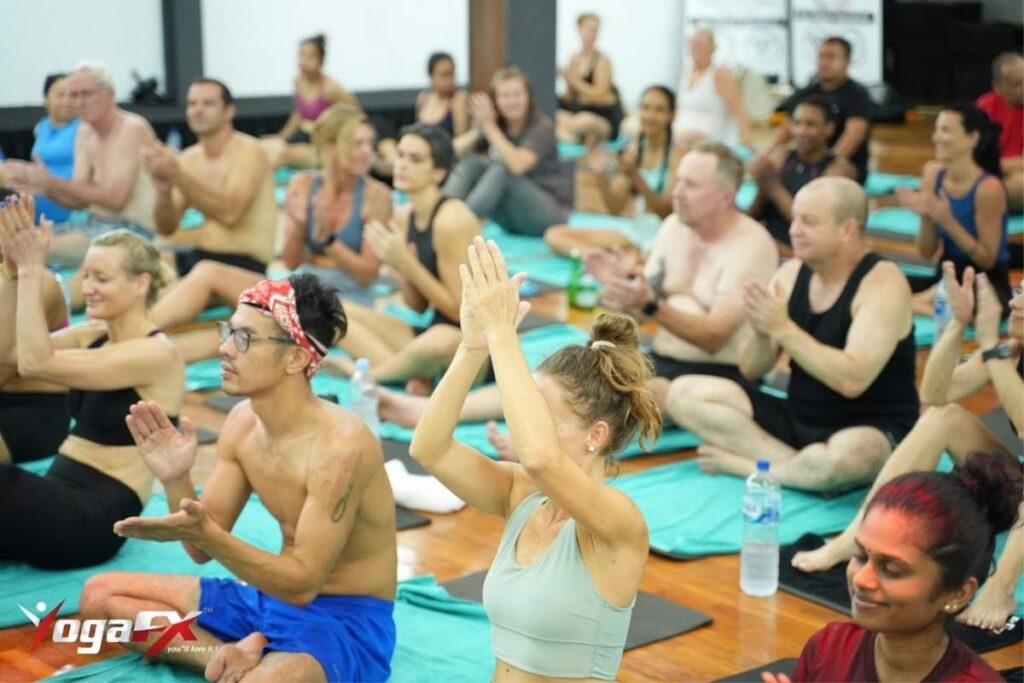
Heat also plays a role that golfers specifically benefit from. Warm muscle tissue accepts a deeper stretch with less resistance than cold tissue, which is one reason a heated practice tends to produce a bigger single-session range-of-motion gain than the same sequence done at room temperature, useful for golfers trying to open up thoracic and hip rotation that has been restricted for years.
The Best Yoga Poses for Golfers
These target the specific rotational and stability demands of the golf swing. Hold each pose for 5-8 slow breaths per side, moving with control rather than forcing depth. These are drawn from the same standing and floor series covered in our full guide to the 26 Bikram yoga poses and sequence.
| Pose | Targets | Why It Matters for Golfers |
|---|---|---|
| Seated Spinal Twist | Thoracic spine, obliques | Directly trains the rotational range that should drive the swing rather than the lower back |
| Extended Triangle Pose | Hips, hamstrings, lateral chain | Builds the hip mobility and lateral stability the swing's weight transfer depends on |
| Low Lunge with a Twist | Hip flexors, thoracic spine | Combines hip opening with rotation, closely mimicking the demands of the downswing |
| Eagle Pose | Single-leg balance, hip stability | Trains the single-leg stability needed through the downswing and follow-through |
| Downward-Facing Dog | Shoulders, hamstrings, lats | Opens shoulder and lat range needed for a full, unrestricted backswing |
| Standing Forward Fold | Hamstrings, lower back | Releases the posterior chain tension that accumulates from repeated forward-bent address position |
A short pre-round warm-up built from the twist, lunge, and eagle pose activates the exact rotational and stability patterns the first few holes demand, while a longer post-round or rest-day session using the full sequence works on building the underlying range of motion over time.
Golfers who play multiple rounds a week, or are preparing for a tournament, often find that consistency across the week matters more than the length of any single session; a brief daily 10-minute routine outperforms one long weekly session for building lasting rotational range.
Yoga vs. Traditional Golf Fitness Training
Golf-specific gym programmes typically emphasise rotational strength through cable exercises and medicine ball throws, and that work is valuable, but it assumes the underlying range of motion to rotate through already exists. Strength training a rotation you cannot physically access just reinforces the compensation pattern rather than fixing it. Yoga and strength training solve different halves of the same problem: yoga builds the range of motion, and strength training then trains power through that range.
Golfers who only do rotational strength work, without addressing the mobility restriction underneath it, often plateau earlier and report more nagging lower back and hip discomfort than those who combine both. The order matters too: doing yoga-based mobility work before a strength session, rather than only after, tends to allow the strength exercises to actually train the intended range rather than a partial, restricted version of it.
Neither approach alone is optimal for most amateur golfers past their twenties; the combination consistently outperforms either in isolation. The same principle shows up across other rotational and endurance sports, as covered in our guide to yoga for cyclists and runners.
Swing Faults That Trace Back to Poor Mobility
Golf instructors spend enormous time on mechanics, but several of the most common swing faults are downstream of a mobility restriction rather than a technique flaw. Understanding which is which can save years of frustrating lessons aimed at fixing a problem that stretching would solve faster.
| Swing Fault | Common Mobility Cause | Yoga's Role |
|---|---|---|
| Early extension (standing up through impact) | Tight hip flexors limiting the ability to maintain posture through rotation | Low lunge and hip-opening poses restore the hip flexion needed to stay in posture |
| Reverse spine angle | Limited thoracic rotation forcing compensation through lateral bend | Seated twists and dynamic rotation work rebuild proper thoracic mobility |
| Short, restricted backswing | Limited shoulder and lat range | Downward dog and shoulder-opening poses extend the available backswing range |
| Loss of balance through the swing | Weak single-leg stability | Eagle pose and other balance postures build the stability the downswing demands |
| Chronic lower back tightness after rounds | Compensating for restricted hip or thoracic rotation by overusing the lumbar spine | A full routine addressing hip and thoracic mobility reduces the compensation pattern |
This does not mean mobility work replaces proper coaching. A golf instructor can identify what the swing is doing; a consistent yoga practice determines whether the body is actually capable of doing what the instructor is asking for. Many golfers who plateau despite regular lessons discover that the missing piece was never technique feedback but the physical range of motion to execute the feedback they were already given.
Bringing this up with your coach is worthwhile too; a good instructor will recognise when a fault is mechanical versus physical and can adjust the lesson plan accordingly rather than repeating the same cue indefinitely. If lower back tightness is the main complaint, our dedicated guide to yoga for lower back pain goes deeper into the postures that help.
A Pre-Round Warm-Up Routine
Static stretching immediately before an athletic movement can temporarily reduce power output, so a pre-round routine should stay dynamic and brief rather than holding deep static poses. This 8-10 minute sequence primes the exact rotational chain the swing uses without over-lengthening anything right before you need power.
- Minutes 0-2: Cat-cow flow. Slow, controlled spinal flexion and extension to wake up the thoracic spine before rotating it.
- Minutes 2-5: Dynamic seated twists. Move in and out of a seated twist on each side rather than holding statically, gradually increasing rotational range.
- Minutes 5-7: Low lunge with reach and twist, both sides. Combines hip opening with a dynamic rotational reach, closely mimicking the loaded positions of the swing.
- Minutes 7-10: Eagle pose, both sides, brief holds. A few short holds to activate single-leg stability before the round rather than fatiguing it with long static work.
Save the deeper static holds, particularly triangle pose and forward fold, for a post-round or separate rest-day session, when a full range-of-motion gain matters more than immediate power output. If you want a longer programme built around swing speed, this yoga routine for golfers who want more swing power adds progressions for before and after the round.
Why Hot Yoga Specifically Suits Golfers
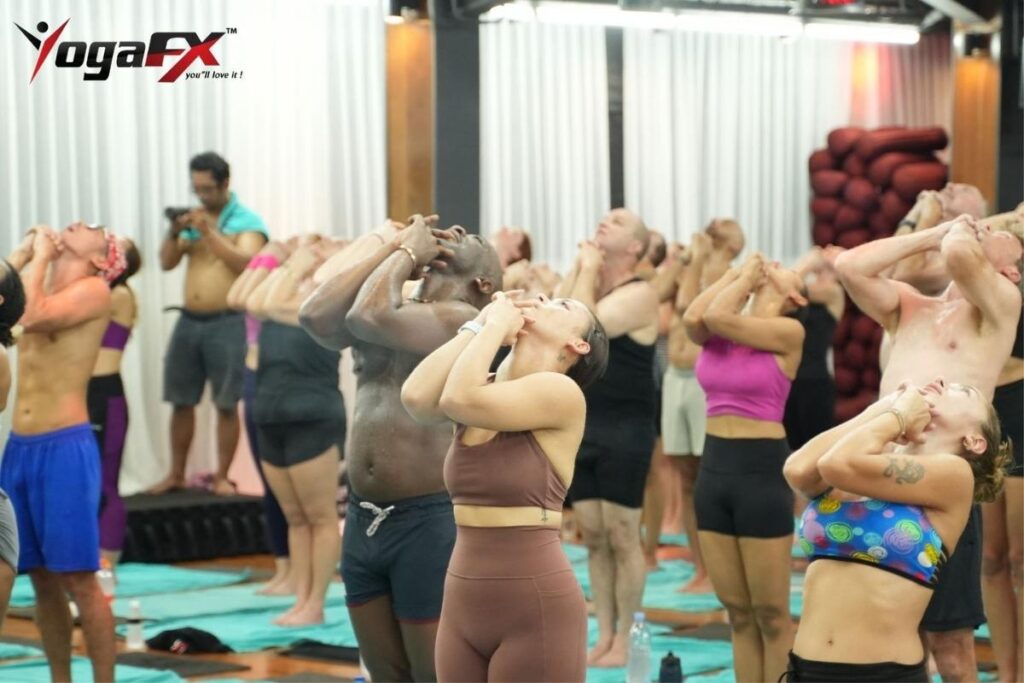
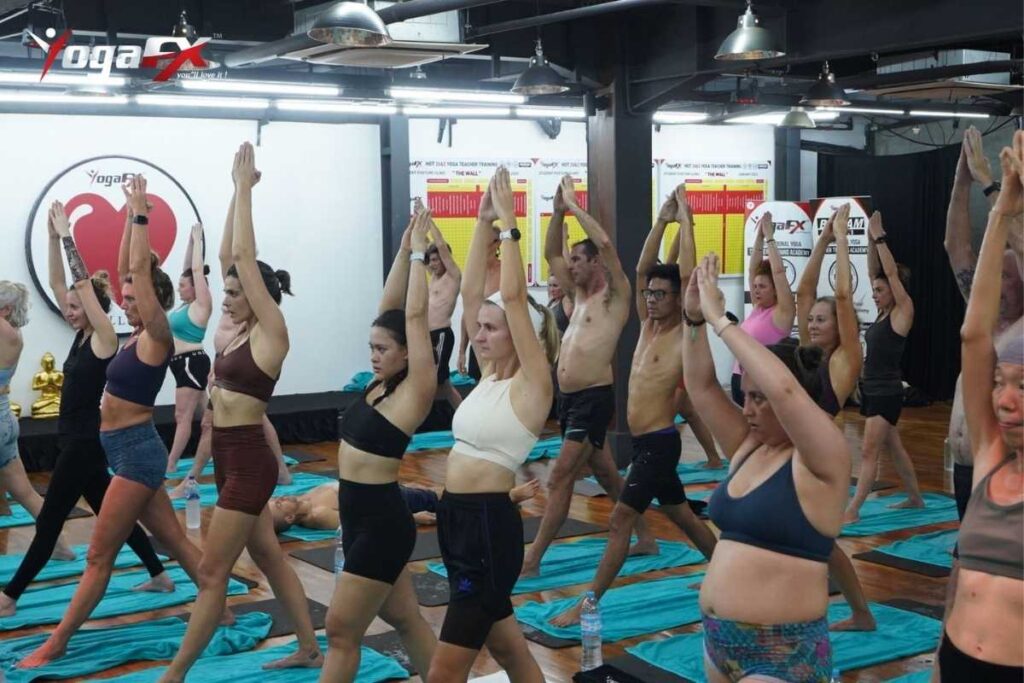
Golfers chasing genuine rotational range rather than a quick warm-up often find that a heated 90-minute practice produces gains a cool-room stretching routine cannot match. The natural tropical heat used in YogaFX's Bali studios, rather than an artificial electric heater, allows the thoracic spine and hip rotators to soften evenly through a full session, which matters specifically for golfers whose rotational restriction has usually built up over years of one-sided loading.
Several golfers who train at YogaFX describe the first heated class as the point where they finally felt their trail hip rotate the way their instructor had been describing for years.
The original Hot 26&2 sequence, developed under founder Mr. Ian Terry, E-RYT 500, moves through a fixed 90-minute order of standing balance postures and deep floor stretches, systematically working the hips, thoracic spine, and shoulders in a single session. Mr. Ian has personally trained more than 1,500 graduates from over 80 countries across more than 12,000 teaching hours, and the discipline of holding a demanding posture through 90 minutes of heat builds a mental steadiness that translates directly to staying composed over a difficult shot late in a round.
As with any new training input, results build with consistency rather than a single session. Golfers who add one or two hot yoga classes a week alongside their normal practice routine typically notice a freer turn and less post-round back stiffness within three to four weeks.
Tracking it is straightforward: note how far into a round the back tightness typically starts, then check again after a month of consistent practice. Most golfers who commit to this find that what they assumed was an unavoidable part of aging or an inherent limit on their swing was actually a trainable restriction they had simply never addressed directly.
FAQ
How often should golfers do yoga?
Two to three sessions a week, combining a brief dynamic warm-up before rounds with one longer session on a rest day, is enough to meaningfully improve rotational range and reduce post-round stiffness for most golfers.
Can yoga improve my golf swing?
Yes, primarily by increasing thoracic and hip rotational range, which allows a golfer to generate more of their swing power through proper rotation rather than compensating through the lower back.
What yoga poses help with golf-related back pain?
Seated spinal twist and low lunge with a twist most directly address the thoracic rotation deficit that causes many golfers to overload their lower back during the swing. Downward-facing dog also helps release general posterior chain tension from the address position.
Should golfers stretch before or after a round?
Before a round, favour brief dynamic movement rather than deep static holds, which can temporarily reduce power output. Save longer, deeper stretches for after the round or a separate session, when tissue is warm and power output is no longer a concern.