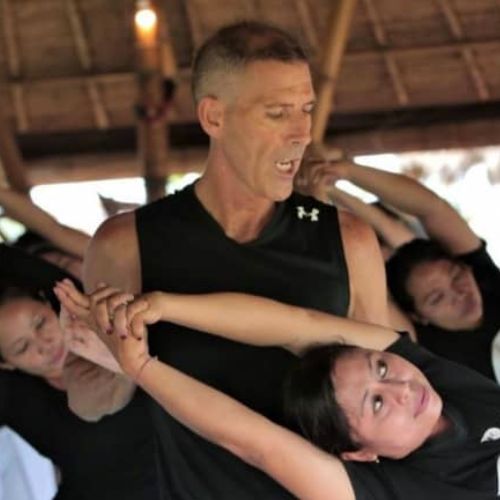
Swimmers put their shoulders through more repetitive overhead motion than almost any other athlete, thousands of rotations per session, which makes shoulder mobility and rotator cuff stability the single biggest yoga priority for anyone serious about the sport.

A focused 15-20 minute yoga routine two or three times a week directly targets the shoulder range, thoracic mobility, and breath control that swimming both demands and, paradoxically, can also erode over time without dedicated counter-work.
This applies whether you swim competitively at a masters or club level or simply swim laps a few times a week for fitness.
The shoulder imbalance pattern scales with volume rather than intensity alone; a recreational swimmer doing 2,000 metres three times a week develops a milder version of the same restriction a collegiate athlete doing 6,000 metres a day experiences, just on a slower timeline. Either way, the underlying fix is identical: open the range swimming restricts, and strengthen the muscles swimming leaves underused.
Why Swimmers Need Yoga
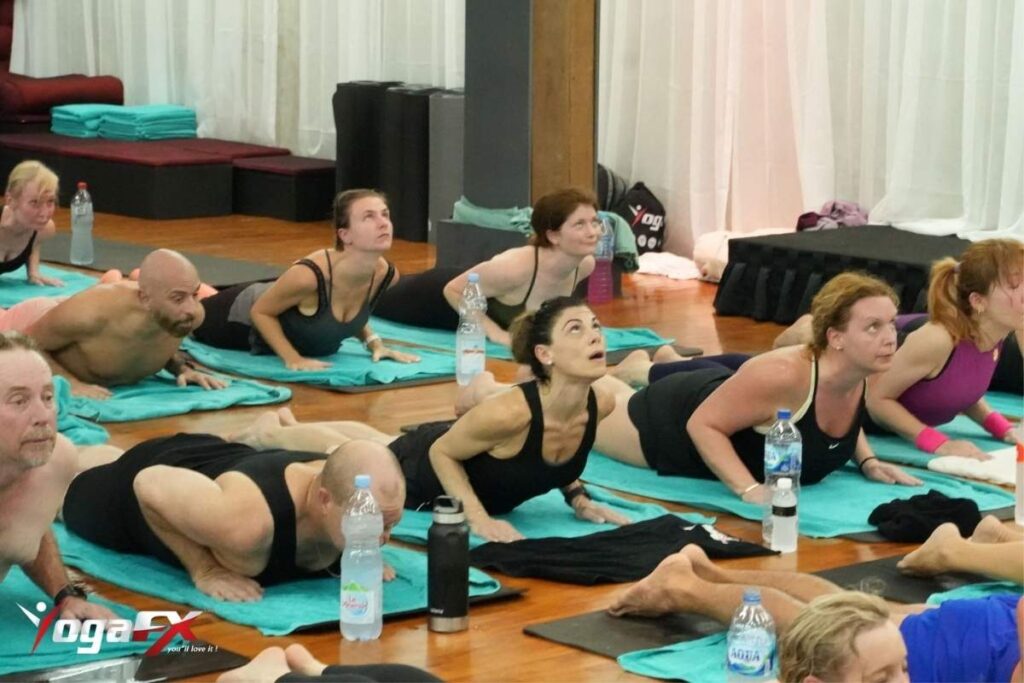
Swimming is often described as a low-impact, joint-friendly sport, and relative to running or heavy lifting, that is true. But low-impact does not mean low-stress on the specific joints involved. The shoulder moves through an enormous range on every stroke, thousands of times per week for a competitive swimmer, and that volume of repetition creates its own pattern of imbalance even without any single traumatic impact.
Freestyle and butterfly place the greatest demand on this rotational pattern, while backstroke and breaststroke distribute load somewhat differently, but every stroke shares the same underlying reliance on repetitive shoulder rotation that a land-based sport rarely replicates.
- Overdeveloped internal rotators, underdeveloped external rotators. The pulling phase of most strokes strengthens internal shoulder rotation far more than external rotation, which can pull the shoulder into a rounded, forward position over time.
- Tight chest and front-of-shoulder muscles. The same pulling-dominant pattern shortens the pectoral muscles, contributing to the rounded posture common among long-term swimmers.
- Limited thoracic extension. Constant forward-reaching strokes and a face-down body position rarely challenge the upper back to extend, which can compound the rounding pattern from tight chest muscles.
- Restricted ankle dorsiflexion. A pointed-toe kick position, held for hours of training over a season, can limit the ankle's range in the opposite direction, relevant for anyone who also runs or does other land-based training regularly.
This pattern is why so many swimmers, even highly fit ones, develop shoulder impingement or general shoulder discomfort as training volume increases. The muscles doing the work of swimming are strong; the muscles and ranges that should be counterbalancing that work are often neglected entirely.
It is a counterintuitive dynamic: the fitter and more dedicated the swimmer, generally the higher the training volume, and the higher the volume, the more pronounced the imbalance becomes without a dedicated counter-practice.
This is part of why shoulder issues are so common even among elite swimmers with access to excellent strength and conditioning support; the strength work often reinforces the same pattern rather than correcting it.
What the Research Says
A 2013 study published in the International Journal of Yoga found that eight weeks of regular yoga practice improved flexibility and posterior chain strength by roughly 20%, both relevant to swimmers working against the internal-rotation-dominant pattern their sport creates.
A broader 2025 systematic review of 43 studies and more than 900 participants found consistent improvements in flexibility across regular practitioners, supporting the basic premise that a dedicated counter-practice can meaningfully offset the joint-specific wear a repetitive sport like swimming creates.
Breath control is where yoga overlaps most directly with swimming technique itself. Swimmers already train breath timing as a core skill, and the slow, controlled breathing emphasised throughout a yoga practice reinforces the same underlying capacity: staying calm and controlled under a breath-restricted, physically demanding state.
Many competitive swimmers report that a consistent breath-focused yoga practice translates noticeably into calmer, more controlled breathing patterns during a hard set or a race.
This is not a coincidence; both disciplines train the same underlying skill of maintaining composure while breath is restricted or timed precisely, just through different physical contexts.
The Best Yoga Poses for Swimmers
These specifically counter the internal-rotation, forward-rounded pattern swimming creates. Hold each pose for 5-8 slow breaths, prioritising the chest and shoulder opening over depth.
| Pose | Targets | Why It Matters for Swimmers |
|---|---|---|
| Cobra or Camel Pose | Chest, front shoulders, thoracic spine | Directly reverses the forward-rounded posture built by pulling-dominant strokes |
| Cow-Face Pose (arms only) | Shoulder rotators, triceps | Trains the external rotation range that swimming's pulling motion neglects |
| Downward-Facing Dog | Shoulders, lats, hamstrings | Decompresses the shoulders and lengthens the lats after repetitive overhead work |
| Fish Pose | Chest, front of neck, thoracic spine | Opens the chest and throat in a way few land sports or swimming strokes do naturally |
| Seated Spinal Twist | Thoracic spine, obliques | Restores rotational range that a face-down, forward-focused body position limits |
| Standing Forward Fold | Hamstrings, lower back | Decompresses the spine after horizontal training and supports overall posture |
Cobra or camel pose, combined with cow-face pose for the arms, does the most direct work against the swimmer-specific shoulder pattern. A short sequence built around these two poses, done consistently after training rather than occasionally, is what tends to produce a noticeable shift in shoulder comfort and posture over a season.
Consistency matters more than intensity here; a swimmer who does a brief version of this sequence after every practice will generally see better results than one who does a longer version sporadically once every couple of weeks.
Yoga vs. Traditional Dryland Training
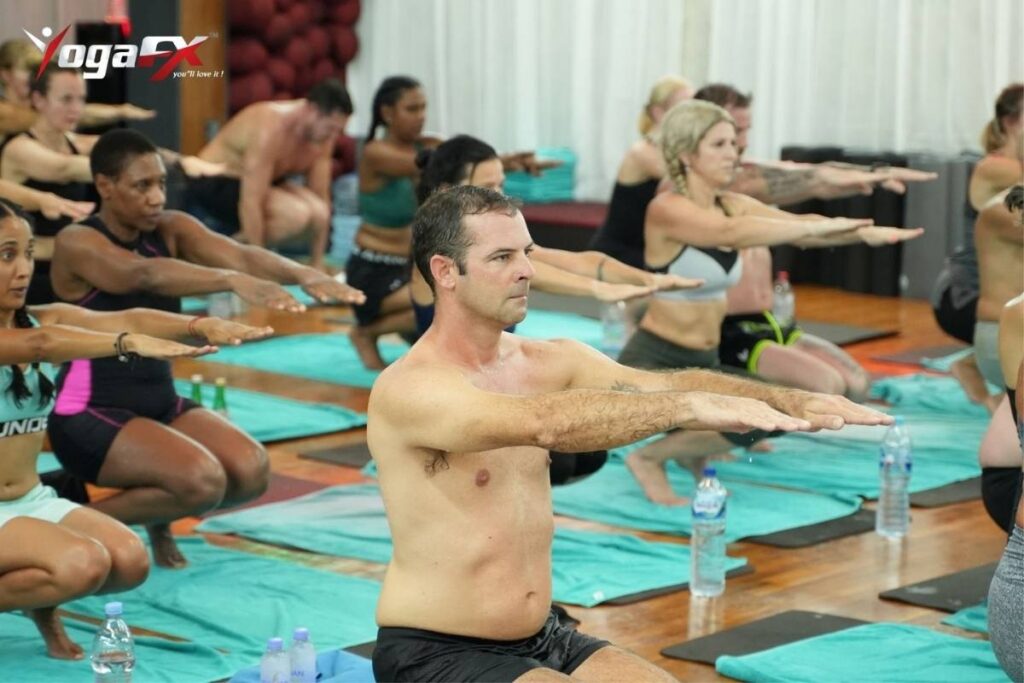
Competitive swim programmes typically include dryland strength work, resistance bands, medicine balls, core circuits, aimed at building the power behind each stroke.
This training is valuable and yoga does not replace it (see our guides to yoga for cyclists and runners and yoga for golfers for how this same principle applies across other sports), but dryland strength programmes rarely address the specific mobility imbalance swimming itself creates, since the exercises are usually chosen to build power in the same movement patterns swimming already reinforces rather than to counterbalance them.
This is the practical distinction: dryland training generally makes swimmers stronger at what they are already doing, while a yoga practice specifically targets what swimming does not train, external rotation, chest and thoracic opening, rotational range through the spine.
Swimmers who do only dryland strength work without a counterbalancing mobility practice often see their shoulder tightness and rounded posture worsen even as their raw power improves, since stronger internal rotators without a matching external rotation practice widens the imbalance rather than closing it.
The two types of training solve different problems, and a well-rounded program benefits from both rather than treating one as a substitute for the other.
A 20-Minute Post-Swim Yoga Routine
Rather than a generic full-body stretch, here is a sequence built specifically around the shoulder and chest pattern swim training creates, done right after practice while the muscles are already warm.
- Minutes 0-3: Cat-cow flow. Slow, controlled spinal flexion and extension to gently mobilise the thoracic spine after hours in a horizontal, forward-reaching position.
- Minutes 3-8: Cobra or camel pose. Move into a backbend to directly reverse the forward-rounded posture the pulling phase of swimming builds. Hold for 8-10 slow breaths, building depth gradually.
- Minutes 8-13: Cow-face pose arms, both sides. Interlace the hands behind the back to work the shoulder's external rotation range specifically, the exact movement swimming's pulling motion neglects.
- Minutes 13-16: Fish pose. Open the chest and front of the throat, a range almost no swimming stroke naturally works.
- Minutes 16-20: Seated spinal twist and downward dog. Finish with a seated twist on each side to restore rotational range, then a final downward dog to decompress the shoulders and lengthen the lats one more time.
Swimmers in a heavy training block, particularly during taper or peak volume weeks, can extend the cobra and cow-face pose holds since those two poses do the most direct work against the specific imbalance a high-yardage week creates.
Preventing Swimmer's Shoulder
Swimmer's shoulder, a broad term for the impingement and rotator cuff irritation common among high-volume swimmers, is one of the most frequent overuse injuries in the sport. It is rarely caused by a single stroke flaw and more often the cumulative result of the internal-rotation-dominant pattern combined with insufficient counter-training.
| Contributing Factor | How It Develops | Yoga's Role |
|---|---|---|
| Rotator cuff imbalance | Internal rotators overworked relative to external rotators | Cow-face pose and external-rotation-focused holds rebalance the ratio |
| Rounded shoulder posture | Tight chest muscles pulling shoulders forward | Chest-opening backbends like cobra and camel directly counter this |
| Poor thoracic extension | Limited upper back mobility forcing the shoulder joint to compensate | Backbends and twists restore the thoracic spine's contribution to overhead reach |
| Training volume without recovery work | High weekly yardage with no dedicated counter-practice | A consistent 2-3x weekly yoga routine provides the structured counter-work most swim programmes never build in |
None of this replaces proper stroke technique coaching or medical evaluation for an existing injury; anyone with persistent shoulder pain should see a physiotherapist or sports medicine physician rather than trying to stretch through it. If your discomfort sits higher in the back rather than the shoulder joint itself, our guide to upper back pain from yoga covers a related but distinct pattern worth ruling out.
But for the ordinary tightness and imbalance that accumulates from consistent training, addressing the pattern early is far more effective than waiting until it becomes a diagnosed impingement.
Coaches who build a brief mobility check-in into weekly training, even just five minutes of shoulder external rotation work at the end of practice, tend to see far fewer overuse complaints across a season than programmes that treat mobility as optional extra credit.
Why Hot Yoga Specifically Suits Swimmers
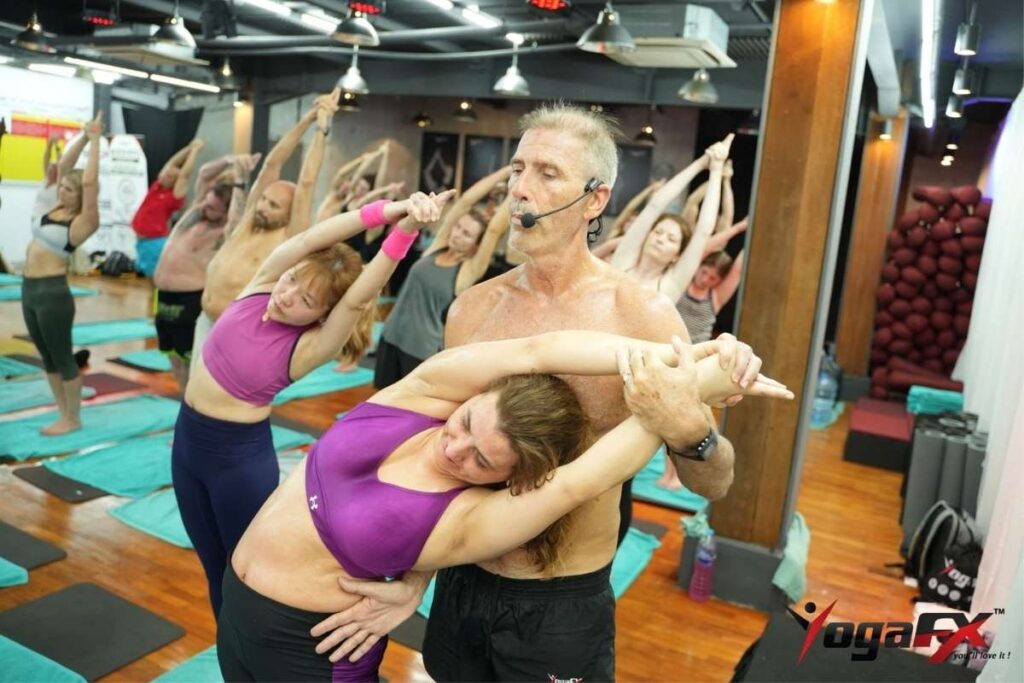
Swimmers chasing a genuine reset of chronically tight chest and shoulder muscles often find that a heated 90-minute practice reaches a depth a poolside stretch cannot.
The natural tropical heat used in YogaFX's Bali studios, rather than an artificial electric heater, lets the pectorals and shoulder rotators soften evenly through a full session, which matters specifically for a muscle group that stays chronically shortened from thousands of weekly pulling strokes.
The original Hot 26&2 sequence, developed under founder Mr. Ian Terry, E-RYT 500, moves through a fixed 90-minute order that includes both standing balance postures and deep backbends, systematically working the chest, shoulders, and thoracic spine in a single class.
Mr. Ian has personally trained more than 1,500 graduates from over 80 countries across more than 12,000 teaching hours, and swimmers in particular often comment that the disciplined breathing pattern woven through the sequence feels like a natural extension of the breath control they already practice in the pool.
Results build with consistency rather than a single class. Swimmers who add one or two hot yoga sessions a week alongside their normal training block typically notice a meaningful reduction in shoulder tightness and improved posture within three to four weeks, which is also roughly the timeline most swim coaches recommend for evaluating any new supplementary training input.
Track it simply: note how your shoulders feel at the end of a hard practice week before starting, then check again after a month of consistent yoga sessions. First time stepping into a heated room?
Our checklist of what to bring to your first hot yoga class covers exactly what you need. Most swimmers who commit to the practice are surprised by how much of the tightness they had come to accept as a normal part of the sport was actually a trainable, reversible pattern rather than an unavoidable cost of high-volume training.
FAQ
How often should swimmers do yoga?
Two to three sessions a week is enough to meaningfully counter the shoulder and posture pattern created by regular swim training, without adding excessive fatigue to an already demanding training schedule.
Can yoga help prevent swimmer's shoulder?
Yes, particularly poses that strengthen external shoulder rotation and open the chest, since swimmer's shoulder is largely driven by an imbalance between overworked internal rotators and underused external rotators.
What yoga poses are best for swimmers' shoulders?
Cobra or camel pose and cow-face pose most directly counter the internal-rotation-dominant pattern swimming creates. Downward-facing dog also helps decompress the shoulders after repetitive overhead work.
Does yoga help with swimming performance?
Indirectly, through improved shoulder mobility, better posture in the water, and breath control that reinforces the same calm, controlled breathing swimming itself demands. It is a supplementary practice rather than a replacement for pool training.