Scoliosis affects approximately two to three percent of the global population - roughly six to nine million people in the United States alone - and presents one of the more nuanced questions in yoga practice: can a system built around symmetric postures help a spine that is structurally asymmetric? The answer depends significantly on the type of scoliosis, the degree of curvature, and which specific postures are being discussed and how they are being performed.

This guide addresses the Bikram yoga and scoliosis question directly, including the per-posture guidance that general yoga-for-scoliosis articles cannot provide, the research that exists, what the heat environment specifically adds for scoliosis, and an honest response to the concerns raised by practitioners who have found the practice unhelpful or uncomfortable for their scoliosis.
Important: scoliosis varies significantly in type, location, degree, and whether it is progressive. This article is for informational purposes only and is not a substitute for assessment by an orthopaedic specialist, physiotherapist, or physician familiar with your specific curvature. If your scoliosis has not been assessed recently or if you are experiencing pain, numbness, or any neurological symptoms, please seek medical assessment before starting or changing your yoga practice.
Understanding Scoliosis in the Context of Yoga
Scoliosis is a lateral curvature of the spine measuring 10 degrees or more on X-ray (Cobb angle). For yoga practice, three distinctions matter most:
Type of Curvature
Idiopathic scoliosis (the most common type, approximately 80 percent of cases) typically develops during adolescence and may stabilise in adulthood. Most adults with idiopathic scoliosis have curves in the 10 to 40-degree range that are stable and manageable in general physical activity including yoga. Degenerative scoliosis develops in adults from asymmetric disc degeneration, often associated with spinal stenosis and more likely to be symptomatic. Congenital scoliosis, present from birth, is less common in adult practitioners and typically requires more individualised medical guidance.
Degree of Curvature
Curves under 20 degrees (mild) generally allow full yoga practice with awareness. Curves of 20 to 40 degrees (moderate) benefit from specific posture modifications and instructor knowledge. Curves over 40 degrees (significant) require individual medical guidance before practicing any vigorous physical format, including Bikram yoga.
Symptomatic vs Non-Symptomatic
Many practitioners with scoliosis have no pain and are primarily interested in whether yoga is safe. Others are managing chronic back pain, muscle fatigue, or in rare cases neurological symptoms from the curvature. The guidance for each group is different. Neurological symptoms associated with scoliosis - numbness, tingling, leg weakness - require medical assessment before yoga practice regardless of the format.
What the Research Shows
The most directly relevant peer-reviewed research on yoga and scoliosis is not Bikram-specific. Fishman et al. (2014, 2016), published in Global Advances in Health and Medicine, found that regular practice of a single posture - side plank (Vasisthasana), held on the convex side of the curve - produced measurable reduction in scoliosis Cobb angle in the majority of participants who completed the study. This is the nascent but genuinely encouraging research that Yoga International (pos 3 in this SERP) correctly highlights.
The broader Bikram research base (Hewett 2015, PMC4609431; Tracy and Hart 2013, PubMed: 23438366) documents improvements in lower and upper body range of motion, balance, and lumbar spine flexibility - outcomes that are specifically relevant for scoliosis symptom management even if the studies were not conducted in scoliosis populations specifically.
The honest position on research: peer-reviewed evidence specifically on Bikram yoga and scoliosis curvature reduction does not yet exist. The practitioner evidence - including the Reddit r/yoga account of a practitioner with S-curve scoliosis who has practiced Bikram for 15 years without back pain - is genuinely encouraging but is not controlled research. What we can say with research support: Bikram yoga improves the range of motion, balance, and spinal mobility that scoliosis typically restricts, and the heat environment provides specific benefits for the paraspinal muscle tension that scoliosis commonly produces.
Why Heat Is Specifically Helpful for Scoliosis
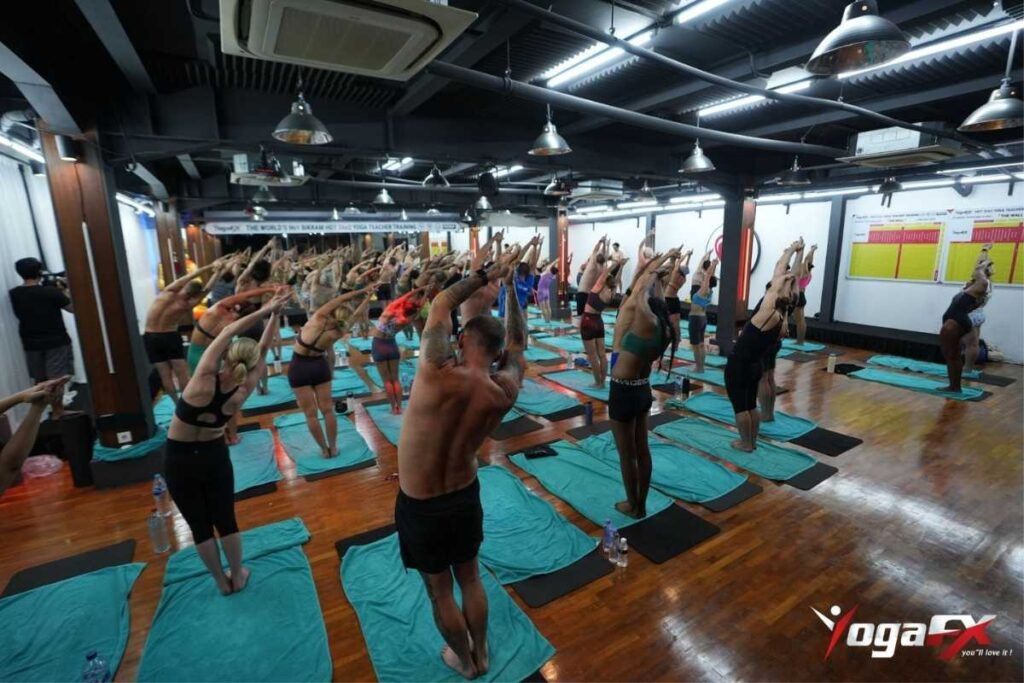
The PAA "Is heat therapy good for scoliosis?" is answered by Baylor Scott and White Health: "heat for chronic stiffness" is one of three evidence-based home management strategies for scoliosis pain. The 40-degree Celsius environment of Bikram yoga provides sustained, whole-body heat application throughout a 90-minute session - a more comprehensive and sustained heat application than a standard heat pad or heat pack, and one that is combined with active movement rather than passive rest.
For scoliosis specifically, heat addresses three things that the structural curvature chronically creates:
- Asymmetric paraspinal muscle tension. The muscles on the concave side of the curve are typically shortened and chronically over-contracted. The 40-degree environment relaxes this muscle spasm before any posture work begins, making the subsequent stretching and strengthening work more accessible.
- Connective tissue restriction. The chronic asymmetric loading of scoliosis produces connective tissue restrictions on the concave side that respond better to heat-enhanced stretching than to room-temperature stretching at equivalent effort.
- Joint stiffness. Asymmetric loading produces localised joint stiffness, particularly in the facet joints on the concave side. The heat reduces synovial fluid viscosity, improving joint mobility before the postures begin loading them.
Bikram Postures and Scoliosis: The Specific Guidance
This is the guidance that general yoga-for-scoliosis articles - including the Cleveland Clinic article recommending Cat/Cow, Mountain Pose, and Tree Pose (none of which are Bikram postures) - cannot provide. The following covers the Bikram 26-posture sequence with scoliosis-specific attention.
Most Beneficial Postures
| Posture | Why It Helps Scoliosis | Key Attention Point |
|---|---|---|
| Half Moon Pose (Posture 1) | Lateral spinal decompression addresses the frontal plane directly - the same plane in which scoliosis creates its primary deviation. Stretches both the convex and concave sides in lateral flexion. | Observe asymmetry between sides - the restricted side should not be forced to match the more flexible side. Both sides matter equally. |
| Eagle Pose (Posture 4) | Bilateral symmetric loading challenges postural asymmetry. The wrapping arms create symmetric tension in the shoulder girdle. Joint lubrication of 14 joints simultaneously in heat-enhanced synovial conditions benefits the asymmetrically loaded joints of scoliosis. | Keep both hip points facing forward. The tendency in scoliosis is for one hip to rotate - maintain bilateral symmetry throughout the hold. |
| Full Locust Pose (Posture 18) | Bilateral posterior chain loading. Both arms at shoulder height and both legs lifting simultaneously produces symmetric load on the spinal erectors - directly challenging the asymmetric muscle development that scoliosis creates. The concave-side muscles are typically underloaded; Full Locust loads both sides simultaneously. | Arms must be equally lifted at shoulder height - not one side dropping. This bilateral symmetry is the therapeutic mechanism. |
| Half Tortoise Pose (Posture 21) | Maximum lumbar decompression with traction. The hips-on-heels position with arms extended forward creates lumbar and lower thoracic traction that relieves the compression asymmetrically loaded scoliotic segments accumulate over time. | Hips must stay on heels - this is the fulcrum for the traction benefit. If hips lift to go deeper, the decompression is lost. |
| Rabbit Pose (Posture 23) | Maximum spinal flexion with traction-based decompression. Hips lifting toward ceiling creates the traction that decompresses the posterior spinal column. One of the most direct spinal decompression postures in the sequence. | Ensure hips are rising symmetrically - scoliosis practitioners often have one hip rising higher than the other. Equal bilateral traction is the goal. |
Postures Requiring Specific Attention
| Posture | Scoliosis Consideration | Modification |
|---|---|---|
| Camel Pose (Posture 22) | Maximum spinal extension. For mild scoliosis, Camel is generally appropriate and helps address the thoracic kyphosis that often accompanies scoliosis. For moderate curves, the bilateral heel reach can feel asymmetric. For degenerative scoliosis with spinal stenosis: medical clearance required before full expression. | Push hips forward symmetrically (both hip points to the mirror equally) before reaching back. If reaching back feels significantly different on one side, stay in Stage 1 (hands on hips, hips forward, chest open) and build gradually. |
| Spine Twist (Posture 25) | The only rotational posture in the sequence. Rotation into the scoliosis direction (the direction the spine already rotates in the curvature) may feel easier but adds to an already-loaded direction. Rotating against the curvature direction is more therapeutically appropriate but may feel restricted. | Both sit bones must remain on the floor - this prevents lumbar compensation. Practice both sides with equal time. If any neurological symptoms appear during rotation (leg tingling, numbness), reduce depth and seek physiotherapy assessment. |
| Triangle Pose (Posture 9) | Deep lateral squat with lateral trunk flexion. Scoliosis practitioners often find one side significantly more accessible than the other, which reflects the curvature's effect on lateral movement. | Focus on hip symmetry rather than depth of lateral reach. A shallower Triangle with both hip points in the correct position is more beneficial than a deeper Triangle with hip rotation compensating for spinal restriction. |
| Standing balance series (Postures 5 to 7) | Single-leg balance reveals postural asymmetries. Scoliosis practitioners often have unequal balance quality between sides. This asymmetry becoming visible is useful information, not a problem. | Practice both sides with equal time and equal attention. Notice without forcing the restricted side to match the more stable side. The gradual narrowing of this gap over sessions is one of the measurable benefits. |
Addressing the Negative Experience: When Bikram Yoga Does Not Help Scoliosis
A 2011 WordPress blog post still ranking in this SERP describes a first-time Bikram class for a scoliosis patient as their "first and last time" and concludes that "Bikram Yoga is NOT for scoliosis patients." This response deserves the same honest treatment as the Yale Daily News article on lower back pain: the experience is real and valid, and the conclusion drawn from a single first class is not generalisable.
A first Bikram class is physically demanding for any body, regardless of scoliosis. The heat adaptation challenge in sessions 1 to 10, the cardiovascular demand of the standing series, the unfamiliarity of the sequence, and the 90-minute duration are all significant for a first-timer. For a scoliosis practitioner whose back is already sensitised, a first class that is too aggressive - particularly in the extension postures - can produce discomfort that a more experienced practitioner would not experience after the same class.
The appropriate response to that experience is not to conclude that the format is wrong for scoliosis, but to communicate with the instructor before class, to modify the extension postures as described above, and to allow the heat adaptation and sequence familiarity to develop over 5 to 10 sessions before evaluating whether the practice is genuinely helping or not. One session - particularly a first session in 40-degree heat - is not an adequate sample.
There are also genuine contraindications. Bikram yoga is not appropriate as a self-directed practice (without instructor guidance and medical clearance) for: curves over 40 degrees that have not been recently assessed, any presentation of scoliosis with active neurological symptoms, post-surgical spinal fusions without specific physiotherapy clearance, or rapidly progressive scoliosis in a younger practitioner.
What Scoliosis Practitioners Report
The Reddit r/yoga thread "Yoga with Scoliosis" (10 or more comments, posted within the last year) includes a practitioner reporting: "S curve scoliosis. And have been practicing Bikram style hot yoga for the last 15 years. Since then I haven't had any back pain." This is a single account, not research evidence, but it reflects a pattern that practitioners and instructors with experience of scoliosis students observe: consistent long-term Bikram practice tends to reduce the symptom burden for stable scoliosis, even when it does not change the structural curvature.
The Hot Yoga Doctor forum thread on scoliosis (13 posts) similarly documents experienced practitioners managing scoliosis through consistent practice with appropriate attention to posture modification and instructor communication.
Practical Guidance: Starting Bikram Yoga With Scoliosis
- Tell your instructor before your first class - specifically the location and direction of your curve (right thoracic, left lumbar, S-curve) and the approximate Cobb angle if you know it. An experienced instructor can watch for compensation patterns and offer specific cues during class.
- Have your scoliosis assessed before starting if it has not been checked recently. Understanding your current Cobb angle, whether it is stable or progressive, and whether there is any stenosis or nerve involvement gives you and your instructor the specific information needed to practice safely.
- Treat the first 10 sessions as a heat adaptation and observation period. Do not evaluate whether the practice is helping or not from the first class. The heat adaptation challenge and the muscle soreness from the posterior chain being loaded in new patterns will both resolve as your body adapts.
- Notice asymmetry without forcing symmetry. Many postures will feel measurably different from side to side. This asymmetry is information, and the gradual reduction of it over sessions is one of the measurable benefits of consistent practice. Forcing the restricted side to match the more flexible side is not appropriate.
- Stop if neurological symptoms appear. Any tingling, numbness, or weakness in the arms or legs during a posture should be treated as a warning sign that requires medical assessment, not a sensation to push through.
For more on the specific postures referenced above, our Bikram yoga postures guide provides alignment cues and common errors for every posture in the sequence. For information on heat therapy and the physiological effects of the 40-degree environment, our Bikram yoga temperature guide covers the specification in detail. Related: our guides on Bikram yoga for lower back pain and hot yoga for shoulder pain.
FAQ
Can Bikram yoga help with scoliosis?
For mild to moderate stable scoliosis, yes. Bikram yoga provides multi-plane spinal mobility in every class (lateral decompression in Half Moon, posterior chain strengthening in Full Locust, spinal traction in Half Tortoise and Rabbit), heat-enhanced relaxation of the paraspinal muscle tension that scoliosis chronically produces, and bilateral symmetric loading that challenges the asymmetric muscle development the curvature creates. Direct evidence that Bikram yoga reduces Cobb angle curvature does not yet exist, but the documented benefits of the practice - improved spinal range of motion, posterior chain strengthening, heat-enhanced muscle relaxation - are specifically relevant to scoliosis symptom management.
Which type of yoga is best for scoliosis?
The evidence most directly related to curvature reduction points to consistent practice of side plank on the convex side (Fishman research). For broader symptom management - paraspinal muscle tension, spinal mobility, balance, and pain reduction - Bikram yoga has specific advantages: the heat addresses the chronic paraspinal muscle tension that scoliosis produces before any posture work begins, and the sequence addresses the spine in all planes (flexion, extension, lateral flexion, rotation) within a single class. The Cleveland Clinic recommends general yoga for scoliosis; Bikram's heated format adds the specific heat therapy benefit that Baylor Scott and White Health identifies as evidence-based for scoliosis stiffness.
Is heat therapy good for scoliosis?
Yes, for chronic stiffness and paraspinal muscle tension associated with scoliosis. Baylor Scott and White Health specifically identifies heat as one of three evidence-based home management strategies for scoliosis pain - specifically for chronic stiffness rather than acute flare-ups. The 40-degree Celsius environment of Bikram yoga provides whole-body sustained heat application combined with active movement, which is more comprehensive and therapeutically more active than passive heat pad application.
What yoga poses should be avoided with scoliosis?
In the Bikram sequence specifically, the postures requiring most attention rather than avoidance are: Camel Pose (modify if extension produces asymmetric pain - use Stage 1 until hip-forward technique is established), Spine Twist (reduce depth if rotation produces neurological symptoms; both sit bones must stay grounded to prevent lumbar compensation), and the standing balance series (do not force the restricted side to match the more flexible side). Complete avoidance of any posture is rarely necessary for mild to moderate scoliosis - modification of depth and technique is more appropriate than elimination.
Can scoliosis get worse from Bikram yoga?
For mild to moderate stable scoliosis practiced with appropriate technique and instructor guidance: no. For curves over 40 degrees, rapidly progressive scoliosis, or scoliosis with neurological symptoms: practicing without medical clearance and specific physiotherapy guidance carries risk. The negative account most commonly referenced for this concern - the 2011 blog post from a scoliosis practitioner who had a difficult first class - reflects a first-session experience in 40-degree heat without scoliosis-specific modifications, not a well-managed sustained practice. The long-term practitioner accounts (including 15 years of Bikram practice with S-curve scoliosis, no back pain) represent a more representative outcome for practitioners who begin with appropriate guidance.