
There are thousands of studios offering hot yoga classes in 2026. Not all of them are teaching the original 26-posture Bikram sequence. Not all instructors were trained in the method. Not all heated rooms meet the temperature and humidity specification the practice requires. Finding an authentic Bikram yoga class means knowing what to look for before you walk in the door.
This guide covers how to find genuine Bikram yoga or 26 and 2 classes in your area, what credentials to verify in an instructor, what separates an authentic class from a hot yoga class that uses the Bikram name loosely, what your first class will actually be like, and why Bali offers the most authentic Bikram practice environment available anywhere in the world.
Authentic Bikram yoga classes teach the fixed 26-posture sequence (also called 26 and 2 yoga) in a room at 40 degrees Celsius with approximately 40 percent humidity for 90 minutes. The instructor delivers a scripted verbal dialogue identical across all certified teachers. To verify authenticity: confirm the instructor holds Yoga Alliance RYT 200 from a Registered Yoga School, a Bikram or 26 and 2 style certification, and has completed training under an instructor with documented lineage in the method.
What Makes a Bikram Yoga Class Authentic
The Fixed 26-Posture Sequence
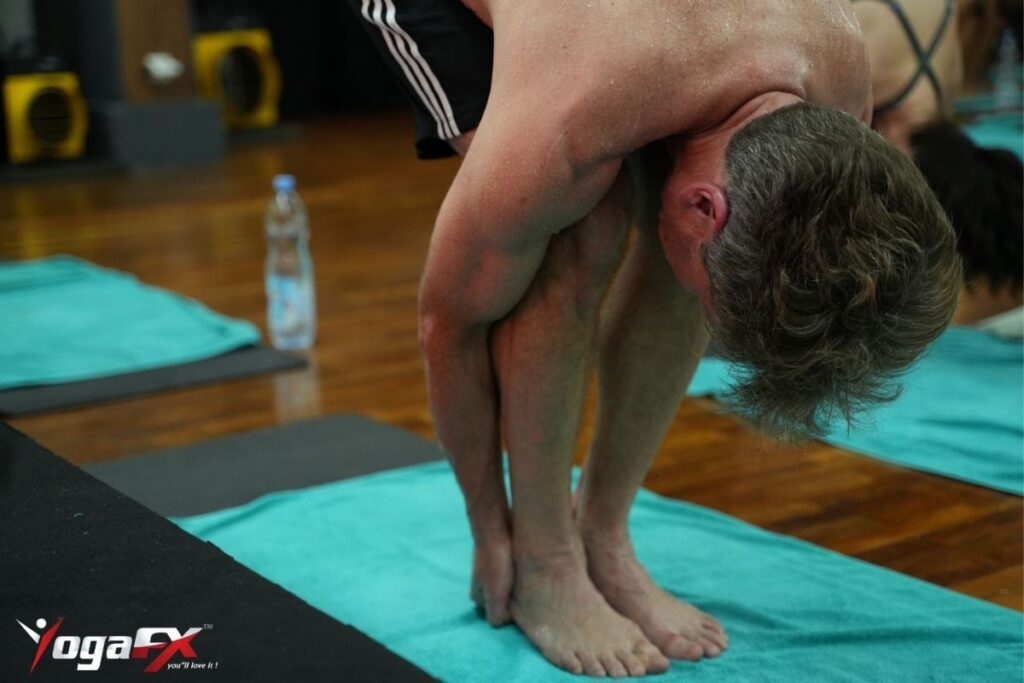
An authentic Bikram or 26 and 2 yoga class teaches exactly 26 postures and 2 breathing exercises in the same fixed order in every class. A studio or instructor that varies the sequence, adds postures from other traditions, or teaches a shortened selection is offering a hot yoga format, not the original Bikram method. The sequence is a physiological system — each posture prepares the body for the next, and the order is not interchangeable.
The Temperature and Humidity Specification
The room specification for authentic Bikram yoga is 40 degrees Celsius (105 degrees Fahrenheit) with 40 percent relative humidity. Both parameters matter. Most hot yoga studios control temperature but not humidity. Electric-heated rooms typically run at 15 to 25 percent humidity, which causes rapid sweat evaporation and incomplete deep tissue warming. The 40 percent humidity specification is functional, not incidental — it maintains core temperature in the therapeutic range for the full 90 minutes.
The Scripted Verbal Dialogue
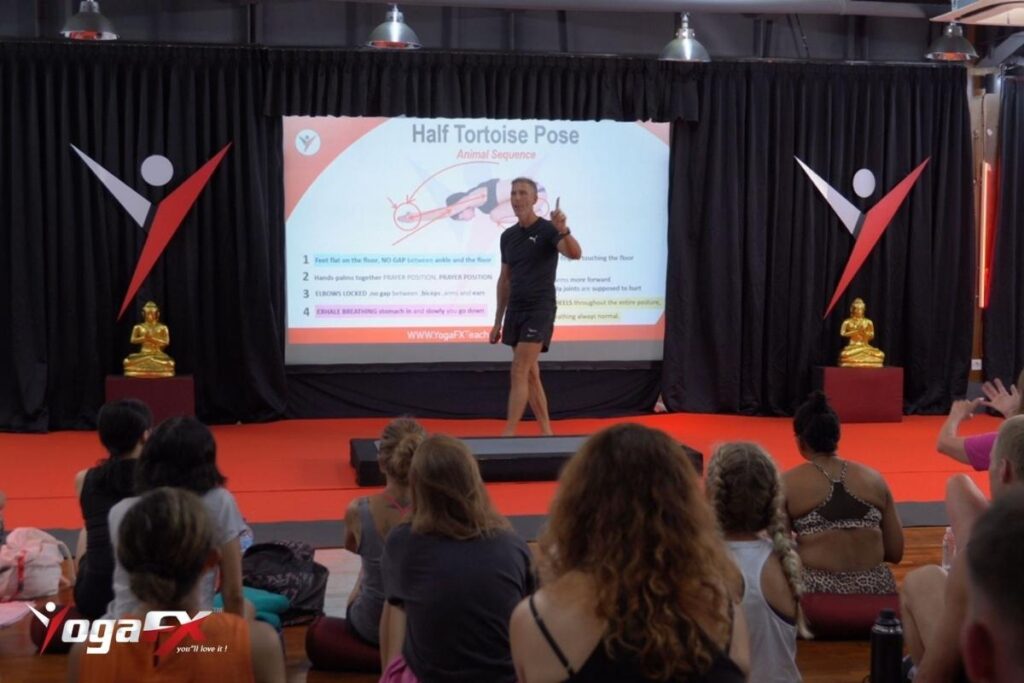
Certified Bikram instructors teach from a memorised script that covers every posture entry cue, hold cue, breathing instruction, and modification. The instructor does not practice alongside students. They stand at the front and deliver continuous verbal instruction. If the instructor is practicing on their mat or demonstrating postures rather than verbally instructing from the front, the class is not the authentic Bikram format.
The 90-Minute Duration
The complete Bikram sequence requires 90 minutes. Classes shorter than 90 minutes are abbreviated formats that omit portions of the floor series. Abbreviated formats exist for legitimate scheduling reasons and are offered at YogaFX in a 60-minute option. But if a studio's primary offering is a 45 or 60-minute class called Bikram yoga, they are not teaching the complete method.
How to Verify Instructor Credentials
The instructor is the most important quality variable in any Bikram yoga class. Verifying credentials takes less than five minutes and is worth doing before your first paid session.
| Credential | What It Means | How to Verify |
|---|---|---|
| Yoga Alliance RYT 200 | Completed 200 hours of teacher training from a Registered Yoga School. The baseline international credential for studio employment. | Search the instructor's name at yogaalliance.org/find-a-teacher |
| Bikram or 26 and 2 Certification | Completed style-specific training in the 26-posture sequence, dialogue, and Bikram methodology beyond general RYT 200 curriculum. | Ask the instructor which programme they attended and who trained them. |
| E-RYT 500 | Yoga Alliance highest designation, requiring 500+ hours training and 1,000+ teaching hours. Less than 5 percent of registered teachers hold this. | Search at yogaalliance.org — E-RYT designations are publicly visible. |
| Direct lineage credentials | Training completed under an instructor who trained directly with Bikram Choudhury or within one generation of the original method. | Ask the instructor about their lineage. Most credentialed instructors are transparent about this. |
| ACE Certification | American Council on Exercise fitness credential. Relevant for studios operating in fitness centre contexts. | Check acefitness.org trainer directory. |
At YogaFX, Mr. Ian Terry holds Yoga Alliance E-RYT 500, Bikram Hot Yoga Certification, and ACE. His lineage credentials include 5 direct training events with Bikram Choudhury between 2012 and 2019 in Bangkok, China, Spain, India, and Los Angeles, and 5 years as Choudhury's assistant teacher on large-scale events. This combination is verifiable and represents the most direct lineage connection available from an independently operating instructor in 2026.
How to Find Bikram Yoga Classes Near You
Use the Yoga Alliance Studio Finder
Yoga Alliance maintains a public directory of Registered Yoga Schools (RYS) at yogaalliance.org. Searching for studios in your area and filtering by style is the most reliable first step. Not all Bikram studios are Yoga Alliance registered, but those that are have met minimum curriculum standards and can be verified publicly.
Search for 26 and 2 Yoga, Not Just Bikram
Many studios that teach the authentic 26-posture sequence have rebranded away from the Bikram name after 2019. Searching for 26 and 2 yoga, original hot yoga, or hot 26 and 2 in addition to Bikram yoga will surface studios teaching the identical method under different names. The practice is the same; only the marketing terminology has changed.
Check the Studio's Class Description Carefully
A genuine Bikram or 26 and 2 studio will typically specify the 26-posture sequence explicitly in their class description. Generic descriptions like hot yoga class, heated flow, or warm yoga class indicate a variable-sequence format. The distinction matters because the physiological benefits documented in peer-reviewed research apply specifically to the fixed 26-posture sequence at the specified temperature and humidity — not to generic heated yoga formats.
Ask About Temperature and Humidity Before Booking
Call or message the studio and ask: what temperature and humidity do you maintain in your hot yoga room? A studio teaching authentic Bikram yoga will answer 40 degrees Celsius (105 degrees Fahrenheit) with 40 percent humidity without hesitation. A studio running a loosely heated room will give a range, express uncertainty, or answer only in terms of temperature. This single question identifies most authentic studios within 30 seconds.
Bikram Yoga Class Cost: What to Expect
| Location | Typical Drop-In Rate | Notes |
|---|---|---|
| New York City | $30 to $45 per class | Some premium studios charge above this range |
| Los Angeles | $28 to $40 per class | Higher competition keeps rates moderate despite high cost of living |
| London, UK | GBP 18 to 28 per class | Studio memberships significantly reduce per-class cost |
| Sydney, Australia | AUD 28 to 42 per class | Comparable to US major markets in USD equivalent |
| Mid-size US cities | $18 to $32 per class | Lower cost base makes consistent practice more accessible |
| Bali, Indonesia (YogaFX) | USD 9 to 18 per class | First class free for new visitors. Best value anywhere globally. |
Most studios offer introductory packages for new students: a first class free, or a one-week unlimited pass at reduced rates. These are standard across the Bikram yoga market and worth using to assess studio quality before committing to a membership. YogaFX Bali provides a free 1-day guest pass to all first-time visitors via WhatsApp — no conditions.
Monthly unlimited memberships are typically USD 80 to 150 in US and European markets. In Bali, the combination of lower class rates and lower cost of living makes a week of daily practice cost approximately what a single week of studio membership costs in a Western market.
What to Expect in Your First Bikram Yoga Class
Arriving at the Studio
Arrive 15 minutes before class starts. This gives time to register as a new student, set up your space, and begin acclimatising to the room temperature before class begins. You will need: a yoga mat, a large non-slip mat towel (essential from session 1 — you will sweat enough to make a bare mat dangerous for balance postures), at least 1 litre of water, and moisture-wicking close-fitting clothing. Cotton t-shirts become extremely uncomfortable within 10 minutes in a heated room.
The First 20 Minutes
The opening Pranayama (standing deep breathing) lasts approximately 5 minutes. The standing series begins with Half Moon Pose (posture 1) and builds through 12 postures of escalating cardiovascular demand. The first 15 to 20 minutes feel the most overwhelming for new practitioners. This is heat adaptation in progress. The body is managing thermoregulation simultaneously with unfamiliar posture demands. This phase passes.
Every certified Bikram instructor expects some new practitioners to need rest during the first few classes. Lying flat in Savasana on your mat is the correct response to heat overwhelm — more beneficial than pushing through incorrectly, and significantly more beneficial than leaving the room. The room itself provides the therapeutic environment; being in it, even resting, is valuable.
The Standing to Floor Transition
After the 12th standing posture (Toe Stand), the class transitions to a mandatory Savasana of at least 2 minutes. The cardiovascular system redistributes blood from the periphery to the core organs, heart rate begins to descend, and the body prepares for the different demands of the floor series. New practitioners often feel a wave of relief at this point — the cardiovascular peak of the class has passed.
The Floor Series
The floor series feels different from the standing series: the cardiovascular demand is lower, the postures work different tissues (primarily the posterior chain and deep spinal musculature), and the compression-and-release mechanism of the prone backbends provides organ stimulation that the standing series does not. Most new practitioners find the floor series more manageable than the standing series in their first class.
After Class
Rehydrate immediately after class — water and electrolytes (sodium and potassium) replace what sweating removed. Expect to feel tired and somewhat spacey for 30 to 60 minutes after your first class. Most practitioners describe feeling better — clearer, calmer, and physically lighter — after the initial recovery period. The sensation is distinctive enough that it has a colloquial name in the Bikram community: the Bikram glow.
The Bali Option: YogaFX in Natural Heat
For practitioners who have the opportunity to practice in Bali, YogaFX in Seminyak and Canggu offers something unavailable anywhere else in the world: the complete 26-posture Bikram sequence in natural tropical heat without electric heaters.
| Feature | Typical Bikram Studio | YogaFX Bali |
|---|---|---|
| Heat source | Electric heaters | Natural Bali tropical climate — no electric heaters |
| Humidity | 15 to 25 percent (dry heat) | Above 70 percent ambient (humid heat) |
| Temperature | 40°C (artificial) | 40°C (natural) |
| Sequence | 26 postures, fixed order | 26 postures, fixed order — identical method |
| Drop-in cost | $18 to $45 depending on market | USD 9 to 18. First class free. |
| Lead instructor | Variable credentials | Mr. Ian Terry, E-RYT 500, 5 direct Choudhury training events |
| Certifications offered | Varies by studio | RYT 200 + Bikram Certification, USD 1,699 |
Studio Authenticity Checklist
✅ Use This Checklist When Evaluating Any Studio
- Sequence: teaches exactly 26 postures and 2 breathing exercises in the same fixed order every class
- Temperature: maintains 40°C (105°F) with 40 percent humidity — both specified
- Duration: 90-minute primary class format (60-minute abbreviated formats acceptable if 90 is also available)
- Instruction: scripted verbal dialogue — instructor does not practice alongside students
- Instructor credentials: Yoga Alliance RYT 200 verifiable at yogaalliance.org
- Style certification: documented Bikram or 26 and 2 training from a named programme
- Lineage transparency: instructor can explain who trained them and their connection to the method
- First class policy: genuine studios typically offer a free or heavily discounted first class
- Class description: explicitly mentions 26 postures or 26 and 2 — not just hot yoga or heated yoga
- Temperature question: when asked directly, gives specific answer of 40 degrees C and 40 percent humidity
FAQ
How do I find authentic Bikram yoga classes near me?
Search for 26 and 2 yoga, original hot yoga, or Bikram yoga in your area. Check the studio's class description for explicit mention of the 26-posture fixed sequence. Verify the lead instructor's credentials at yogaalliance.org. Call and ask what temperature and humidity the studio maintains — 40 degrees C with 40 percent humidity is the authentic specification. Studios that answer this confidently and specifically are likely teaching the real method.
What should I bring to my first Bikram yoga class?
The essentials: a large non-slip yoga mat towel (this is not optional — you will sweat enough to make a bare mat unsafe for balance postures), a yoga mat, at least 1 litre of water (pre-hydrate heavily throughout the day before class), and moisture-wicking clothing that fits close to the body. Shorts and a sports bra or fitted top for women; shorts for men. Arrive 15 minutes before class to acclimatise to the room temperature.
How much does a Bikram yoga class cost?
Drop-in rates range from approximately USD 18 to 45 in major Western markets, with London and New York at the higher end and mid-size US cities at the lower end. Monthly unlimited memberships typically run USD 80 to 150. In Bali, YogaFX drop-in rates are USD 9 to 18 with a free first class for new visitors. Most studios offer introductory packages or first-class-free policies for new students.
Is my first Bikram yoga class going to be hard?
Yes, but the difficulty is primarily the heat adaptation, not the postures. The first 20 minutes of the standing series, before heat tolerance begins to develop, is the peak challenge. Most practitioners who stay in the room for their first complete class are surprised they finished it. Lying in Savasana when overwhelmed is the correct technique — it is not failure. The class that feels like survival in session 1 becomes manageable by session 5 to 7 for most practitioners.
Can beginners take Bikram yoga classes?
Yes. The scripted verbal dialogue provides complete instruction for every posture — practitioners follow the instructor's voice and do not need to know the sequence in advance. Every posture has modifications that the dialogue covers. The same class accommodates all levels because progress is measured by posture depth within the fixed sequence, not by advancing to more complex postures. The primary beginner challenge is heat adaptation, which develops progressively across the first 5 to 10 sessions.
How often should I attend Bikram yoga classes?
The research protocols that documented Bikram yoga's benefits used 3 to 4 sessions per week. This frequency produces measurable strength gains (20 percent over 8 weeks), flexibility improvement, and cardiovascular conditioning. Two sessions per week produces meaningful benefit for practitioners with time constraints. Daily practice is sustainable for committed students once heat adaptation is established, typically after 10 sessions.
What is the difference between Bikram yoga classes and regular hot yoga classes?
Authentic Bikram yoga classes teach a fixed 26-posture sequence at 40 degrees C with 40 percent humidity for 90 minutes with scripted verbal instruction. Hot yoga classes in general use variable instructor-designed sequences in heated rooms at variable temperatures and humidity. The peer-reviewed research documenting Bikram yoga's specific outcomes — calorie burn, strength gains, depression reduction — was conducted on the fixed-sequence, specific-temperature Bikram format, not on generic hot yoga.