
In a 40°C room with 40% humidity, What to Wear to Bikram Yoga matters more than in almost any other exercise environment. The wrong fabric makes the session significantly more uncomfortable than it needs to be. The right gear is almost invisible — you stop thinking about it within the first five minutes of class.
This guide covers exactly what works, what does not, and what to bring to your first Bikram yoga class — for both men and women — based on decades of observation from inside the hot room.
For Bikram yoga, wear the minimum amount of moisture-wicking, form-fitting clothing you are comfortable in. Women: a sports bra and shorts, or a fitted crop top and shorts. Men: compression shorts or brief athletic shorts. Avoid loose fabric and cotton entirely. Bring: 1 litre of water minimum (pre-hydrate all day), a large non-slip yoga mat towel, a full-size yoga mat, and a change of clothes. Cotton becomes saturated within 10 minutes in a hot room — every practitioner learns this once.
The Core Rule: Less Is More in a Hot Room
The most common mistake first-time Bikram practitioners make is wearing too much. In a room heated to 40°C with high humidity, loose cotton t-shirts and baggy shorts become heavy and uncomfortable within minutes. The heat and sweat saturate fabric quickly — saturated loose fabric creates friction, bunching, and constant distraction. You adjust your clothing instead of focusing on the postures.
Your choice of bottoms can make or break your focus when you start sweating heavily. Investing in the best shorts for Bikram yoga ensures you aren't constantly pulling at your clothes during floor poses.
Experienced practitioners in any Bikram studio wear close to the minimum viable coverage. This is not vanity — it is practicality. The less fabric in the room, the less you think about it.
Women: What to Wear to Bikram Yoga
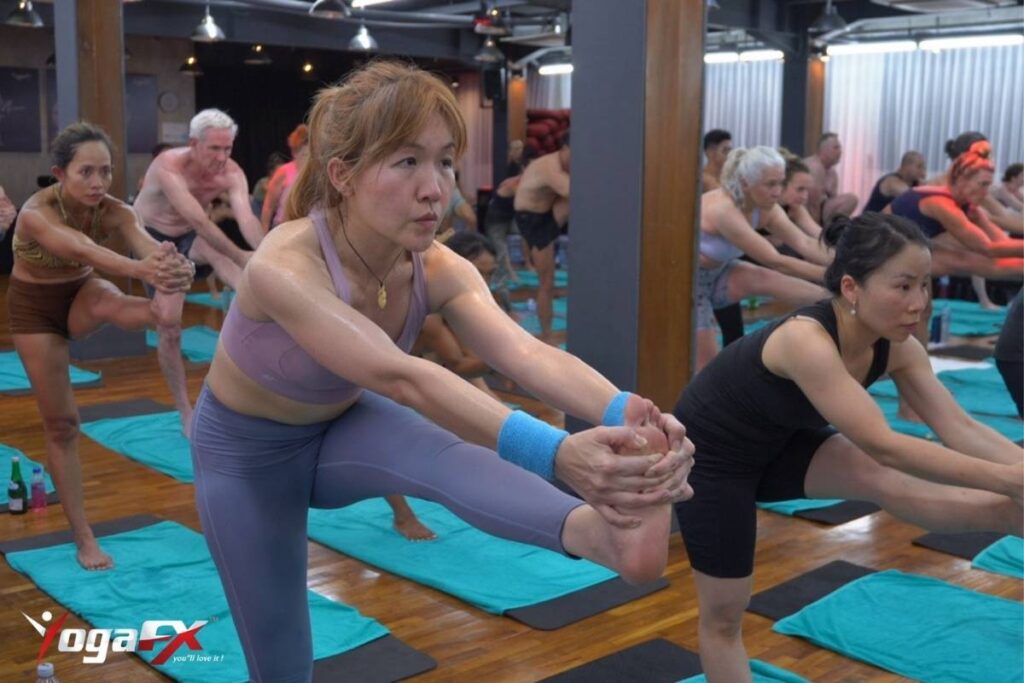
Best Option: Sports Bra + Shorts
A fitted sports bra and above-the-knee shorts is the most practical Bikram yoga outfit for women. The sports bra moves with the body in all postures including floor backbends and forward folds, and eliminates the distraction of excess fabric. Shorts should sit at mid-thigh — above the knee is the practical standard.
Alternative: Fitted Crop Top + Shorts
If a sports bra alone is too minimal, a fitted moisture-wicking crop top works well. It must stay in place during Standing Bow, Camel Pose, and the floor series without needing readjustment. A top that rides up is more distracting than no top at all.
What to Avoid — Women
- Cotton anything — absorbs sweat heavily, saturates within 10 minutes, adds unnecessary weight
- Loose t-shirts — bunches and shifts during floor postures
- Loose shorts — fabric gaps in Eagle Pose and Fixed Firm are uncomfortable
- Full-length leggings — unnecessarily warm in 40°C; capri length is the maximum practical
- New gear for the first class — test-drive clothing in another workout before bringing it into the hot room
Men: What to Wear to Bikram Yoga
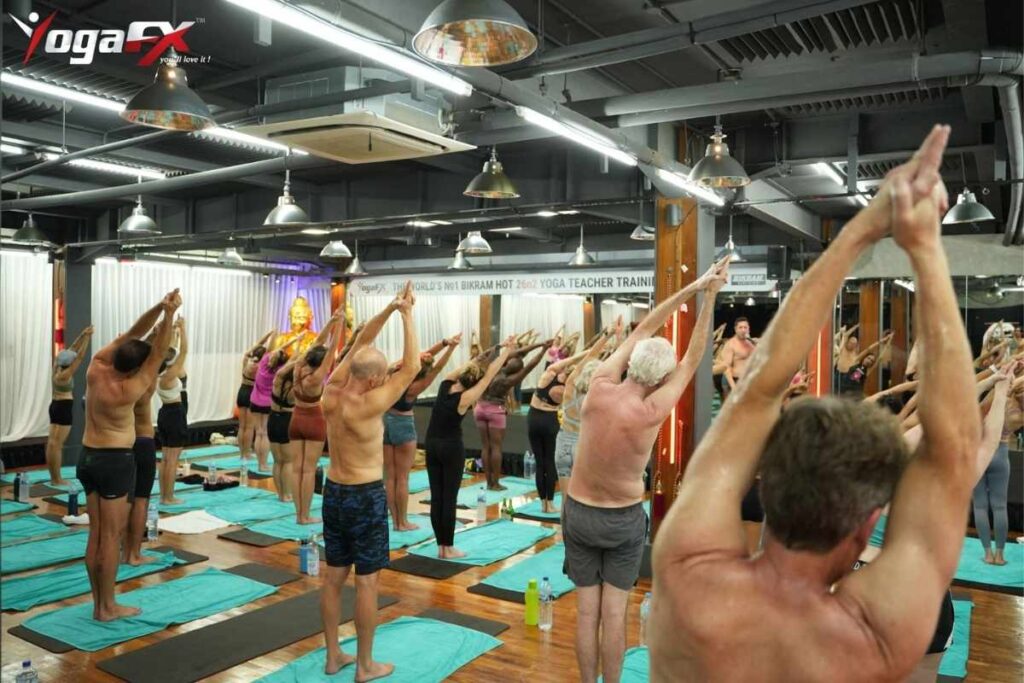
Best Option: Compression Shorts or Brief Shorts
Most male Bikram practitioners globally What to Wear to Bikram Yoga compression shorts or short athletic shorts. Compression shorts stay in place through all postures including Eagle Pose (both legs wrapped) and Fixed Firm Pose (kneeling backbend), and manage sweat more effectively than looser alternatives.
Alternative: Fitted Athletic Shorts (Above the Knee)
Fitted athletic shorts that sit above the knee work well if compression shorts feel too minimal. They must stay in position during Eagle Pose and Triangle Pose. Shorts that bunch or ride up in these postures are the most common clothing complaint in the hot room.
What to Avoid — Men
- Long board shorts — excess fabric becomes heavy with sweat and restricts range of motion
- Cotton t-shirts — most male practitioners remove them within the first few classes; skip the step
- Loose basketball shorts — too much fabric, rides up in floor postures
- Underwear under compression shorts — redundant layer that adds heat and friction
Fabric What to Wear to Bikram Yoga Guide
| Fabric | Sweat Management | Comfort in Heat | Verdict |
|---|---|---|---|
| Moisture-wicking polyester/nylon | Excellent | Excellent | ✅ Best — wicks away from skin |
| Compression fabric (spandex blend) | Very good | Very good | ✅ Excellent — stays in place |
| Bamboo fabric | Good | Good | ✅ Acceptable — softer, less odour resistant |
| Cotton blend (50/50) | Adequate | Adequate | ⚠️ Borderline — better than pure cotton |
| Cotton | Poor | Poor | ❌ Avoid — retains sweat, becomes heavy |
| Wool / linen | Poor | Very poor | ❌ Never — designed for dry cool environments |
What to Bring to Bikram Yoga: Complete Checklist
Essential — Do Not Arrive Without These
- Water — minimum 1 litre. Pre-hydrate throughout the entire day before class. Arrive already hydrated, not hoping to hydrate during class. Most experienced practitioners bring 1.5–2 litres.
- Large yoga mat towel. Full-length, non-slip, covers the entire mat. You will need it. Standard hand towels are completely inadequate.
- Yoga mat. Full-size. Mat hire is available at YogaFX if needed.
- Change of clothes for after. You will be completely soaked. Dry clothing after class is not optional — it is basic planning.
Useful — Worth Bringing
- Small face towel — for wiping sweat during postures
- Flip flops or sandals — for the changing room and shower area
- Electrolytes — small supplement or drink for post-class rehydration
Leave at Home
- Jewellery — rings and bracelets become uncomfortable quickly in heat
- Strong perfume or cologne — in a closed hot room, fragrances become overwhelming for others
- Phone — leave it in your locker; the hot room is phone-free
- Socks — barefoot throughout; socks create slipping risk on a sweat-covered mat
📋 First Class at YogaFX Bali — What to Expect
- Arrive 15 minutes early to acclimatise before class starts
- Inform the instructor it is your first class — you will receive specific first-class guidance
- Rest in Savasana whenever needed — staying in the room matters more than completing every posture
- Do not leave the room during class — staying in the heat, even resting, is more beneficial than exiting
- Free 1-Day Guest Pass for all first-time visitors — claim via WhatsApp before attending
What NOT to Worry About
Every person in the room is focused on their own posture, their own breathing, and their own survival in the heat. Nobody is looking at you. YogaFX operates on a zero-ego, zero-intimidation principle — practitioners from every country, age group, body type, and experience level practice here. There is no yoga culture gatekeeping.
If you arrive in moisture-wicking shorts and a sports bra, or compression shorts, you are dressed appropriately. If you arrive in cotton shorts and a t-shirt for your first class because you did not know better — every practitioner in the room has been there.
FAQ
Can I wear a full-length t-shirt to Bikram yoga?
You can — nothing stops you. A cotton t-shirt will be saturated with sweat within 10–15 minutes in a 40°C room and will likely become uncomfortable enough that you consider removing it mid-class. A moisture-wicking fitted top is more viable. For your first class, What to Wear to Bikram Yoga makes you comfortable — the fabric lesson is one most practitioners learn by experience rather than advice.
What do Bikram yoga beginners typically wear?
First-timers tend to arrive in more clothing than experienced students — typically a t-shirt and longer shorts — and progressively move toward less clothing as they become comfortable with the heat. Experienced practitioners almost universally What to Wear to Bikram Yoga the minimum: sports bra and shorts for women, compression or brief shorts for men. The transition happens naturally at your own pace.
Is there a dress code at Bikram yoga studios?
Most Bikram studios including YogaFX Bali have a practical rather than formal dress code: appropriate athletic clothing that allows full range of motion. No colour requirements, no uniform. The unwritten standard is moisture-wicking and close-fitting — but this is practical advice, not a rule. No instructor will turn you away for wearing cotton to your first class.
What should I wear if I am self-conscious about my body?
What to Wear to Bikram Yoga are comfortable in — the only functional requirement is moisture-wicking fabric and enough range of motion for the postures. The heat and physical demand of the sequence eliminate self-consciousness quickly. There is too much else to focus on. The zero-ego culture at YogaFX means nobody is looking at your body. They are too busy managing their own.
Do I need special yoga socks for Bikram?
No. Bikram yoga is practiced barefoot. Socks create a slipping risk on a sweat-covered mat and are not worn by any practitioner in a standard Bikram class. Bare feet are the only appropriate option.
Can I wear leggings to Bikram yoga?
Full-length leggings are technically wearable but unnecessarily warm in a 40°C room. If you prefer leg coverage, capri-length leggings (below the knee) in moisture-wicking fabric are the practical maximum. Most practitioners who arrive in full leggings switch to shorts within a few classes — the heat makes the choice obvious.