
Bikram yoga and Vinyasa yoga are compared so frequently that a popular wellness website currently holds the featured snippet for "Is Vinyasa or Bikram better?" with a claim that a skilled Vinyasa practitioner will be both stronger and more aerobically fit than a Bikram practitioner. That claim is more nuanced than its source suggests. Both halves of it require specific examination against what the research actually shows.
Bikram yoga vs Vinyasa yoga: the research base is asymmetric. Bikram has three peer-reviewed studies with direct metabolic measurement (UW 2014), documented strength gains (Tracy and Hart 2013), and a randomised controlled trial on depression (Harvard MGH 2023). Vinyasa has no equivalent direct measurement studies. On strength: Vinyasa wins on upper body (chaturanga transitions); Bikram wins on lower body and posterior chain (documented 20 percent deadlift increase). On cardiovascular fitness: the Bikram data shows 80 percent of maximum heart rate sustained throughout — no equivalent Vinyasa measurement exists for direct comparison.
Side-by-Side Bikram Yoga vs Vinyasa Yoga Comparison
| Dimension | Bikram Yoga (26 and 2) | Vinyasa Yoga |
|---|---|---|
| Sequence | Fixed: 26 postures, identical every class globally | Variable: instructor-designed, changes every class |
| Temperature | 40°C, 40% humidity — mandatory | Room temperature or lightly heated (up to 35°C in hot Vinyasa) |
| Movement style | Static holds: 10 to 20 seconds per posture | Dynamic flow: breath-linked continuous movement |
| Music | No music — silence except verbal dialogue | Usually music; instructor's choice |
| Cardiovascular demand | 80 percent max HR sustained throughout (UW 2014) | Variable — depends on class intensity |
| Calorie burn (90 min) | 333 to 460 kcal — direct measurement (UW 2014) | Estimated 300 to 500 kcal — no equivalent direct study |
| Upper body strength | Limited — standing series primarily | High — chaturanga transitions build chest, shoulder, tricep |
| Lower body strength | High — Awkward Pose, Eagle, standing series | Moderate — from flow transitions |
| Progress tracking | Direct — same sequence, measurable session to session | Difficult — variable sequence prevents direct comparison |
| Beginner accessibility | High — verbal dialogue requires no prior knowledge | Variable — depends on instructor and class level |
| Research base | 3 major peer-reviewed studies (UW 2014, T&H 2013, Harvard 2023) | Limited — general yoga research, no equivalent specific RCTs |
| Teacher training | Scripted dialogue: teachable from certification day one | Sequencing skill requires 1 to 2 years to develop confidently |
The "Stronger and More Aerobically Fit" Claim: Examined
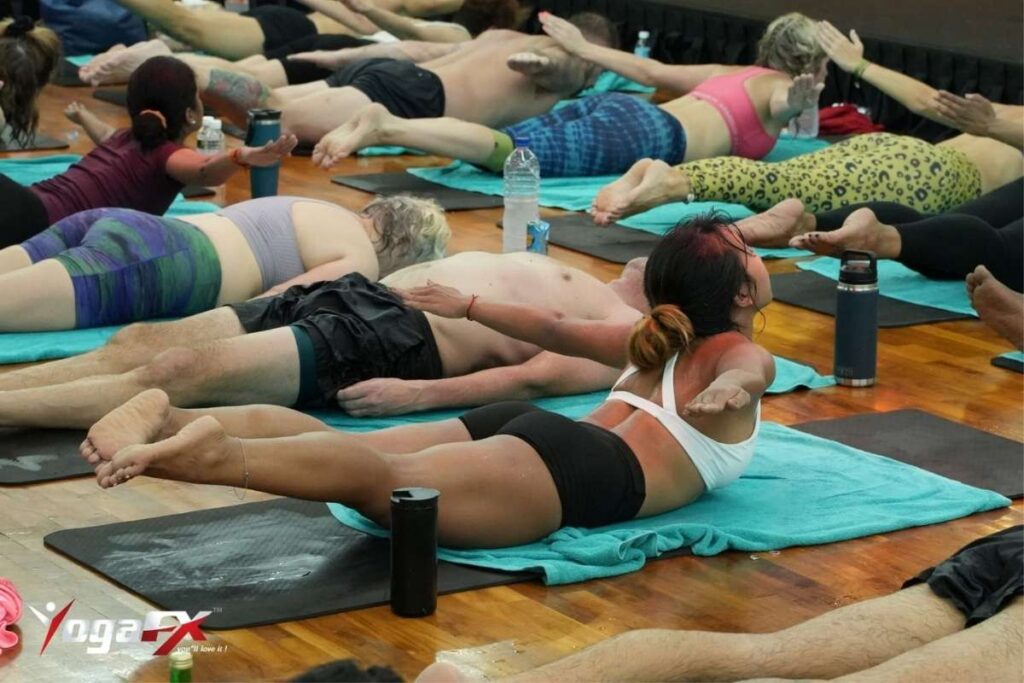
On Strength
Vinyasa builds superior upper body strength through the chaturanga push-up transition that links every pose sequence. Chaturanga is essentially a triceps push-up performed at body weight, repeated dozens of times per class. Consistent Vinyasa practice produces genuine chest, shoulder, and tricep development that Bikram does not specifically develop.
Bikram builds superior lower body and posterior chain strength. The Tracy and Hart (2013) study (PubMed: 23438366) documented a 20 percent deadlift strength increase after 8 weeks — in the posterior chain muscles (gluteus maximus, hamstrings, spinal erectors) that Vinyasa does not load as specifically. The standing series of Bikram, particularly Awkward Pose (6 total sets of quadricep and adductor loading), produces lower body conditioning that most Vinyasa formats do not match.
The correct statement: Vinyasa produces better upper body strength; Bikram produces better lower body and posterior chain strength. Combining both produces more complete body strength than either alone. The claim that Vinyasa practitioners will be comprehensively stronger is not accurate.
On Aerobic Fitness
The University of Wisconsin 2014 study (Porcari et al., PubMed: 24700459) directly measured heart rate and metabolic output during actual 90-minute Bikram classes. Heart rate averaged 80 percent of maximum throughout. Active participants reached 90 to 94 percent of maximum at the cardiovascular peak postures. This represents sustained moderate-to-vigorous cardiovascular exercise for 90 minutes.
No equivalent peer-reviewed study has directly measured heart rate and metabolic output during a Vinyasa class under comparable conditions. The claim that Vinyasa practitioners will always be more aerobically fit than Bikram practitioners is not supported by the comparative evidence base.
Calorie Burn: What the Data Actually Shows
| Practice | Calorie Burn Data | Source Quality |
|---|---|---|
| Bikram yoga (90 min) | 333 kcal women (avg 68kg); 460 kcal men (avg 82kg). Active participants: 600+ kcal. | Direct measurement via indirect calorimetry during actual classes (UW 2014). Highest quality. |
| Vinyasa yoga (60 min) | Estimated 300 to 500 kcal depending on intensity and duration. | No equivalent direct measurement study. Estimates from general yoga research and heart rate monitoring. |
| Hot Vinyasa (60 min, heated) | Estimated 350 to 500 kcal. | No direct measurement study specific to hot Vinyasa conditions. |
For weight loss: both practices produce meaningful calorie burn at comparable rates per session. Bikram additionally documents lean muscle gain (Tracy and Hart 2013) which increases resting metabolic rate for between-session calorie burning. For body composition, combining both produces more complete results than either alone.
Flexibility: Why Heat Is the Decisive Factor
The 40-degree Celsius environment of Bikram yoga reduces muscle viscosity and connective tissue resistance before any stretching begins. The Tracy and Hart (2013) study documented significant lower back and hamstring flexibility gains after 8 weeks at 3 to 4 sessions per week.
Vinyasa yoga improves flexibility through active movement and dynamic stretching within flow sequences. The gains are real but slower-developing than in the heat environment, because room-temperature connective tissue requires more sustained loading to produce the same extensibility changes. For practitioners with significant hip flexor, hamstring, or thoracic mobility restrictions: Bikram produces faster early flexibility gains.
What Heat Actually Does: The Physiological Case
Most Bikram vs Vinyasa comparisons treat heat as a preference — some people like it, some don't. This misses the physiological significance. At 40 degrees Celsius with 40 percent humidity, four specific changes occur that are absent in a room-temperature Vinyasa class:
- Muscle viscosity decreases — muscles move through their range with less internal resistance
- Connective tissue extensibility increases — tendons, ligaments, and fascia become more pliable
- Synovial fluid viscosity decreases — joint mobility improves across all joints simultaneously
- Cardiovascular demand increases — thermoregulatory work adds significant metabolic load independent of the physical postures
Hot Vinyasa partially reproduces these effects but typically at lower temperatures (32 to 38 degrees Celsius) and without humidity specification. The documented research outcomes for Bikram yoga were measured under the full specification conditions.
Teacher Training Bikram Yoga vs Vinyasa Yoga: The Career Difference
| Dimension | Bikram / 26 and 2 Teaching | Vinyasa Teaching |
|---|---|---|
| Core teaching skill | Scripted dialogue mastery — memorised verbal instruction covering all 26 postures | Creative sequencing — designing new class sequences, often spontaneously |
| Ready to teach from day one? | Yes — the dialogue provides the complete instructional framework | Partial — scripting an effective 60-minute flow sequence takes time to develop |
| Salary premium | Hot yoga specialist: 15 to 25 percent above general RYT 200 rates | General RYT 200 rate at most studios |
| YogaFX credential advantage | RYT 200 + Bikram Certification + ACE — three credentials for USD 1,699 | Not available at YogaFX — Bikram-specific programme |
For Beginners: Which to Start With
For complete beginners with no yoga experience: Bikram's verbal dialogue is specifically more accessible than Vinyasa's combination of demonstration and instruction. The scripted dialogue provides one clear source of information rather than two simultaneous inputs (watching and listening). The heat is harder; the instruction is clearer. The fixed sequence means every class is identical — there is nothing to catch up to.
Vinyasa yoga for beginners: the movement is more intuitive for many because it mirrors how bodies naturally move between positions. The visual demonstration component allows beginners to follow by watching when verbal instruction is unclear. But class quality varies significantly by instructor, and a poorly designed beginner Vinyasa class can produce confusion or injury in ways that the Bikram scripted dialogue specifically prevents.
Combining Bikram Yoga vs Vinyasa Yoga Practices
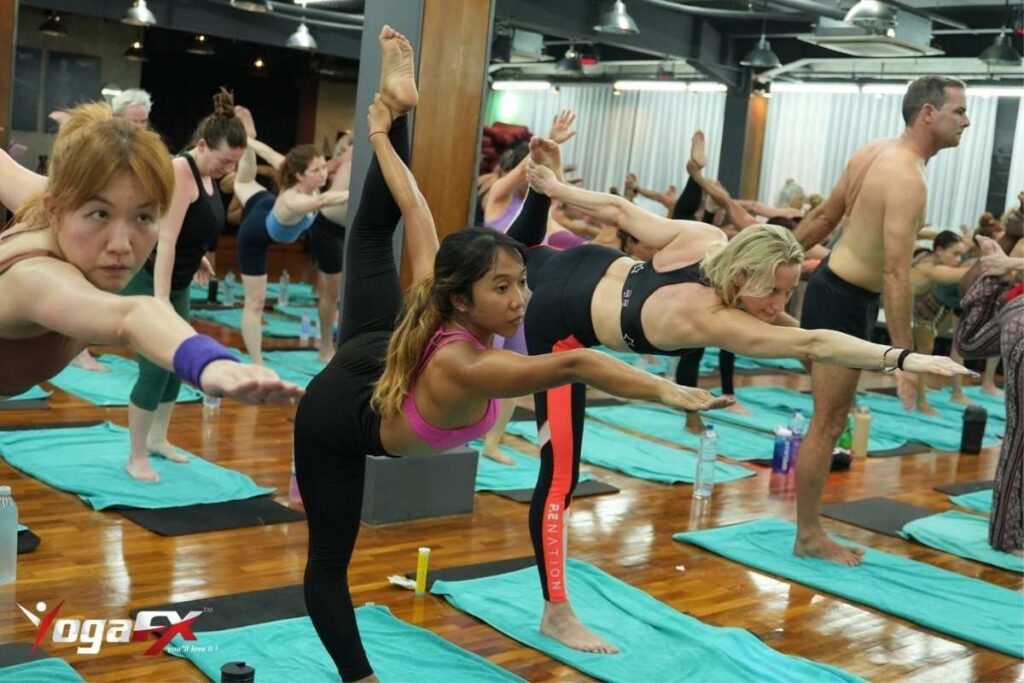
The most effective approach for serious practitioners is not choosing one but combining them. Bikram provides: heat-enhanced flexibility gains, lower body and posterior chain strength, documented cardiovascular conditioning, spinal decompression across all planes, and the mental health effects documented by Harvard MGH 2023. Vinyasa provides: upper body strength from chaturanga transitions, arm balance and inversion development, creative sequencing variety, and a practice that works in any room without heat infrastructure.
Practical combination: Bikram 3 times per week for primary conditioning and documented outcomes; Vinyasa once or twice per week for upper body and variety. Most practitioners who commit to this schedule for 8 weeks report that their Bikram postures improve from the upper body stability gained in Vinyasa, and their Vinyasa practice improves from the flexibility gains of the Bikram heat environment.
Decision Bikram Yoga vs Vinyasa Yoga Framework
| Your Goal | Better Practice | Reason |
|---|---|---|
| Documented calorie burn with research evidence | Bikram | Direct measurement 333 to 460 kcal — no equivalent Vinyasa data |
| Upper body strength (chest, shoulders, triceps) | Vinyasa | Chaturanga transitions — Bikram does not match this |
| Lower body and posterior chain strength | Bikram | Awkward Pose standing series + documented 20 percent deadlift increase |
| Fastest flexibility gains | Bikram | Heat-enhanced connective tissue extensibility — room temperature cannot match the rate |
| Depression and mental health (documented) | Bikram | Harvard MGH 2023 RCT — no equivalent Vinyasa study exists |
| Variety and creative class experience | Vinyasa | New sequence every class — Bikram is identical every session |
| Progress measurement over time | Bikram | Fixed sequence: same postures every class, improvement directly comparable |
| Career as teacher — fastest start | Bikram | Scripted dialogue: teach complete class from day one of certification |
| Comprehensive body conditioning | Combine both | Bikram: lower body, heat flexibility, mental health. Vinyasa: upper body, variety. |
FAQ
Is Bikram yoga better than Vinyasa?
Neither is universally better. Bikram is better for documented cardiovascular outcomes, heat-enhanced flexibility gains, lower body strength, progress tracking, and mental health effects backed by peer-reviewed research. Vinyasa is better for upper body strength development, class variety, and a less structured environment. For comprehensive body conditioning, combining both produces better results than either alone.
Which is harder, Bikram or Vinyasa?
Different rather than simply harder. Bikram is harder thermally: the 40-degree Celsius environment sustained for 90 minutes produces a physiological challenge that cardiovascular fitness does not prepare you for. Vinyasa is harder in terms of upper body demands (chaturanga transitions) and cognitive complexity (following variable sequences). A beginner Vinyasa class is less demanding than any Bikram class. An advanced power Vinyasa class is comparable in intensity to Bikram through different mechanisms.
Is Bikram yoga or Vinyasa better for weight loss?
Both produce comparable calorie burn per session. Bikram's 333 to 460 kcal per 90-minute session is directly measured (UW 2014); Vinyasa estimates range from 300 to 500 kcal without equivalent direct measurement. Bikram additionally documents lean muscle gain that increases resting metabolic rate. For weight loss, the practice you will sustain consistently is better than the practice that is marginally superior in calorie count.
Can I practice Bikram and Vinyasa in the same week?
Yes. The two practices are physiologically complementary. Bikram provides the posterior chain loading, heat flexibility, and spinal decompression that Vinyasa does not. Vinyasa provides the upper body push-pull strength that Bikram does not. Practical schedule: Bikram 3 times per week, Vinyasa once or twice. Allow at least one rest day between intense sessions of either format.
Does Bikram yoga have more benefits than Vinyasa?
Bikram has a more specific and rigorous peer-reviewed research base. Three major studies (UW 2014, Tracy and Hart 2013, Harvard MGH 2023) document specific outcomes under measured conditions. Vinyasa benefits are real but less specifically documented — not because Vinyasa is less beneficial, but because the fixed sequence and controlled conditions of Bikram make it more precise to study.
Why is Bikram yoga 90 minutes while Vinyasa is usually shorter?
The 90-minute duration of Bikram is a physiological requirement, not a scheduling choice. The floor series — which delivers the deepest spinal work and therapeutic benefits — requires the complete 45-minute standing series to have pre-heated the body before it functions as designed. Vinyasa can be effectively delivered at any duration because its variable sequence can be expanded or contracted without a fixed architectural dependency.