
Bikram yoga has a documented effect on skin appearance. Practitioners who practice consistently for 4 to 8 weeks commonly report clearer skin, improved tone, reduced pore visibility, and a post-class glow that room-temperature exercise does not produce at the same intensity. These improvements are real and have physiological explanations.
The full picture also includes concerns that the wellness content industry rarely mentions: dehydration-related skin problems if fluid intake is inadequate, the potential for heat-induced flushing in practitioners with rosacea or sensitive skin, and the question of whether Bikram Yoga Skin Benefits ages the skin over years of practice. This article covers both sides honestly.
Bikram yoga improves skin primarily through four mechanisms: increased circulation delivering more oxygen and nutrients to skin cells, deep sweating that clears sebum and debris from pores, cortisol reduction that reduces stress-related inflammation, and improved sleep quality which is when most skin repair occurs. The "Bikram glow" reported by practitioners is real — it is the combined effect of these mechanisms visible immediately post-class. The aging concern from extended practice is addressable through post-class skincare protocol and adequate hydration. Most practitioners report skin improvement, not deterioration, from consistent practice.
What Actually Happens to Your Skin During a Bikram Class
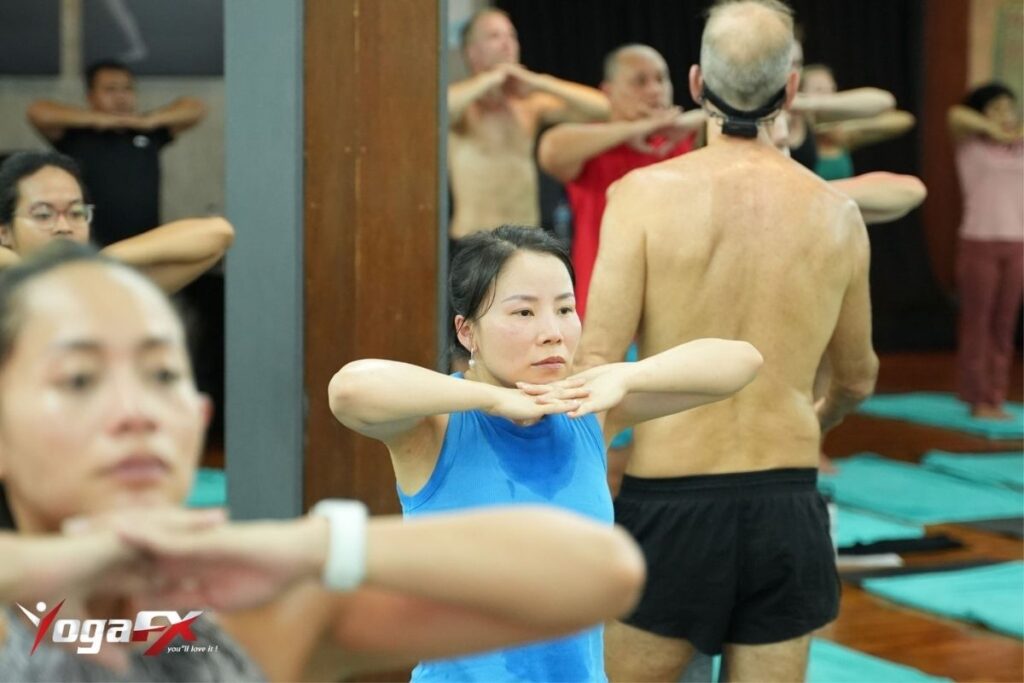
Understanding the physiological mechanisms separates the documented effects from the marketing claims. Four things happen to skin specifically during 90 minutes in a 40-degree Celsius room.
1. Increased Circulation: Oxygen and Nutrients to Skin Cells
The University of Wisconsin 2014 study (PubMed: 24700459) documented average heart rate at 80 percent of maximum throughout a Bikram session. This sustained cardiovascular elevation drives significantly increased blood flow to peripheral tissues including the skin. Blood delivers oxygen and nutrients to skin cells and removes cellular waste products. The skin improvement from improved circulation is the same mechanism that underlies the cardiovascular fitness benefits of aerobic exercise — applied to the skin as an organ.
Better circulation produces: more even skin tone from consistent oxygen delivery to all skin cell layers, faster cellular turnover from improved nutrient availability, reduced dullness from better waste product removal, and the temporary flushing and glow that is visible immediately post-class.
2. Sweating: Pore Clearing and Not Quite "Detox"
The honest version of the sweating-skin claim requires a distinction that most hot yoga content avoids making. Sweat itself is primarily water, sodium, and potassium. The kidneys and liver perform the body's primary detoxification functions. Sweat glands are not a significant organ of toxin elimination.
What sweating does do for skin: it clears sebum (natural skin oil), dead skin cells, and environmental debris from pore openings. Sebum accumulation in pores creates the congestion that contributes to blackheads and some acne. The sustained sweating of a Bikram class flushes pore openings more thoroughly than normal perspiration because the volume and duration of sweat production is significantly higher.
The practical result is the same as the marketing claim describes — clearer pores and reduced breakouts — but the mechanism is mechanical clearing rather than toxin elimination. This distinction matters because it also explains the post-class skincare requirement: if sweat is not rinsed off promptly, the sebum and debris it has mobilised can redeposit on the skin surface.
3. Cortisol Reduction: Stress and Skin
The Harvard MGH 2023 randomised controlled trial (Nyer et al., PubMed: 37883245) documented significant depression reduction from Bikram yoga practice. The proposed mechanism includes cortisol normalisation from sustained heat exposure and the parasympathetic recovery of the floor series and Savasana. Cortisol is directly relevant to skin health: elevated cortisol triggers sebum overproduction, impairs skin barrier function, reduces wound healing speed, and contributes to inflammatory skin conditions including acne, eczema flares, and psoriasis.
Practitioners who report that their acne improved significantly with consistent Bikram practice are typically experiencing the combined effect of pore clearing (from sweating) and cortisol reduction (from the stress-modulating effects of the practice). Both mechanisms operate simultaneously.
4. Sleep Quality and Skin Repair
Most skin cell repair, collagen synthesis, and epidermal renewal occurs during sleep. Sleep quality improvement is one of the most consistently reported early benefits of starting Bikram yoga, typically appearing within 1 to 2 weeks of consistent practice. Better sleep directly benefits skin by extending the repair window and improving the quality of the restorative processes that occur during it.
This mechanism is the least commonly cited in hot yoga skin content but may be the most significant for longer-term skin improvement. The circulation and sweating effects of a single class produce the immediate post-class glow. The sleep quality improvement produces the longer-term skin quality change that consistent practitioners report after 4 to 8 weeks.
The Bikram Glow: What It Is and Why It Happens
The distinctive skin appearance immediately after a Bikram class — flushed, bright, with a visible luminosity — has a specific physiological explanation. It is not imagination and it is not a single mechanism. Immediately post-class, the skin shows: residual vasodilation from the cardiovascular demand of the class (skin blood vessels remain dilated for 20 to 40 minutes post-exercise), cleared pore openings from the sweating, elevated skin surface temperature from the residual heat, and an elevated moisture content at the skin surface from the humidity of the Bali natural heat environment at YogaFX.
In the natural tropical humid heat of YogaFX Bali specifically, the 70 percent ambient humidity means sweat does not evaporate as rapidly as in dry electric-heated studios. The skin maintains a hydrated surface throughout the class rather than drying progressively from rapid evaporation. This is one reason practitioners from dry electric-heated studios consistently report a qualitatively different post-class skin appearance at YogaFX.
Specific Skin Conditions: What to Expect
| Condition | Expected Effect From Bikram | Notes |
|---|---|---|
| Acne (hormonal and stress-related) | Improvement for most practitioners after 4 to 6 weeks | Cortisol reduction addresses hormonal acne; pore clearing addresses congestion acne. Post-class rinse essential. |
| Acne (from heat or sweat) | Possible worsening initially | Some practitioners experience heat-triggered breakouts in first 2 to 3 weeks before adaptation. Usually self-resolves. |
| Rosacea | Potential worsening | Heat triggers flushing in rosacea-prone skin. Consult dermatologist before starting if rosacea is active. |
| Dry or sensitive skin | Variable — may improve or worsen | Depends entirely on post-class skincare. With adequate post-class moisturisation, improves. Without it, can dehydrate. |
| Eczema | Possible improvement from cortisol reduction | Heat can trigger eczema flares in some practitioners. Individual response varies significantly. |
| Dull, uneven skin tone | Clear improvement within 4 to 8 weeks | Circulation improvement is the most consistent skin benefit reported across all skin types. |
| Large visible pores | Improvement from consistent practice | Regular sweating reduces sebum accumulation in pore openings. Effect builds over weeks, not single sessions. |
Does Hot Yoga Age Your Skin? The Honest Answer
The concern is legitimate and deserves a direct answer rather than dismissal. The mechanism of concern: sustained heat exposure can degrade collagen in skin tissue, and UV radiation from any heat source accelerates photoaging. Dermatologists have raised concerns about repeated heat exposure reducing skin elasticity over time.
The countervailing evidence: the circulation improvement from consistent Bikram practice stimulates collagen synthesis by delivering the oxygen and nutrients that collagen-producing fibroblasts require. The stress reduction from consistent practice reduces cortisol, which when chronically elevated degrades collagen. The skin repair during improved sleep directly benefits collagen maintenance.
The practical answer from observing thousands of practitioners over years: practitioners who practice consistently and maintain adequate hydration and post-class skincare protocol do not show accelerated aging. Practitioners who practice consistently but neglect post-class hydration and skincare — allowing the skin to remain in the sweating-dehydration cycle without restoration — do show faster skin surface dehydration over time.
The determining factor is not the practice. It is the post-class protocol. Bikram Yoga Skin Benefits practiced with the skincare routine below produces skin improvement for most practitioners, not accelerated aging.
Post-Class Skincare Protocol: Non-Negotiable
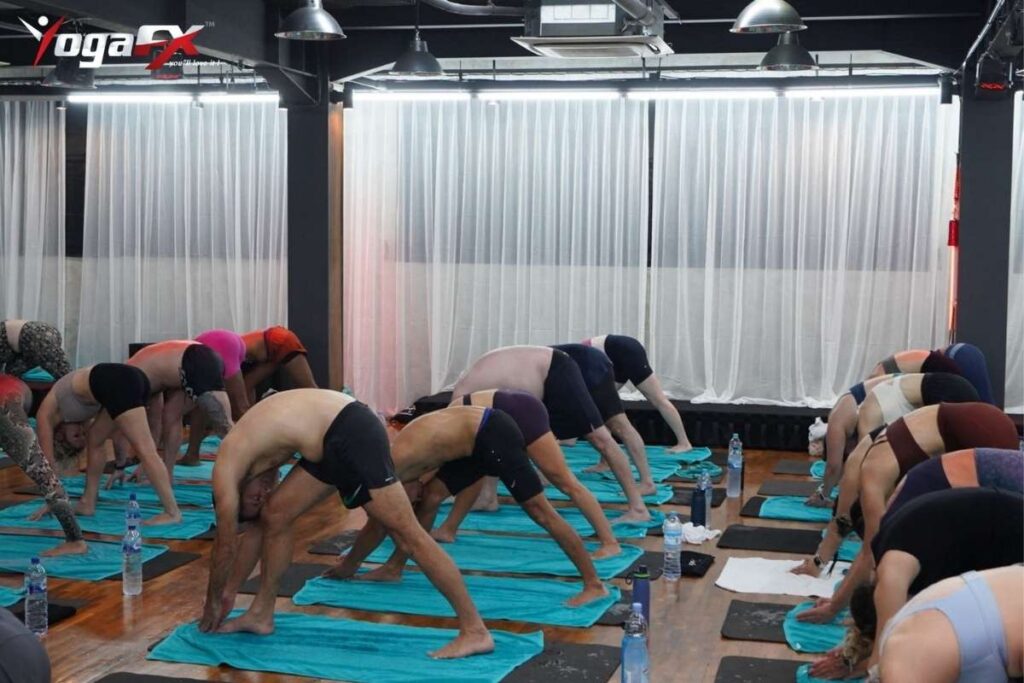
The Bikram Yoga Skin Benefits are conditional on a post-class skincare routine that addresses the specific effects of the practice. Most practitioners who report skin problems from hot yoga have skipped some or all of these steps.
Step 1: Rinse Within 20 Minutes
The sweat produced during a Bikram class has mobilised sebum, dead skin cells, and debris from pore openings. If this mixture dries on the skin surface, it redeposits and can contribute to congestion rather than clearing it. Rinsing with cool or tepid water within 20 minutes of class prevents redeposition. A gentle cleanser removes residual sebum without stripping the skin's moisture barrier.
Step 2: Rehydrate Immediately Inside and Out
Significant fluid loss from sweating during a Bikram class requires internal rehydration with water and electrolytes. External rehydration with a moisturiser appropriate for your skin type should follow the cleanse step. The skin's moisture barrier is temporarily compromised immediately post-class — applying moisturiser within 5 minutes of cleansing (while the skin surface is still slightly damp) maximises absorption.
Step 3: SPF on Face Before Morning Classes
This applies if you are practicing in the morning and going outdoors afterwards. The increased circulation from Bikram practice temporarily increases skin UV sensitivity. An SPF 30 or higher facial product before any post-class outdoor exposure reduces the photoaging risk that is the legitimate concern behind the hot yoga aging discussion.
What Not to Do
- Do not apply makeup before class — heat and sweat drive foundation and concealer ingredients into pore openings, worsening congestion
- Do not skip rinsing because you are in a hurry — this single step most commonly accounts for post-class skin problems
- Do not apply heavy oil-based products immediately after class — the elevated skin temperature increases absorption rate and some oil-based products become comedogenic under these conditions
Timeline: When to Expect Skin Changes
| Timeline | Typical Skin Changes |
|---|---|
| First class | Immediate glow from vasodilation and circulation increase — lasts 30 to 60 minutes post-class |
| Week 1 to 2 | Improved skin brightness beginning; possible initial breakout from heat adaptation in acne-prone skin |
| Week 3 to 4 | Initial breakouts typically resolve; pore clearing effects beginning to be visible; skin tone more even |
| Week 4 to 8 | Measurable improvement in skin clarity and evenness; hormonal acne reduction from cortisol normalisation if present |
| Month 3 onwards | Established skin improvement; visible pore reduction from consistent sebum clearing; sustained glow from improved circulation |
The Bali Natural Heat Difference for Skin
YogaFX practices in Bali's natural tropical heat without electric heaters. The ambient humidity above 70 percent produces a different skin environment during class than electric-heated studios at the same temperature. Electric-heated studios run at 15 to 25 percent humidity. In dry heat, sweat evaporates rapidly from the skin surface, creating a cooling effect that maintains skin surface hydration at lower levels. In practice, the skin surface in a dry-heated studio feels tighter and drier throughout the class.
At YogaFX Bali, the natural humidity prevents rapid evaporation. The skin surface maintains a higher hydration level throughout the class. Post-class, practitioners consistently report that skin feels more supple and less tight than after equivalent sessions in dry electric-heated studios. The anti-aging concern — repeated dehydration and rehydration cycles — is less pronounced in natural humid heat than in dry electric heat at the same temperature.
FAQ
Is Bikram yoga good for your skin?
Yes, for most practitioners with most skin types. The primary mechanisms are increased circulation delivering oxygen and nutrients to skin cells, pore clearing from sustained sweating, cortisol reduction from the stress-modulating effects of the practice, and improved sleep quality which is when skin repair occurs. Most practitioners report visible skin improvement within 4 to 8 weeks of consistent practice at 3 or more sessions per week. Post-class skincare protocol — rinse, rehydrate, moisturise — is required for the benefits to manifest without dehydration-related problems.
Why does my skin look better after hot yoga?
The immediate post-class glow has four contributing mechanisms: residual vasodilation keeping skin blood vessels dilated for 20 to 40 minutes post-class, cleared pore openings from sweating, elevated skin surface temperature from residual heat, and in humid-heat environments like YogaFX Bali, maintained skin surface hydration from the humidity. The glow is not imagination — it has a specific physiological basis.
Does hot yoga age your skin?
Not in practitioners who maintain adequate post-class hydration and skincare protocol. The concern is legitimate: repeated heat exposure can degrade collagen in theory. In practice, the circulation improvement from consistent Bikram practice stimulates collagen synthesis, and the cortisol reduction reduces the primary hormonal driver of collagen degradation. Practitioners who neglect post-class skincare and let sweat dry on their skin repeatedly can experience dehydration-related skin problems. The practice is not the problem — the protocol determines the outcome.
Is hot yoga bad for sensitive or rosacea-prone skin?
Heat is a known trigger for rosacea flushing. Practitioners with active rosacea should consult a dermatologist before starting Bikram yoga. Practitioners with sensitive skin without rosacea generally adapt within 3 to 4 weeks — the initial heightened flushing response settles as vasomotor regulation adapts to the regular heat exposure. Post-class cooling and calming skincare products (aloe vera, centella asiatica, niacinamide) specifically address the reactive flushing that some sensitive-skin practitioners experience.
Can Bikram yoga help with acne?
For hormonal and stress-related acne: yes, through cortisol reduction. The stress-reducing effects of consistent Bikram practice lower cortisol, which when chronically elevated triggers sebum overproduction and impairs skin barrier function. For congestion-related acne and blackheads: yes, through pore clearing from sustained sweating, provided post-class rinsing prevents redeposition. For heat-triggered acne: practice may initially worsen it in the first 2 to 3 weeks before heat adaptation, then improve it through the cortisol mechanism.
Which yoga is best for glowing skin?
Bikram yoga produces the most immediate and most sustained glow of any yoga format for three reasons: the cardiovascular demand is higher (80 percent of maximum heart rate throughout, University of Wisconsin 2014), producing more intense circulation improvement; the sweating is more sustained and complete, producing more thorough pore clearing; and the cortisol reduction from the combined thermal and physical stress adaptation is more pronounced than in room-temperature practice. Room-temperature yoga also improves skin through circulation and stress reduction, but the thermal component of Bikram yoga amplifies these effects significantly.
How long until I see skin improvement from Bikram yoga?
The immediate glow appears from the first class. Sustained skin clarity improvement is typically visible within 4 to 6 weeks of consistent practice at 3 or more sessions per week. Hormonal acne improvement from cortisol reduction typically takes 6 to 8 weeks because cortisol normalisation occurs gradually. Pore visibility reduction from consistent sebum clearing typically becomes noticeable within 4 to 6 weeks. Sleep quality improvement, which produces the longer-term skin repair benefit, typically appears within 1 to 2 weeks of starting practice.