
Three sessions per week is the research-validated optimal frequency for Bikram yoga. This is not an estimate — it is the exact protocol used in the Tracy and Hart (2013) study that documented 20 percent strength increase, significant flexibility gains, and body fat reduction at 8 weeks. The Harvard MGH 2023 depression RCT used Bikram Yoga 3 Times a Week and documented the most significant yoga mental health outcomes in peer-reviewed literature.
What happens specifically to your body and mind at 3 sessions per week, in what order, and at what timeline — that is what this guide covers.
Three sessions of Bikram yoga per week at 90 minutes per session produces: heat adaptation completing by weeks 2 to 3, first visible flexibility improvements by weeks 3 to 4, documented 20 percent strength increase at 8 weeks (Tracy and Hart 2013), measurable body fat reduction at 8 weeks, and significant depression symptom reduction in the Harvard MGH 2023 RCT. Weekly calorie contribution: approximately 999 kcal (women, avg 68kg) or 1,380 kcal (men, avg 82kg). Sleep quality improvement typically appears within the first 1 to 2 weeks.
Why 3 Sessions Per Week Is Specifically Optimal
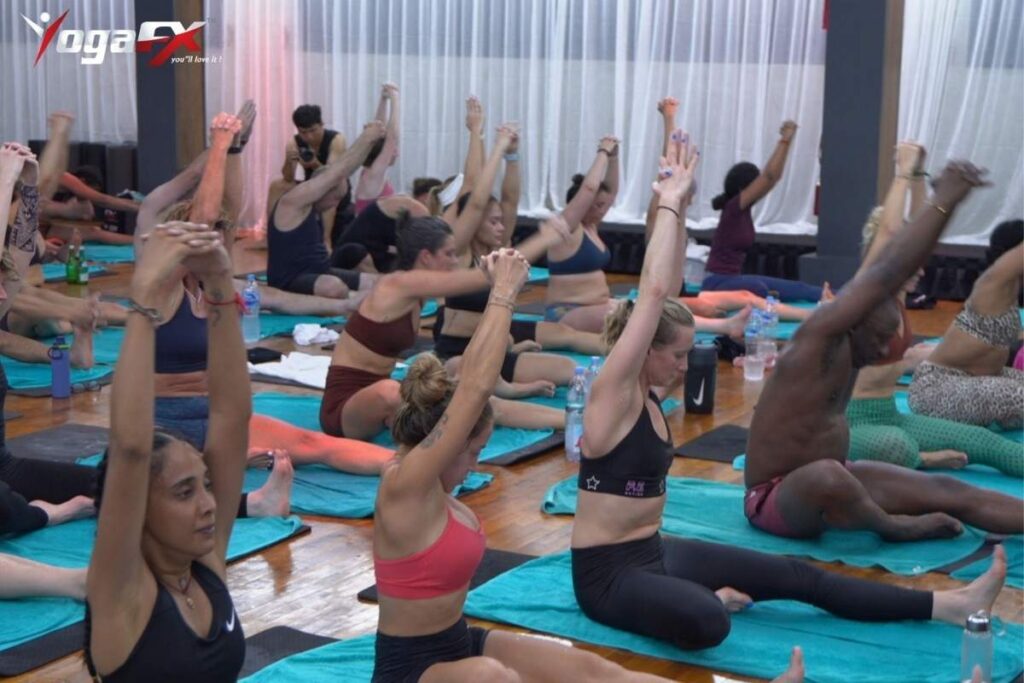
Three sessions per week is the minimum frequency at which heat adaptation develops reliably. The thermoregulatory adaptation required for the full Bikram experience — earlier sweat onset, improved cardiovascular heat management, reduced perceived intensity of the standing series — develops across 5 to 10 sessions. With three sessions per week, this adaptation typically completes within 2 to 3 weeks. With one or two sessions per week, adaptation takes 4 to 6 weeks and may never fully develop because the interval between sessions allows partial regression.
Three sessions per week also provides the rest intervals that connective tissue adaptation requires. The flexibility gains from Bikram yoga come from progressive connective tissue remodelling between sessions, not from single-session stretching. Three weekly sessions with one or two days between each allows the remodelling to accumulate progressively — two consecutive rest days are not optimal, and daily practice without rest days doesn't produce proportionally faster flexibility gains.
The 8-Week Timeline: What to Expect Week by Week
| Week | Physical Changes | Mental and Lifestyle Changes | Research Anchor |
|---|---|---|---|
| 1 to 2 | Heat adaptation developing. Significant post-class fatigue. Sleep quality improvement typically appears in week 1 to 2. | Class feels overwhelming. Motivation challenge between sessions. First experience of post-class clarity. | Heat tolerance develops progressively across sessions 1 to 7 regardless of fitness level. |
| 3 to 4 | Heat tolerance noticeably improved. First visible flexibility improvements in standing forward folds and Eagle Pose. Savasana rests less frequent during class. | Class transitions from survival to manageable. Sleep quality consistently better. Appetite regulation changes often reported. | Csala 2021: flexibility improvements begin appearing in weeks 3 to 4 at 3x/week. |
| 5 to 6 | Body composition changes beginning — body fat reduction starting. Standing balance postures becoming more stable. Post-class fatigue reducing. | Mental focus in balance postures improving. Stress tolerance in difficult postures translating to daily life. Skin clarity often reported. | Tracy and Hart 2013: body fat reduction measurable at 5 to 6 weeks. Lean muscle gain beginning. |
| 7 to 8 | Documented: 20 percent deadlift strength increase. Significant lower back and hamstring flexibility gains. Heart rate recovery between postures faster. | Harvard MGH 2023 protocol: depression reduction measurable by week 6 to 8. Practice feels part of routine rather than effort. | Tracy and Hart 2013: primary strength and flexibility outcomes documented at the 8-week mark. |
| Beyond 8 weeks | Continued body composition improvement. Spinal mobility gains across all planes. Joint health improvements from consistent Eagle Pose synovial lubrication. | Mental toughness and discomfort tolerance developed in the hot room transferring to performance contexts outside the studio. | Research documents ongoing improvements past the 8-week mark with continued consistent practice. |
Flexibility: The Most Visible Early Result
Flexibility is typically the first outcome that practitioners can measure at 3 sessions per week. The Tracy and Hart (2013) study specifically documented significant improvements in lower back flexibility and hamstring flexibility at 8 weeks — the two most restricted areas in most adults and the two that heat-enhanced connective tissue extensibility specifically targets.
At 40 degrees Celsius, the viscoelastic properties of connective tissue change measurably — collagen viscosity decreases, fascial resistance to stretch reduces. Three weekly sessions in the heat produce cumulative connective tissue adaptation that room-temperature yoga at the same frequency does not match. By week 3 to 4, forward fold depth in Standing Separate Leg Stretching is typically visibly increased. By week 6 to 8, Eagle Pose arm wrap depth and Hands to Feet forward fold are measurably deeper than at week 1 — observable with specific posture benchmarks rather than just subjective impression.
Strength: The Less Expected Outcome
The 20 percent deadlift strength increase documented by Tracy and Hart (2013) at 8 weeks of 3 to 4 Bikram sessions per week is the research finding that most surprises practitioners who think of yoga as a flexibility practice. The mechanism: the Bikram floor series provides specific posterior chain loading through Cobra, Locust, Full Locust, and Bow — loading the spinal erectors, gluteus maximus, and hamstrings in prone positions where anterior chain compensation is eliminated. The heat environment amplifies this by reducing muscle viscosity and producing greater muscle fibre recruitment at equivalent effort levels.
Additionally, the standing balance postures (Standing Head to Knee, Standing Bow, Balancing Stick, Tree Pose, Toe Stand) develop single-leg stability and intrinsic foot and ankle strength that conventional strength training does not specifically target. The 9 percent balance improvement also documented by Tracy and Hart (2013) reflects these gains.
Weight Loss and Body Composition
Three sessions per week produces meaningful body composition changes through two simultaneous mechanisms: direct calorie expenditure during sessions, and lean muscle gain that elevates resting metabolic rate between sessions.
The University of Wisconsin 2014 study directly measured calorie burn: 333 kcal for women (average 68kg) and 460 kcal for men (average 82kg) per 90-minute session at 80 percent of maximum heart rate.
| Frequency | Weekly Calorie Burn (Women avg 68kg) | Weekly Calorie Burn (Men avg 82kg) |
|---|---|---|
| 3 sessions per week | 999 kcal per week | 1,380 kcal per week |
| 4 sessions per week | 1,332 kcal per week | 1,840 kcal per week |
| 5 sessions per week | 1,665 kcal per week | 2,300 kcal per week |
| Monthly at 3 sessions (4 weeks) | 3,996 kcal (approx. 0.5kg deficit) | 5,520 kcal (approx. 0.7kg deficit) |
Tracy and Hart (2013) documented significant lean muscle gain alongside body fat reduction at 8 weeks of 3 to 4 sessions per week. Lean muscle gain increases resting metabolic rate — the baseline calorie expenditure between sessions. For weight loss: three sessions per week produces meaningful results when combined with adequate protein intake and reasonable caloric awareness. It is not a rapid weight loss method but a sustainable body composition improvement programme with multiple simultaneous mechanisms.
Mental Health: The Most Significant Recent Research
The Harvard Medical School MGH 2023 randomised controlled trial (Nyer et al., PubMed: 37883245) used 8 weeks of Bikram yoga at 2 to 3 sessions per week in adults with moderate to severe depression. Approximately 60 percent of the yoga group reduced depression symptoms by 50 percent or more. 44 percent achieved full remission. The control group: only 6.3 percent saw comparable improvement.
For practitioners at 3 times per week, the mental health timeline typically mirrors the physical timeline: sleep quality improvement within 1 to 2 weeks, mood stabilisation by weeks 3 to 4, and deeper stress resilience development by weeks 6 to 8. Sleep quality consistently appears first and is the earliest indicator that the practice is having its intended effect.
3 Times a Week vs Other Frequencies
| Outcome | 1x per week | 3x per week | 5x per week |
|---|---|---|---|
| Heat adaptation | Slow or incomplete — may regress between sessions | Complete by weeks 2 to 3 | Complete by week 1 to 2 |
| Flexibility gains | Minimal — insufficient frequency for connective tissue adaptation | Significant at 8 weeks (Tracy and Hart 2013) | Faster initial gains, similar long-term |
| Strength gains | Limited | 20 percent deadlift increase at 8 weeks | Similar — strength gains plateau independent of frequency above 3x |
| Body composition | Modest calorie contribution only | Meaningful fat reduction + lean muscle gain at 8 weeks | Faster initial results, requires more recovery management |
| Mental health | Some benefit from single sessions | Significant depression reduction at 8 weeks (Harvard 2023) | Similar to 3x — frequency above 3x does not linearly increase mental health outcomes |
| Sustainability | Easy to maintain in schedule | Optimal balance of outcomes and recovery | Requires heat adaptation, schedule commitment, and recovery management |
How to Structure 3 Sessions Per Week
Non-Consecutive Days
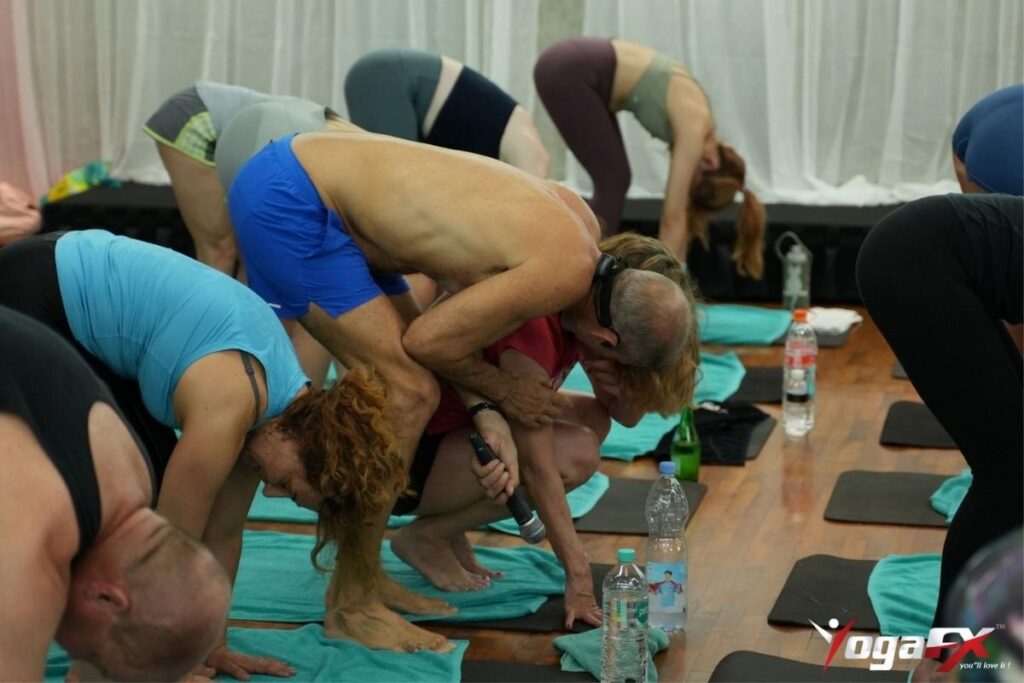
Ideally: Monday/Wednesday/Friday or Tuesday/Thursday/Saturday. One day between sessions maintains adaptation momentum while allowing the tissue remodelling that consecutive sessions do not permit. Two consecutive Bikram sessions on back-to-back days is manageable for heat-adapted practitioners but the connective tissue adaptation that produces flexibility gains specifically requires rest periods.
Morning vs Evening Sessions
Both work. Morning sessions benefit from reduced food-timing concerns and metabolic activation for the rest of the day. Evening sessions benefit from the parasympathetic nervous system activation of the floor series and Savasana, which promotes sleep quality — one of the first benefits practitioners at 3 sessions per week typically report. Consistency matters more than timing: a practitioner who commits to the same sessions each week will make more progress in 8 weeks than one who attends irregularly.
What to Do on Off Days
Light walking, swimming, or general mobility work complement the practice on the four non-Bikram days. Heavy posterior chain strength training (deadlifts, squats) on off days can affect soreness in the next Bikram session but does not contraindicate the practice. The main objective on off days is adequate rest and hydration rather than additional training load.
3 Sessions Per Week in Bali at YogaFX
For practitioners visiting Bali who want to experience this protocol in natural heat, YogaFX runs morning and evening classes daily at both Seminyak and Canggu. A one-week stay with 5 to 6 classes is functionally equivalent to completing the most significant heat adaptation phase of a 3x per week programme. Practitioners already adapted to hot yoga from a home studio often find that a week of YogaFX classes in natural tropical heat resets their practice — producing rapid flexibility and recovery improvements that their adapted body had stopped experiencing in a dry electric-heated studio.
FAQ
Is yoga 3 times a week enough to see results?
Yes. The Tracy and Hart (2013) Bikram yoga study documented 20 percent strength increase, significant flexibility gains, and body fat reduction at 8 weeks using a 3 to 4 sessions per week protocol. The Harvard MGH 2023 depression RCT used 2 to 3 sessions per week and documented approximately 60 percent of participants reducing depression symptoms by 50 percent or more. Three sessions per week is the research-validated minimum for meaningful, measurable outcomes from Bikram yoga.
How long does it take to see results from Bikram yoga 3 times a week?
Sleep quality improvement: typically within 1 to 2 weeks. Flexibility gains: noticeable within 3 to 4 weeks, measurable at 6 to 8 weeks. Strength gains (posterior chain): measurable at 8 weeks per Tracy and Hart (2013). Body composition changes: beginning around week 5 to 6. Mental health improvements: beginning around week 3 to 4 per the Harvard 2023 protocol. Total calorie expenditure at 3x per week: approximately 999 to 1,380 kcal per week.
Can you lose weight doing yoga 3 times a week?
Yes, particularly with Bikram yoga. The University of Wisconsin (2014) direct measurement documented 333 to 460 kcal per 90-minute session. At 3 sessions per week: approximately 999 to 1,380 kcal of direct weekly calorie expenditure, plus the metabolic rate elevation from lean muscle gain. Body fat reduction is documented in the research at 8 weeks of 3 to 4 sessions per week. Weight loss depends on overall caloric intake — yoga 3 times a week provides a meaningful contribution to any weight management programme.
Is yoga 3 times a week too much?
No, for most healthy adults. Research protocols that documented the most significant Bikram yoga outcomes used 3 to 4 sessions per week with no adverse effects reported at this frequency. The key consideration: the 40-degree heat and 90-minute duration create a thermoregulatory demand that requires adequate rest and hydration between sessions. Three non-consecutive sessions per week provides this rest interval naturally.
What does 3 months of Bikram yoga do?
Three months at 3 sessions per week is approximately 37 to 39 sessions. The documented 8-week outcomes continue to develop past the 8-week mark. By 3 months, most practitioners report: established heat tolerance, visible body composition change, meaningful flexibility improvement across multiple postures, significantly improved sleep quality and stress tolerance, and the beginning of the spinal mobility development that the full floor series specifically targets.
How often should I do Bikram yoga for best results?
Three to four sessions per week is the research-validated optimal frequency for most outcomes — the exact protocol used in Tracy and Hart (2013). Below 3 sessions per week, heat adaptation may not fully develop and outcome accumulation is slower. Above 5 sessions per week, additional sessions produce diminishing returns for most outcomes while increasing recovery demand. For practitioners new to Bikram yoga, starting with 2 to 3 sessions per week and building to 3 to 4 once heat adaptation is established (approximately weeks 2 to 3) is the recommended progression.