
Yoga does not cure tinnitus, and no honest article should suggest otherwise. What yoga can do is address two of tinnitus's most well-documented aggravating factors: jaw and neck tension linked to TMJ dysfunction, and the stress response that measurably increases how loud tinnitus is perceived to be.

Neither mechanism eliminates the underlying condition, but both are real, and both respond to the kind of practice a structured yoga class provides. This distinction, managing the aggravating factors versus treating the condition itself, is the honest frame for everything that follows.
Why Yoga and Tinnitus Show Up in the Same Searches
The connection is not a wellness-industry invention. A large study from the Swedish Tinnitus Outreach Project found that temporomandibular joint (TMJ) complaints were present in 36 percent of people with severe tinnitus, compared to 19 percent of people with tinnitus generally, and that this group more often reported stress as a driver of their symptoms.
The jaw joint sits directly next to the cochlea, and the nerve pathways connecting the two structures are well mapped, which is why jaw tension and clenching can genuinely modulate how tinnitus is experienced even though the jaw is not the origin of the sound itself.
The mechanism runs through the trigeminal nerve, which serves the jaw and face, and its documented crosstalk with the cochlear nucleus, the brainstem structure involved in processing auditory signals. Because these two nerve pathways are physically adjacent and functionally connected, chronic tension or clenching in the jaw can alter activity in the auditory pathway even without any change to the ear itself.
This is why dental and TMJ specialists sometimes see tinnitus improve after jaw treatment even when a hearing evaluation finds nothing wrong with the ear, and it is the same anatomical logic that makes jaw-release yoga work relevant here.
Bruxism, the habit of clenching or grinding the teeth, is one of the most common drivers of TMJ-linked tension, and it is frequently a stress response itself, often happening unconsciously during sleep or during concentrated work. This creates a loop worth naming directly: stress contributes to jaw clenching, jaw clenching contributes to TMJ tension, and TMJ tension is statistically linked to more severe tinnitus.
Breaking any one link in that chain, rather than expecting a single intervention to resolve the whole loop, is the realistic goal.
Stress works through a separate but related pathway. Research on the hypothalamus-pituitary-adrenal (HPA) axis has found that tinnitus patients show altered, sluggish stress responses, and that higher perceived stress correlates with louder perceived tinnitus, independent of any actual change in the underlying auditory signal.
In practical terms: tinnitus is often a fixed background signal, but how loud and distressing it feels fluctuates with stress and muscular tension, and that fluctuating part is where yoga has a legitimate, if modest, role to play.
The Practices With Real Relevance
Three categories of practice have a plausible mechanism behind them, which separates them from the long list of mudras and hand gestures that circulate online with no supporting rationale.
- Jaw and neck release work. Given the documented TMJ-tinnitus overlap, gentle jaw unclenching, neck rotations, and upper trapezius release address a genuine contributing factor rather than a symbolic one. This is the single most evidence-backed category here.
- Slow, extended-exhale breathing (pranayama). Breathing practices that lengthen the exhale relative to the inhale activate the parasympathetic nervous system, which is the branch implicated in tinnitus suppression in some of the HPA-axis research above. This is a stress-modulation mechanism, not a hearing mechanism.
- Legs-up-the-wall pose (Viparita Karani). A passive, supported inversion commonly recommended for general nervous-system downregulation. It is not part of the Bikram 26-posture sequence, but it is a reasonable addition at home before sleep for anyone whose tinnitus is worse when stressed or overtired, since poor sleep is itself a well-documented tinnitus aggravator.
Notably absent from this list are the various hand mudras (Shunya Mudra, Surya Mudra) that dominate search results for this topic. These circulate widely in wellness content, but none have a documented physiological mechanism connecting a specific finger position to auditory nerve function. They are not harmful to try, but they should not be mistaken for the jaw-release and stress-reduction mechanisms that do have supporting research behind them.
It is worth being specific about why the mudra content is so prevalent, since understanding the gap helps explain why this article treats it differently. Many of these pages exist because a hand-gesture practice is easy to describe, easy to illustrate, and easy to name after a specific ailment, which makes for shareable content regardless of whether a physiological pathway supports the claim.
Jaw release, by contrast, requires understanding an actual anatomical connection, which is less immediately appealing as a headline but is the part of the picture with genuine supporting research behind it.
What a Bikram-Format Class Specifically Offers
The Bikram 26-posture sequence does not include headstands or full inversions, but several postures directly address the neck, jaw, and shoulder tension implicated in the TMJ-tinnitus connection.
Eagle Pose wraps and releases the shoulder girdle and upper trapezius in a way few other postures in any style replicate.
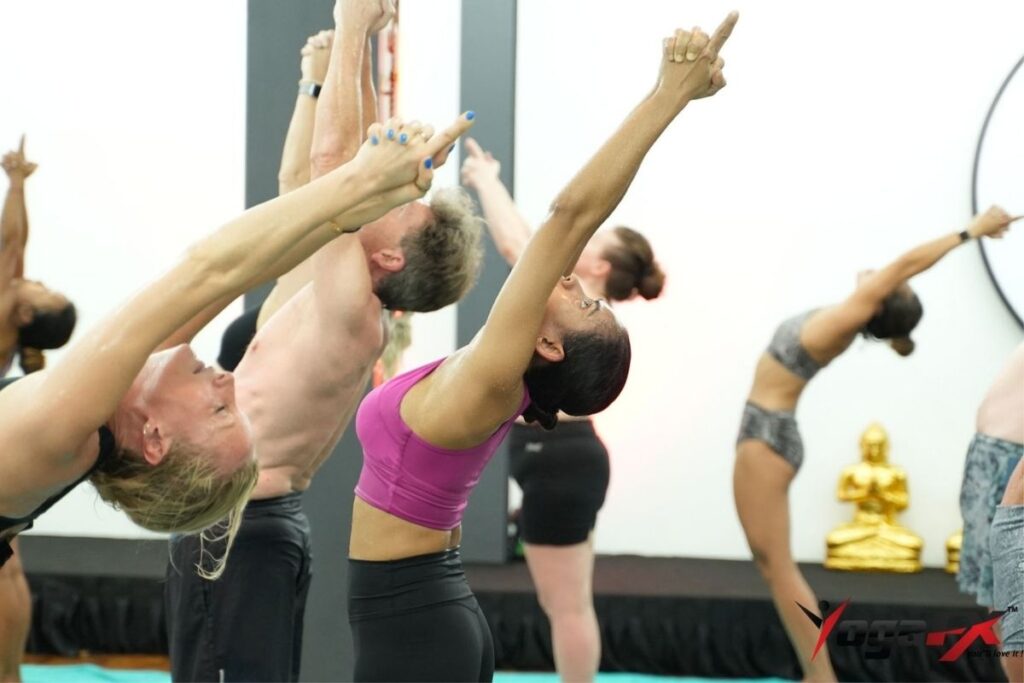
Camel Pose opens the throat and front of the neck, the same region that carries much of the muscular tension associated with jaw clenching.
Half Moon Pose's lateral stretch releases the side-neck muscles that frequently tighten alongside the masseter and temporalis, the primary muscles involved in TMJ dysfunction.
On the stress side, Mr. Ian Terry, E-RYT 500, notes that the standard advice given to any student managing a stress-sensitive condition applies here too: the benefit comes from consistent attendance, not any single posture.
A Harvard-affiliated Massachusetts General Hospital trial (Nyer et al., PMID 37883245) found significant reductions in depression symptoms after eight weeks of regular heated yoga practice, evidence of a genuine stress and mood effect from consistent practice, which is the same general mechanism that would be expected to modestly ease stress-linked tinnitus loudness, though no study has tested Bikram yoga specifically against tinnitus outcomes.
That last point is worth being explicit about: this is a reasonable extrapolation from adjacent research, not a direct clinical finding. Anyone managing tinnitus as a primary concern should treat yoga as a supportive addition to established care, such as sound therapy, hearing evaluation, or TMJ treatment, rather than a substitute for any of them.
Addressing the Direct Question: Can Yoga or a Hot Room Cause Tinnitus?

This question comes up often enough in searches related to this topic that it deserves a direct answer rather than avoidance. There is no evidence that practicing yoga, including in a heated room, causes tinnitus. Tinnitus is most commonly linked to hearing loss, loud noise exposure, earwax blockage, or the TMJ and stress mechanisms discussed above, none of which are created by a yoga class itself.
The one practical, unrelated hygiene point worth mentioning: a heated, humid room means more sweat, and moisture trapped in the ear canal after any workout, hot yoga included, is a known contributor to outer ear irritation for people who are prone to it.
Drying the outer ear gently after class is a sensible habit for anyone prone to ear issues, but this is a separate consideration from tinnitus and does not indicate any special risk specific to a heated yoga room.
The confusion behind this question likely comes from two unrelated things sharing a search query: outer ear moisture irritation, which is a genuine minor consideration in any humid or sweaty environment, and tinnitus, which is an internal auditory nerve phenomenon that a hot room has no documented pathway to cause. Conflating the two makes the hot room sound riskier than the actual evidence supports.
Someone who develops new tinnitus after starting a yoga practice has very likely encountered an unrelated cause, most commonly increased overall stress from a busy period, sleep disruption, or an unrelated change in hearing, rather than the yoga itself, and it is worth ruling out those more common explanations before assuming any connection to the practice.
How Much Practice, and How Long Before Noticing Anything
Given that the mechanisms here are indirect, jaw tension and stress rather than the auditory system itself, expectations matter. Nobody should expect a class or two to change tinnitus perception in a noticeable way.
The stress-reduction research generally documenting mood benefits from heated yoga uses an eight-week window of two to three sessions weekly before measuring outcomes, and there is no reason to expect a stress-linked symptom like tinnitus loudness to respond faster than that.
A realistic framework: track whether tinnitus loudness on particularly stressful weeks feels different from tinnitus loudness on weeks with consistent practice and adequate sleep, rather than expecting a linear week-by-week improvement. Tinnitus perception is naturally variable day to day regardless of any intervention, which makes short-term self-assessment unreliable.
A running note over six to eight weeks, tracking practice consistency alongside subjective tinnitus severity, gives a more honest picture than judging any single week in isolation.
| Practice | Mechanism | Evidence Strength |
|---|---|---|
| Jaw and neck release work | Directly addresses documented TMJ-tinnitus association | Moderate: mechanism well studied, direct outcome studies limited |
| Slow, extended-exhale breathing | Parasympathetic activation, HPA axis modulation | Moderate: supported by broader stress-tinnitus research |
| Legs-up-the-wall (Viparita Karani) | General nervous system downregulation, sleep support | Low-moderate: plausible but not tinnitus-specific |
| Consistent heated yoga practice | General stress and mood improvement (adjacent research) | Indirect: extrapolated from depression/anxiety research, not tinnitus-specific trials |
| Hand mudras (Shunya, Surya, etc.) | No established physiological mechanism | None documented |
FAQ
Can yoga help tinnitus?
Yoga cannot cure tinnitus, but it can help with two documented aggravating factors: TMJ and jaw tension, which are present in over a third of severe tinnitus cases, and stress, which measurably increases perceived tinnitus loudness. Jaw-release postures and slow breathing are the most evidence-supported practices.
What is the best yoga pose for tinnitus?
No single pose treats tinnitus directly. Postures that release jaw, neck, and shoulder tension, such as Eagle Pose and Half Moon Pose, address the TMJ-linked contributing factor most directly. Legs-up-the-wall pose (Viparita Karani) is commonly used as a calming addition for stress-linked symptoms, though it is not part of every yoga style's core sequence.
Can yoga or hot yoga cause tinnitus?
No evidence supports this. Tinnitus is most commonly linked to hearing loss, loud noise exposure, earwax blockage, or TMJ and stress-related mechanisms, none of which a yoga class creates. Drying the ears after a sweaty class is a sensible general hygiene habit, but it is unrelated to tinnitus specifically.
Is the connection between TMJ and tinnitus well established?
Yes, reasonably well. Research has found TMJ complaints present in a significantly higher proportion of severe tinnitus cases than general tinnitus cases, and the jaw joint sits anatomically close to the cochlea with mapped nerve connections between the two, giving the association a plausible physiological basis rather than just a statistical correlation.
Do hand mudras like Shunya Mudra actually help tinnitus?
There is no documented physiological mechanism connecting a specific hand or finger position to auditory nerve function or tinnitus severity. These practices are not harmful to try, but they should not be substituted for jaw-release work or stress-reduction practices, which do have a plausible, evidence-supported mechanism behind them.
This article is for general educational purposes and is not medical advice. Tinnitus has many possible causes, some of which require specific medical evaluation. Anyone experiencing new, worsening, or one-sided tinnitus, or tinnitus accompanied by hearing loss or dizziness, should see a healthcare professional or audiologist for proper assessment.