
Bikram yoga is 90 minutes. Not because the class happens to take that long, but because 90 minutes is the minimum duration required for the physiological system to work as designed. This is worth understanding precisely, because a growing number of studios now offer 60-minute compressed formats and the difference between the two is not simply 30 minutes less of the same thing.
Bikram yoga is 90 minutes because three physiological systems require it: the heat adaptation curve needs 15 to 20 minutes before connective tissue reaches optimal temperature; the floor series depends on the complete standing series for pre-heating; and the double-set system requires rest between sets that makes second sets more effective than first sets. The University of Wisconsin 2014 study documented 333 to 460 kcal per 90-minute session at 80 percent of maximum heart rate throughout. At YogaFX Bali, full Bikram Yoga 90 Minutes classes run morning and evening at both Seminyak and Canggu studios in natural tropical heat.
Why Bikram Yoga Is 90 Minutes: The Three Physiological Reasons
1. The Heat Adaptation Curve
Entering a 40-degree Celsius room and immediately practicing at maximum intensity would be physiologically counterproductive. The body needs 15 to 20 minutes of progressive heat exposure before connective tissues have reached the temperature at which their extensibility is maximally enhanced. The cardiovascular system needs 10 to 15 minutes of progressive loading before it can sustain the peak demands of Standing Bow and Balancing Stick.
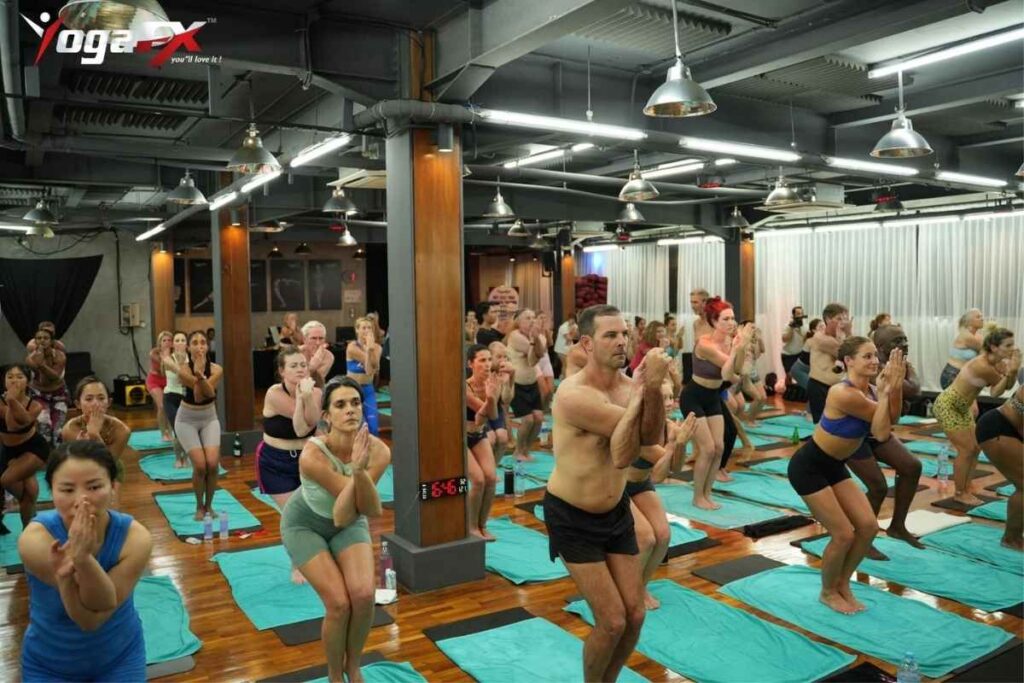
The first four postures of the standing series — Half Moon, Hands to Feet, Awkward Pose, and Eagle Pose — are specifically designed to produce this progressive warm-up while delivering their own therapeutic benefits simultaneously. By the time the cardiovascular peak of postures 5, 6, and 7 arrives, the body has been systematically prepared. Compressing this warm-up phase eliminates the preparation that makes the peak demands safe and effective.
2. The Floor Series Depends on the Standing Series
The floor series postures — particularly the deep backbends (Camel, Bow), the kneeling and seated work (Fixed Firm, Rabbit, Head to Knee), and the spinal rotation of Spine Twist — require a level of connective tissue warmth that only the full standing series has produced.
Camel Pose (posture 22) is the maximum spinal extension in the entire sequence. It requires the thoracic spine to have been mobilised through the preceding 21 postures — particularly Half Moon (lateral extension), Standing Bow (anterior chain opening), and the standing forward folds (hamstring and posterior chain release). Practicing Camel without the thermal and mechanical preparation of the full standing series produces significantly less range and significantly more risk than the same posture after 45 minutes of full standing series work.
3. The Double-Set System Requires Time
Most postures in the Bikram sequence are performed twice — two sets with a brief rest between. The first set opens the range. The rest between sets allows the nervous system to integrate the new range. The second set goes deeper than the first in ways that would not be accessible without the first-set opening. This double-set system is a specific pedagogical and physiological design choice. It requires time. A class that rushes through both sets eliminates the rest period that makes the second set more effective. A class that eliminates the second set eliminates the deepening mechanism entirely.
How Bikram Yoga 90 Minutes Is Distributed: The Full Timing Breakdown
| Section | Time Start | Duration | What Happens |
|---|---|---|---|
| Room entry and setup | 0:00 | 2 to 3 min | Acclimatise to room temperature. Mat and towel positioned. Instructor greets class. |
| Pranayama breathing (opening) | 0:03 | 5 min | 6 complete breath cycles standing. Maximum respiratory preparation and cardiovascular initiation. |
| Standing Series 1: warm-up (postures 1 to 3) | 0:08 | 12 to 14 min | Half Moon, Hands to Feet, Awkward Pose (3 parts). Progressive lateral, forward fold, and lower body warm-up. |
| Standing Series 2: cardiovascular peak (postures 4 to 7) | 0:22 | 18 to 20 min | Eagle, Standing Head to Knee, Standing Bow, Balancing Stick. Peak cardiovascular demand. Heart rate 80 to 90 percent of maximum. |
| Standing Series 3: closing (postures 8 to 12) | 0:42 | 16 to 18 min | Standing Separate Leg Stretching, Triangle, Head to Knee Standing, Tree, Toe Stand. Active recovery transitioning to Savasana. |
| Savasana transition | 1:00 | 2 to 3 min | Mandatory cardiovascular redistribution. Non-negotiable rest between standing and floor series. |
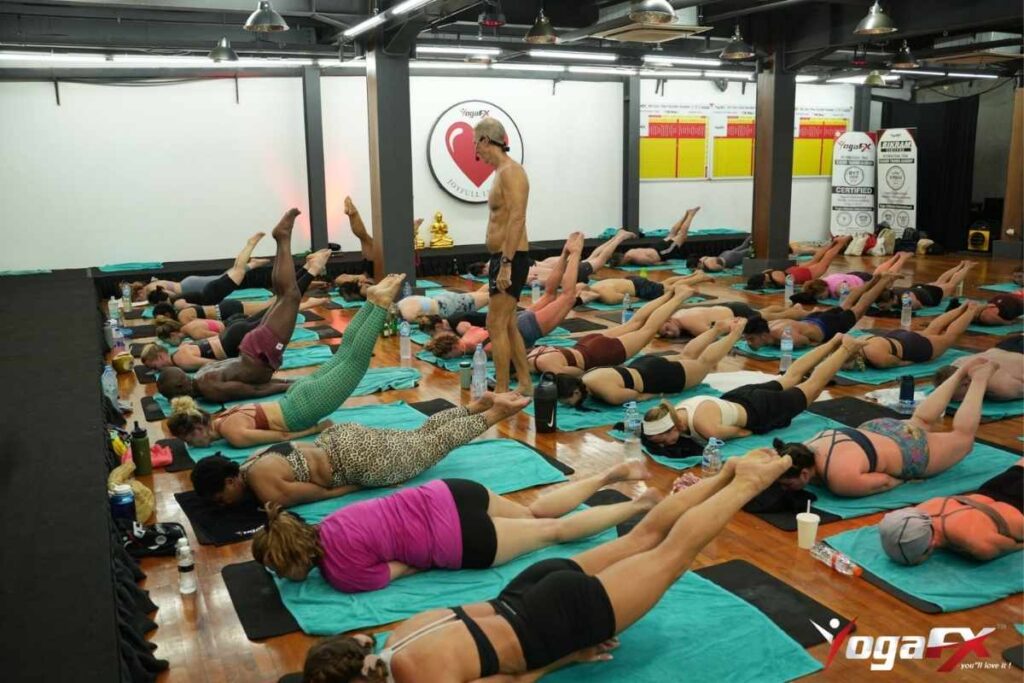
| Floor Series 1: prone backbends (postures 14 to 19) | 1:03 | 16 to 18 min | Wind-Removing, Cobra, Locust, Full Locust, Bow. Posterior chain loading, organ massage, anterior body opening. |
| Floor Series 2: kneeling and seated (postures 20 to 25) | 1:21 | 14 to 16 min | Fixed Firm, Half Tortoise, Camel, Rabbit, Head to Knee, Spine Twist. Deepest spinal work of the session. |
| Kapalbhati and final Savasana | 1:37 | 3 to 5 min | Closing breath series (60 rapid exhales) and final rest. Nervous system completion. |
The total adds to 88 to 94 minutes in practice — arriving at the 90-minute standard that studios and the research have converged on. Individual instructor pacing affects timing within sections but not the overall structure.
How Many Calories Does 90 Minutes of Bikram Yoga Burn?
The University of Wisconsin 2014 study is the only peer-reviewed direct metabolic measurement of calorie expenditure in Bikram yoga. The study measured metabolic output using indirect calorimetry during actual Bikram Yoga 90 Minutes classes.
| Measurement | Women (avg 68kg) | Men (avg 82kg) |
|---|---|---|
| Average calorie burn per 90-min session | 333 kcal | 460 kcal |
| Range (active participants) | Up to 600+ kcal | Up to 600+ kcal |
| Average heart rate throughout | 80% of maximum | 80% of maximum |
| Peak heart rate | 90 to 94% of maximum | 90 to 94% of maximum |
| Equivalent to | 45 min moderate cycling | 45 min moderate cycling |
The 333 to 460 kcal figure is a direct measurement, not an estimate. Many wellness sources cite much higher claims (600 to 1,000 kcal per Bikram Yoga 90 Minutes Bikram class) that are not supported by direct metabolic measurement. The UW 2014 study represents the evidence-based standard. The more significant finding for overall fitness is the 80 percent of maximum heart rate sustained throughout the session — this produces aerobic conditioning effects comparable to structured endurance exercise, not typically associated with yoga in public perception.
60 Minutes vs 90 Minutes: What You Actually Lose
| Element | 90-Minute Class | 60-Minute Class |
|---|---|---|
| Standing series | Complete — all 12 postures, both sets | Complete or near-complete |
| Floor series | Complete — all 12 postures in sequence | Abbreviated — typically postures 14 to 20 or similar |
| Camel and Rabbit (postures 22 and 23) | Both included — the deepest spinal work | Often omitted or abbreviated |
| Spine Twist (posture 25) | Included — the only spinal rotation | Often omitted |
| Second sets of postures | All prescribed second sets included | Some second sets omitted to save time |
| Savasana rest periods | Full prescribed timing | Reduced to accommodate shortened class |
| Calorie burn (estimated) | 333 to 460 kcal (directly measured) | Approximately 220 to 310 kcal (estimated proportionally) |
| Deep spinal benefit | Complete — full floor series sequence | Partial — most significant floor postures often cut |
| Mental focus training | Full Bikram Yoga 90 Minutes sustained attention | 60-minute sustained attention |
Practitioners whose primary goal is spinal health or mental wellbeing lose the most significant elements from a 60-minute class. The floor series postures most commonly omitted from 60-minute formats — Camel, Rabbit, and Spine Twist — are the postures that provide the deepest spinal decompression, maximum spinal extension, and the only spinal rotation in the sequence.
The Psychological Benefit of the Full 90 Minutes
The Harvard MGH 2023 randomised controlled trial documented significant depression reduction from Bikram yoga practice. One proposed mechanism is whole-body hyperthermia — the physiological stress of sustained heat exposure over the full Bikram Yoga 90 Minutes duration. This mechanism specifically requires the sustained duration: brief heat exposure does not produce the whole-body hyperthermia that the research associates with the mental health effects.
The mental training dimension of the Bikram Yoga 90 Minutes class is also significant. Sustaining focus and continued effort through Bikram Yoga 90 Minutes of physical challenge in a hot room is a specific mental training stimulus. The discomfort tolerance developed over the full class duration transfers to performance contexts outside the studio. Practitioners consistently report that completing a full Bikram Yoga 90 Minutes class produces a qualitatively different sense of accomplishment and mental clarity than a 60-minute class — the full duration contains a threshold-crossing experience that the compressed format does not reach.
Surviving Your First 90-Minute Bikram Class
Before the Class
- Hydrate from morning — not just the hour before class. Arrive already fully hydrated.
- Eat lightly or not at all in the 2 to 3 hours before class. A full stomach in a 40-degree room is uncomfortable within 20 minutes.
- Bring: mat, large non-slip mat towel (non-optional), 1.5 litres of water minimum, moisture-wicking clothing.
- Arrive 15 minutes early to begin room acclimatisation before class starts.
The First 20 Minutes
The first 20 minutes feel disproportionately hard. This is the heat adaptation phase — the cardiovascular system is simultaneously managing exertion and thermoregulation while the body's heat tolerance is not yet active for that session. This phase passes for every practitioner in every class. Stay in the room. Savasana — lying flat on your mat — is always the correct response if overwhelmed, not leaving the room.
Minutes 20 to 40: The Transition
Between minutes 20 and 40, heat adaptation mechanisms activate. Sweat onset accelerates. Heart rate, which peaked around postures 5 to 7, begins settling into a sustained working range. The class that felt like survival in the first 20 minutes becomes navigable. This transition is why completing the first class matters more than performing every posture correctly.
The Floor Series: Minutes 60 to 90
After the Savasana transition at approximately the 60-minute mark, the floor series feels completely different from the standing series. The cardiovascular demand drops significantly. Most first-time practitioners are surprised that the floor series is more manageable — this is by design. Camel Pose (posture 22) often produces a strong physical and sometimes emotional response in new practitioners — dizziness, intensity, emotional release. These are normal. The immediate counterpose (Rabbit, posture 23) is specifically placed to address this response.
After the Class
Rehydrate immediately with water and electrolytes (sodium and potassium replacement matters after Bikram Yoga 90 Minutes of sweating). Most practitioners describe feeling significantly better 30 to 60 minutes after their first class than during it. The heat adaptation develops across sessions 1 to 10 independently of general fitness level — the class that felt impossible in sessions 1 to 3 becomes manageable in sessions 4 to 7.
FAQ
Why is Bikram yoga 90 minutes?
Three physiological reasons: the heat adaptation curve requires 15 to 20 minutes before connective tissue reaches optimal temperature; the floor series depends on the complete 40 to 45-minute standing series having pre-heated and prepared the body; and the double-set system requires the rest time between first and second sets that makes second sets more effective than first sets. Remove 30 minutes and you remove the heat pre-loading that makes the floor series function as designed, eliminate several of the most therapeutically significant floor postures, and reduce the cardiovascular conditioning effect.
How many calories does 90 minutes of Bikram yoga burn?
333 kcal for women (average 68kg) and 460 kcal for men (average 82kg) per 90-minute session, measured directly by the University of Wisconsin 2014 study using indirect calorimetry. Active participants reached 600 or more kcal. Heart rate averaged 80 percent of maximum throughout. Higher figures (600 to 1,000 kcal) cited elsewhere are not supported by direct measurement.
Is 90 minutes too long for hot yoga?
Not for practitioners who have developed heat tolerance (typically 5 to 10 sessions). For first-time practitioners, 90 minutes in a 40-degree room is genuinely challenging regardless of fitness level. The first 20 minutes are the hardest as heat adaptation activates. After the cardiovascular peak and the Savasana transition, the remaining 30 to 35 minutes of floor series are more accessible than the standing series. Most practitioners who complete their first Bikram Yoga 90 Minutes class report being surprised they finished.
How long does Bikram yoga take?
The standard class is exactly 90 minutes. A 60-minute compressed format is offered at many studios and omits or abbreviates the floor series. The Bikram Yoga 90 Minutes format is required for the complete 26-posture sequence with both sets and prescribed Savasana timing. From arriving at the studio to being ready to leave: approximately 2 hours including changing time before and after.
What is the difference between a 60-minute and 90-minute Bikram class?
The 60-minute format typically covers the complete standing series and an abbreviated floor series omitting or shortening postures 20 to 25 — specifically Camel, Rabbit, and Spine Twist. These are the postures that provide the deepest spinal decompression (Half Tortoise, Rabbit), maximum spinal extension (Camel), and the only spinal rotation in the sequence (Spine Twist). Practitioners whose primary goals are spinal health, mental wellbeing, or maximum calorie burn lose the most significant elements from a 60-minute class.
Can I do 90-minute Bikram yoga as a beginner?
Yes. The Bikram Yoga 90 Minutes class accommodates all levels because the verbal dialogue provides complete instruction and every posture has modifications. The heat adaptation challenge is real but manageable with adequate pre-class hydration, a mat towel, and the willingness to rest in Savasana when overwhelmed rather than leaving the room. Most beginners who commit to completing the first 5 to 7 classes describe a transition from survival to manageable practice that makes the full Bikram Yoga 90 Minutes sustainable.