


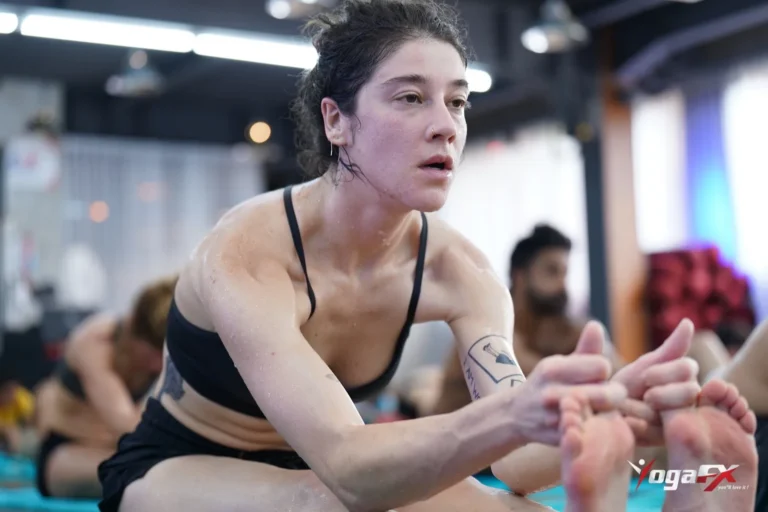
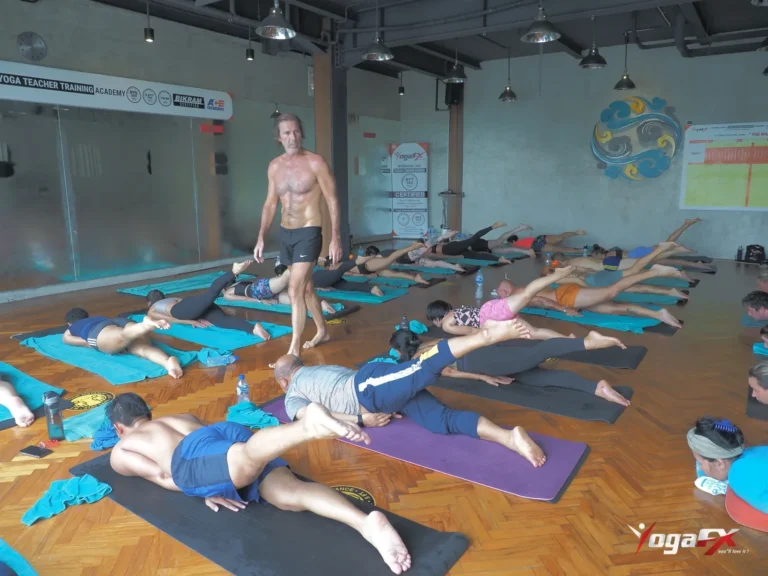
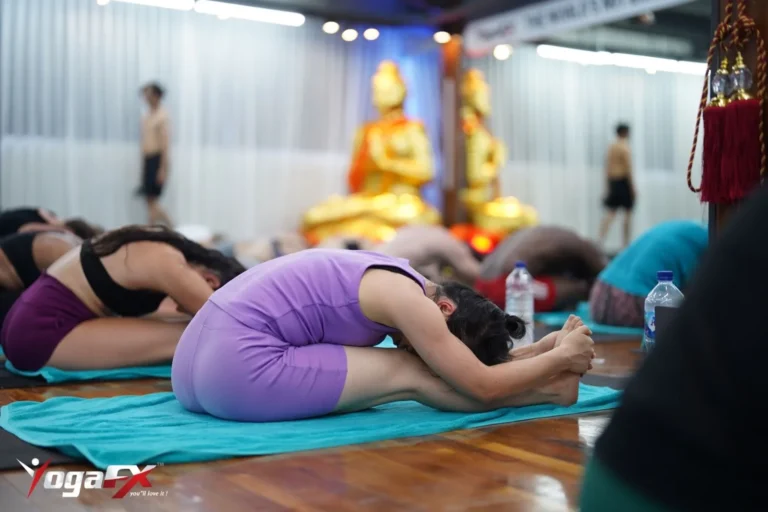

Bikram yoga is practised at 40°C (104°F) with 40% relative humidity, for 90 minutes, in still air with no fans. The original specification is 40.6°C (105°F), which is why you see both figures quoted. That is the hot yoga temperature for any Bikram or Original Hot 26&2 class. Other hot yoga styles vary by studio and usually run cooler, commonly 32 to 38°C.

If you are weighing up your first class, or a full teacher training, the figure matters. It decides how your body copes, what you should bring and who should check with a doctor first. This guide gives the exact hot yoga temperature numbers, the lineage reason for them and what researchers measured inside a real class. It also explains how to stay safe when the room is hot.
What Temperature Is Bikram Yoga? The Exact Numbers
The Bikram yoga temperature is a fixed specification, not a range, and that makes it the clearest hot yoga temperature to quote. The room is held at 40°C (104°F), and the original figure is 40.6°C (105°F). Studios round to one or the other, so you will see both numbers online. Both describe the same room.
| Condition | Metric | Imperial |
|---|---|---|
| Room temperature | 40°C (original spec 40.6°C) | 104°F (original spec 105°F) |
| Relative humidity | 40% | 40% |
| Class length | 90 minutes | 90 minutes |
| Sequence | 26 postures and 2 breathing exercises | Same order every class |
Humidity is half of the specification. In short, the hot yoga temperature on its own doesn't tell you much. A room at 40°C with dry air feels very different from the same room with 40% humidity, because sweat evaporates at a different speed. We come back to that below.
Still air: why a Bikram room has no fans
Still air is the part of the specification most often missing from descriptions of a Bikram room. Fans feel better, because they cool the skin and soften the perceived heat. They also speed up sweat evaporation, drop skin surface temperature and reduce the deep tissue warming the class depends on. So a Bikram room has no fans during class, by design.
At our studios in Seminyak and Canggu, the heat comes from the tropics. YogaFX classes run 90 minutes at 40°C and 40% humidity, and the warmth is natural tropical heat, not electric heaters.
How hot is a hot yoga temperature of 40°C in everyday terms?
Think of a very hot day in the tropics with still air. You are not moving fast, yet your skin is wet within minutes. That is the feeling of a Bikram room at the start of class. Then the sequence adds effort on top, so the heat builds as the 90 minutes go on.
Heated classes differ by style. Our guide explains what hot yoga is and how the method grew from one sequence.
How Hot Is Hot Yoga Compared With Other Heat?
A sauna is much hotter than a Bikram room, but you sit still in it. In a hot yoga class you make your own heat by moving for 90 minutes, and the room adds to it. So the two experiences are not the same, even when the numbers sound similar. Our guide to heat therapy benefits looks at passive heat on its own.
- A Bikram class combines a warm, humid room with continuous movement. Your heart rate rises because of both.
- A sauna uses much hotter air for a short stay. The heat does the work while you rest.
- A gentle warm class may use a mild room and slow poses. It feels closer to a heated studio than to a Bikram room.
If you want the side-by-side comparison, our article on hot yoga vs sauna covers active and passive heat in more detail. It also helps to know that the hot yoga temperature printed on a studio website is a target. Rooms drift during a class as bodies and breath add warmth.
So ask any studio three questions about its hot yoga temperature before you book. What temperature do you aim for? What humidity? How do you measure both? A studio that cannot answer is guessing. A good one reads a thermometer and a hygrometer and tells you the figures.
Why the Lineage Uses 40°C and 40% Humidity
The Bikram method, now taught as Original Hot 26&2 Yoga, was built around a hot room from the start. The hot yoga temperature is part of the design. The lineage explanation is simple. Warm muscles and joints feel looser, so deep stretches feel more reachable, and the heat asks more of the heart and breathing.
Mr. Ian Terry, E-RYT 500, trained for five years from 2014 to 2019 with the founder of the method. He has taught more than 12,000 hours of the class. The class he teaches treats the room as part of the method. That means the temperature, the humidity, the spoken dialogue and the 26 postures belong together, and changing one changes the class.
The class has no music and no demonstration. The teacher's voice carries timing and breath, while the room carries the heat. Everything is fixed. So a student can compare one class with the next, and a teacher can learn to run the room the same way each time.
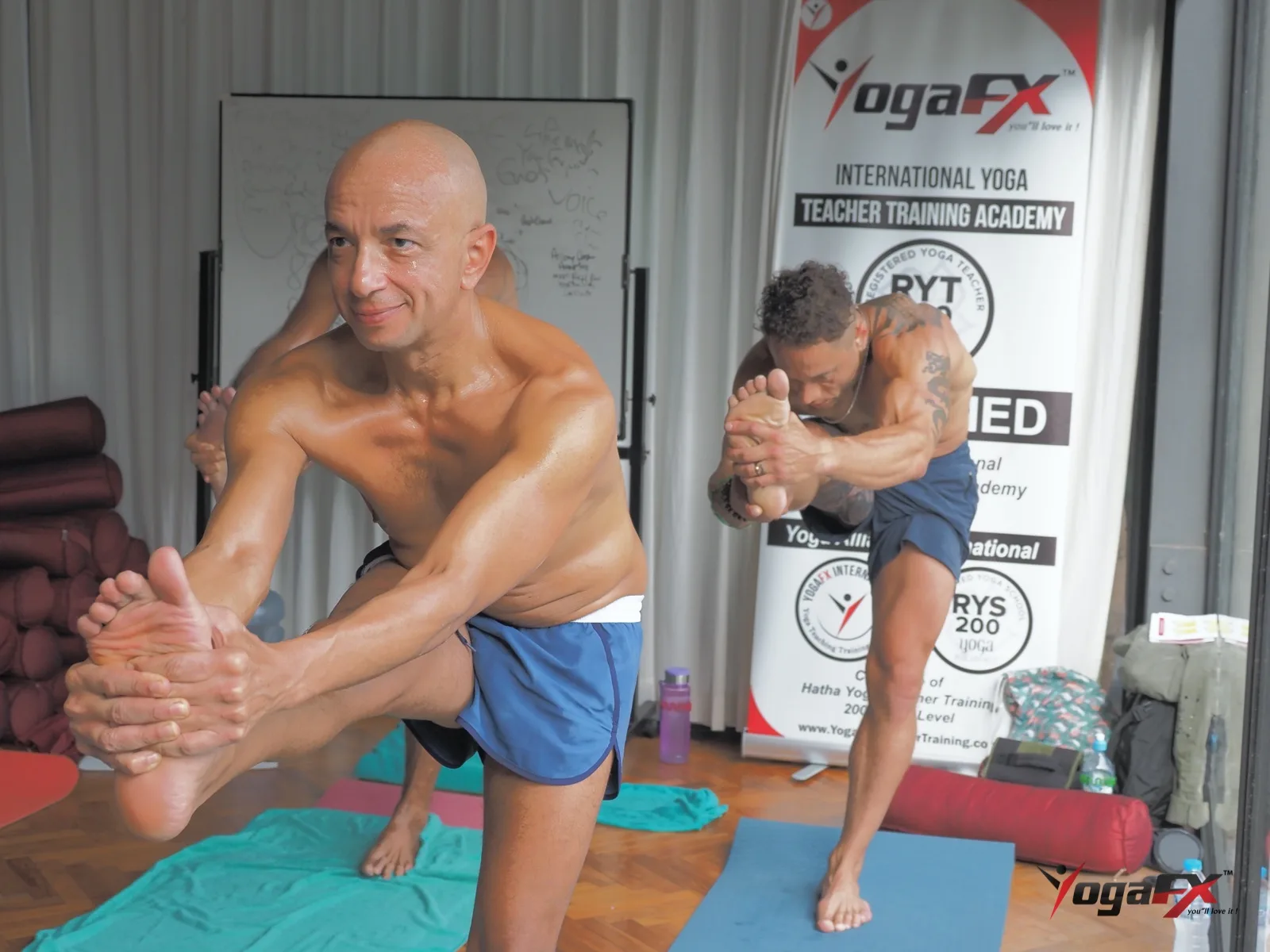
None of this makes heat magic. It makes the class harder in a predictable way, and that's what you're training for. Taking the heat away is not a small change, and it changes what the class asks of you.
What 40°C Does to Your Body
The lineage explanation has a physical basis. At 40°C, muscles, connective tissue, joints and the heart all respond to the heat, and each response explains part of why the class feels the way it does.
Muscles and connective tissue
Muscle tissue has a property called viscosity: the internal resistance of muscle fibres sliding past each other as you move. At 40°C muscle viscosity decreases measurably, so the same muscular effort produces a greater range of motion. Connective tissue, the collagen and elastin fibres of tendons, ligaments and fascia, shows the same temperature-dependent change and can stretch further before it reaches its structural limit. That is why the hip flexor depth in Fixed Firm Pose, the hamstring range in Standing Head to Knee and the thoracic extension in Camel Pose usually exceed what the same student reaches at room temperature.
Heart and circulation
In the heat, the cardiovascular system manages two demands at once: the physical effort of 26 postures and the work of keeping core temperature safe. Blood is sent to the skin to release heat while the working muscles also call for it. This dual demand is why heart rate in a Bikram class is higher than in the same postures at room temperature, as the measurements in the next section show.
Joints
Synovial fluid, which lubricates the major joints, has reduced viscosity at higher temperatures. In a 40°C room it moves more freely through the joint space in response to the compression and release of postures such as Eagle Pose.
What Researchers Measured in a Bikram Room
Most claims about hot yoga temperature are opinions. A few have data. A University of Wisconsin-La Crosse team led by Emily Quandt and John Porcari recruited 20 healthy, regular Bikram students aged 28 to 67. They measured heart rate and core temperature through a 90-minute class. The study was sponsored by the American Council on Exercise (Quandt et al., reported in 2015).
| Measure | Men | Women |
|---|---|---|
| Average heart rate | About 80% of predicted maximum | About 72% of predicted maximum |
| Highest heart rate | 92% of predicted maximum | 85% of predicted maximum |
| Average highest core temperature | 103.2°F (39.6°C) | 102.0°F (38.9°C) |
| Highest single reading | 104.1°F (40.1°C), one man | Not reported separately |
Seven of the 20 people passed 103°F (39.4°C) at some point. None showed signs of heat intolerance. Core temperature rose steadily through the class. That fits what you feel in the room, where the second half is warmer inside you than the first.
A Bikram class in five numbers
What the room is set to, and what the body did inside it.
Heart rate tells the same story from another angle. A separate San Diego State University lab study (Pate and Buono, 2014) measured an average of 286 calories in a 90-minute class (range 179 to 478). Heart rate sat at about 72% (beginners) to 86% (experienced) of predicted maximum. That is a solid workout, so the heat is one load among several.
A 2025 systematic review of 43 studies and 942 participants (Willmott et al.) is the widest summary of hot yoga research so far. It looks at what hot yoga does to the body and mind, not at one temperature alone. So treat the numbers above as a description of what a Bikram class asks of you, not as proof that hotter is better.
Humidity: The Number People Forget
Most people ask about the hot yoga temperature in degrees and ignore humidity. Yet sweat only cools you when it evaporates, and that's the whole point of relative humidity. In dry air it evaporates fast, so you feel cooler than the thermometer says. In humid air it clings to your skin, so you feel hotter.
Mayo Clinic lists high temperatures, particularly with high humidity, among the main causes of heat exhaustion. It also names strenuous activity, dehydration and overdressing. You'll find its overview of heat exhaustion symptoms and causes for the full list.
That is why a studio's humidity figure matters as much as its hot yoga temperature. A hot room that feels stuffy is not automatically a better class. It can simply be harder to cool down in. Forty percent is the lineage setting. It is humid enough to be demanding, yet sweat can still evaporate, so the room is hard without being impossible.
Electric heat, dry air and natural heat
Most studios outside the tropics reach 40°C with electric forced-air heaters, which typically run at 15 to 25 percent relative humidity. In that dry air sweat evaporates rapidly, the skin cools quickly and the surface ends up noticeably cooler than the body core, so the warmth reaches the muscles and connective tissue less completely.
Dry hot air below 20 percent humidity also dries the lining of the airways under the steady breathing a 90-minute class demands. That is why many students who find dry electric studios uncomfortable say a 40 percent room feels more breathable at the same temperature. Our comparison of hot yoga and a steam room looks at the same question from the humidity side.
| Feature | Electric-heated studio | YogaFX Bali (natural heat) |
|---|---|---|
| Heat source | Electric forced-air heaters | Bali's natural tropical climate |
| Temperature | 40°C, reached artificially | 40°C, ambient plus studio environment |
| Humidity | 15 to 25 percent | Above 70 percent ambient, studio-moderated |
| Sweat evaporation | Rapid, skin surface cools quickly | Slower, steadier core temperature rise |
| Breathing comfort | Often dry for sensitive practitioners | Humid air keeps the airways moist |
Our tropical studios already sit in warm, humid air. That may help new students arrive partly used to the climate. Even so, we ask everyone to take the first classes seriously, which we cover in the next sections.
Is a 40°C Hot Yoga Room Safe?
For most healthy adults who drink enough, a Bikram class at this hot yoga temperature is manageable. The study above saw no heat intolerance in 20 regular practitioners. Still, 40°C is hot, and some people carry more risk. This is general information, so please talk to a healthcare professional if you are unsure.
Mayo Clinic lists several risk factors for heat exhaustion. They include older age, very young age, some medicines, obesity, dehydration and sudden exposure to heat. Its medicine list includes beta blockers and diuretics. The NHS adds that people with long-term conditions such as diabetes or heart problems are at higher risk. Its page on heat exhaustion and heatstroke explains what to do.
Check with a doctor first if any of these apply
- You have a heart or circulation condition, or you take medicine that affects blood pressure or fluid balance.
- You are pregnant, or you are not sure whether a hot room suits your stage of pregnancy.
- You have a fever, an infection or a stomach bug today.
- You are dehydrated, or you have not drunk much since yesterday.
- You have never practised in heat and plan to start with a full 90-minute class.
This article is general information, not medical advice. Consult a healthcare professional before you start hot yoga, especially if you have a health condition, take regular medicine or are pregnant.
Know the warning signs
Heat exhaustion can show up as heavy sweating, faintness, dizziness, a weak and rapid pulse, muscle cramps, nausea and headache. If that happens, stop, rest, cool down and drink. Mayo Clinic advises contacting a healthcare professional if symptoms get worse or do not improve within an hour.
Mayo also says a core body temperature of 104°F (40°C) or higher needs help right away. The NHS treats signs of heatstroke, such as confusion, a seizure or hot skin that has stopped sweating, as an emergency. A class is not worth ignoring any of this.
Your First Class in the Heat: What to Expect

At any hot yoga temperature, the first ten to fifteen minutes usually feel the hardest, because your body has not caught up with the room. Breathing slows, sweat starts and the standing series begins to feel steadier. Many students find the second class a little easier, though everyone adapts at their own pace. Our honest look at how hard Bikram yoga feels covers the wider challenge.
- Arrive hydrated. Drink water through the day before class, and keep water within reach during it.
- Bring a towel. Wet skin makes a mat slippery, so a grippy towel helps in balancing postures.
- Wear light, fitted clothing. Thin, fitted fabric copes best with sweat in a 40°C room.
- Use a checklist. The first hot yoga class checklist lists the small things that matter.
- Rest when you need to. Lie down on your mat and breathe. Staying in the room is part of how you adapt.
How long heat adaptation takes
Most students adapt over roughly ten classes at three to four sessions a week. The first one to three sessions feel disproportionately hard compared with general fitness, because cardiovascular fitness does not transfer directly to heat tolerance and the body's cooling system needs time of its own.
Between sessions 4 and 10 the body becomes more efficient at managing exercise and cooling together. Sweating starts earlier in class, which improves cooling, and the standing series becomes more sustainable. Students visiting YogaFX for a week or more typically notice the change between class 3 and class 5. By about session 10 the heat starts to feel supportive rather than threatening.
Staying in the room is a rule of the class, and trainees remember it. Deny, in a YouTube review from 2025, described a very hard first day with shaking legs and a wish to go home. Then came the reminder of the rule: stay in the room until the end, no quitting. Deny stayed and finished with the group (paraphrased from the video).
If you are new to heated classes, start with our guide to Bikram yoga for beginners. It walks through the first week in plain steps. Sweat's main job is cooling you down, so a wet towel is a sign your body is doing its work.
Hot Yoga Temperature at YogaFX in Bali
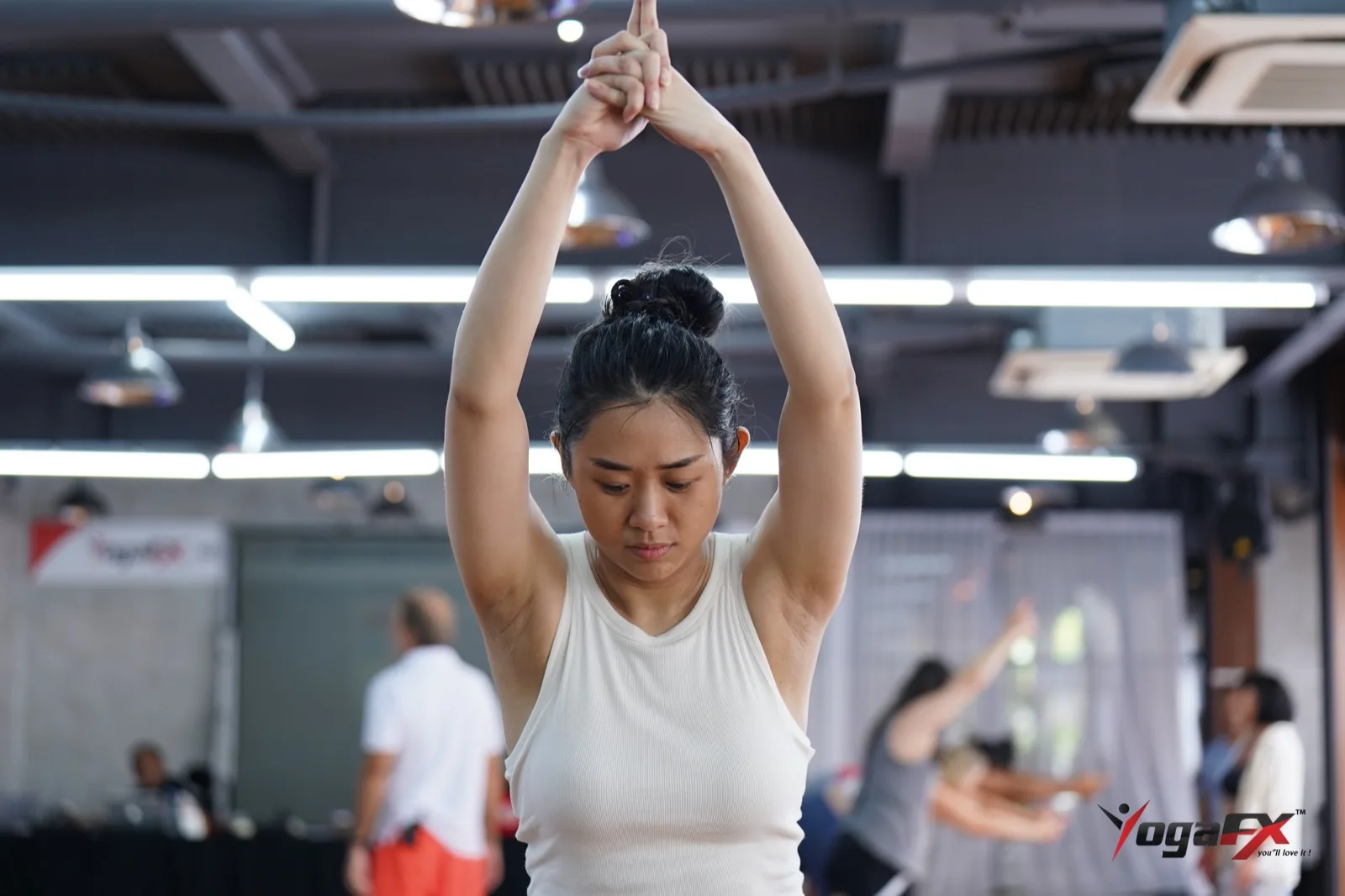
Our hot yoga temperature is the Bikram one. The Original Hot 26&2 sequence runs at 40°C and 40% humidity for 90 minutes, with a scripted dialogue and no music or demonstration. The heat is natural tropical heat, so we do not run electric heaters. Studios open every day from 06:00 to 22:00 in Seminyak and Canggu.
If you want to teach this room one day, you have to learn to run it. The Bikram Hot 26&2 Yoga Teacher Training MasterClass is a 6-day hybrid course: pre-course online study, then an intensive in Bali.
Graduates leave with a Yoga Alliance RYT 200-Hour certification and a Bikram Hot 26&2 200-Hour International Yoga Certification. Mr. Ian Terry leads it, and YogaFX has trained 1,500+ graduates from 80+ countries since 2017.
It actually changed me, and changed my brain, changed my mind, changed my body, changed my future.
Erick, YouTube review, 2024
Erick's review is about the whole training, not the temperature. It shows how students talk about the experience afterwards. The next batch checks in on Sunday 24 January 2027 and checks out on Friday 29 January 2027 at Soham Wellness Center in Seminyak. See the Bali intensive dates, price and inclusions for the details.
The wider YogaFX teacher training hub lists every programme in one place.
FAQ
What hot yoga temperature is normal?
The normal hot yoga temperature depends on the style and the studio. A Bikram room is set to about 40°C (104 to 105°F) with 40% humidity. Many other hot yoga classes run cooler. Always ask a studio for its temperature and humidity targets, and how it measures them, before you book.
What is the Bikram yoga temperature and humidity?
The Bikram specification is 40°C (original figure 40.6°C or 105°F) with 40% relative humidity, for a 90-minute class. Studios round to either figure. Humidity is part of the specification because it changes how well sweat cools you. A hot room with dry or wet air is not the same class.
Is hot yoga temperature the same as a sauna?
No. A sauna uses much hotter air while you sit still. A Bikram class uses a warm, humid room plus 90 minutes of movement. So your heart rate and body temperature rise from both. In one university study, average heart rate reached about 72% to 80% of predicted maximum.
Is hot yoga too hot or dangerous?
For most healthy, well-hydrated adults it is manageable, but heat exhaustion is possible. Risk rises with certain medicines, dehydration, heart conditions and sudden exposure to heat. Stop if you feel faint, dizzy or sick, rest, cool down and drink, and speak to a doctor first if you are unsure.
Does hot yoga raise core body temperature?
Yes. In a University of Wisconsin-La Crosse study of 20 regular Bikram students, the average highest core temperature was 103.2°F (39.6°C) for men. For women it was 102.0°F (38.9°C). One man reached 104.1°F (40.1°C). Nobody showed signs of heat intolerance, but a doctor should advise anyone at risk.
Can you do Bikram yoga without the heat?
You can practise the postures in a cooler room, and many people do. You will not get the same heat load, and the stretches may feel less open. So you are doing a different class, not a weaker copy. Our guide to Bikram yoga without heat explains what you keep and lose.
Still have questions? Message Mr. Ian and the YogaFX team on WhatsApp and we will answer them personally.
Last updated: November 21, 2026